Account-Based Selling has become one of the most widely discussed motions in B2B sales-but also one of the most misunderstood. Many teams hear “ABS” and assume it simply means going after large accounts or coordinating with marketing on a few campaigns. But in reality, true ABS is far more foundational and far more transformational.
At its core, Account-Based Selling isn’t a tactic-it’s a way of operating. It changes the way your team picks accounts, works with marketing, creates engagement across the buying committee, and build pipeline. And when it’s done right, it becomes one of the most reliable engines for creating predictable revenue, deeper customer relationships, and a consistent flow of high-quality opportunities.
This guide breaks down the full ABS process in a way that’s practical for SDRs, managers, and GTM leaders
What is Account-Based Selling (ABS)?
Account-Based Selling is a focused outbound strategy where SDRs stop chasing random leads and instead go after high-probability accounts using data, social proximity, and buying-committee insights. Instead of blasting sequences, you work a curated list of accounts—chosen based on relationships, past customer influence, and trigger signals—and activate them through coordinated, multi-threaded plays.
Account-Based Selling is all about prioritizing the right accounts, engaging the right people, and running the right plays to create predictable pipeline.
Account based selling vs Traditional sales
Traditional, prospect-based outbound is built for volume: you work big prospect lists, run time-based cadences around personas, and measure success by activity and meetings booked.
Account Based Selling (ABS) is built for focus: you work a defined Target Account List, plan at the account level, and measure success by qualified pipeline and revenue from high-value accounts.
| Traditional sales outreach | Account Based Selling |
|---|---|
| Inconsistent account follow-up | Execute a clear follow-up plan, account by account |
| Inconsistent account follow-up | Execute a clear follow-up plan, account by account |
| Insufficient account coverage; engage 1–2 prospects per account and manually add more | Engage the entire buying committee systematically, account by account, using top-down, bottom-up, or custom coverage rules |
| Inefficient, manual, and time-consuming account research | Account research consolidated across data sources and synthesized into a POV for each account |
| Context leakage from one conversation to the next; each call feels like a cold call | Context carried forward from conversation to conversation, enabling continuous discovery and personalized pitches to decision-makers |
| Heavy Excel work and ops dependency to track account progression | Accounts scored, tracked by stage, and prioritized |
| High manual and one-off task execution; reps must remember and execute everything | Tasks scheduled by account, pre-populated so reps only need to approve and perform them |
| Focused on prospect-level personalization | Focused on account and persona-level relevance |
| Activity goal: book meetings | Activity goal: discover pain, need, timing, competition, growth stage, and executive priorities before booking a meeting |
Who should be doing Account-Based Selling?
To determine whether your business is ready for an account-based approach, it is helpful to examine the decision-making path discussed below:
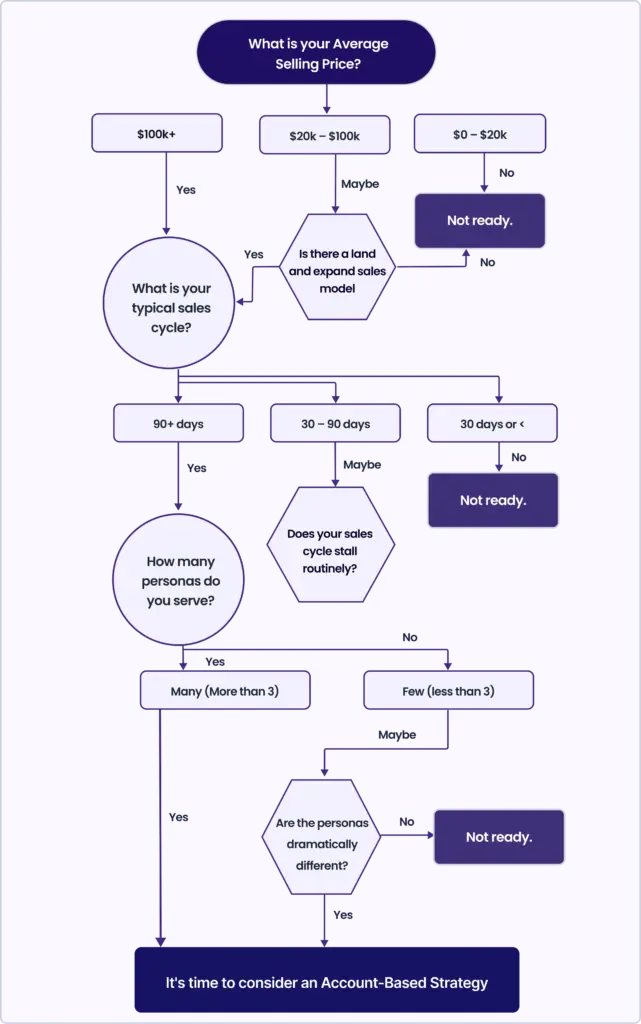
- Businesses selling $100K+ ACV products – Should do when you sell high-value deals, have long or complex sales cycles (90+ days or cycles that stall), engage many personas, and those personas are dramatically different.
- Businesses selling $20K–$100K ACV products – May be to consider if you have a land-and-expand sales model, sales cycles of 30–90 days that stall, serve multiple personas, and those personas are dramatically different.
- Businesses selling under $20K ACV products – Not ready for account-based selling because the investment, time, and personalization required will not match the deal size.
Account-Based Selling - Key things to focus
1. Target Addressable Market (TAM) Mapping
The first step in Account-Based Selling is getting absolute clarity on your Target Addressable Market (TAM).
In the context of Account-Based Selling, Target Addressable Market is not the same as Total Addressable Market. You are not trying to measure the total market value. You are building a working list of accounts you actually want to pursue.
Defining TAM properly requires looking at past, current, and ideal customers and identifying the patterns that consistently show up among accounts that convert, retain, and expand.
If you are not aware your Ideal Customer Profile (ICP) segements, here is how you can approach.
A good way to do this is by asking targeted questions like:
- What common characteristics do companies have that experience the problem we solve?
- What tools or platforms are they already using that are complementary to—or competitive with—our solution?
- If we already have customers, which industries have we historically sold into with the most success?
- Where are our current customers located geographically?
- Where are the companies we want to sell to located?
- How large are these companies in terms of employee count, revenue, or operational complexity?
These questions help you move from assumptions to evidence.
Once you’ve gathered this information, you can start breaking it down into more usable customer segments.
For example, for a Healthcare Billing Software company, the TAM might include segments such as:
- Hospital systems with more than four locations and over five hundred administrative employees, struggling with disconnected billing workflows
- Clinic groups operating six or more locations that rely on legacy billing software
- Healthcare providers in specific states in US that are adapting to newly introduced compliance regulations in billing
This level of segmentation makes choosing the Accounts becomes logical instead of subjective.
2. Account Segmentation
Once your TAM is clearly mapped and you have list of Accounts. The next job is assign the accounts to the sales for a month or a quarter depending your process.
This is where most sales teams go wrong.
They choose the accounts randomly by treating treating all the Accounts inside your TAM as equal. Treating them all the same is how effort gets wasted and pipeline becomes random.
Another common mistake is chasing big names or flashy logos just because they “look good.” In Spear Selling, this method is called as “Wallet Share” Account Selection. These are companies that are in your TAM but may not be actively looking to change. They feel exciting, but they are usually slow, political, and hard to move. Not ideal if you care about building pipeline predictably.
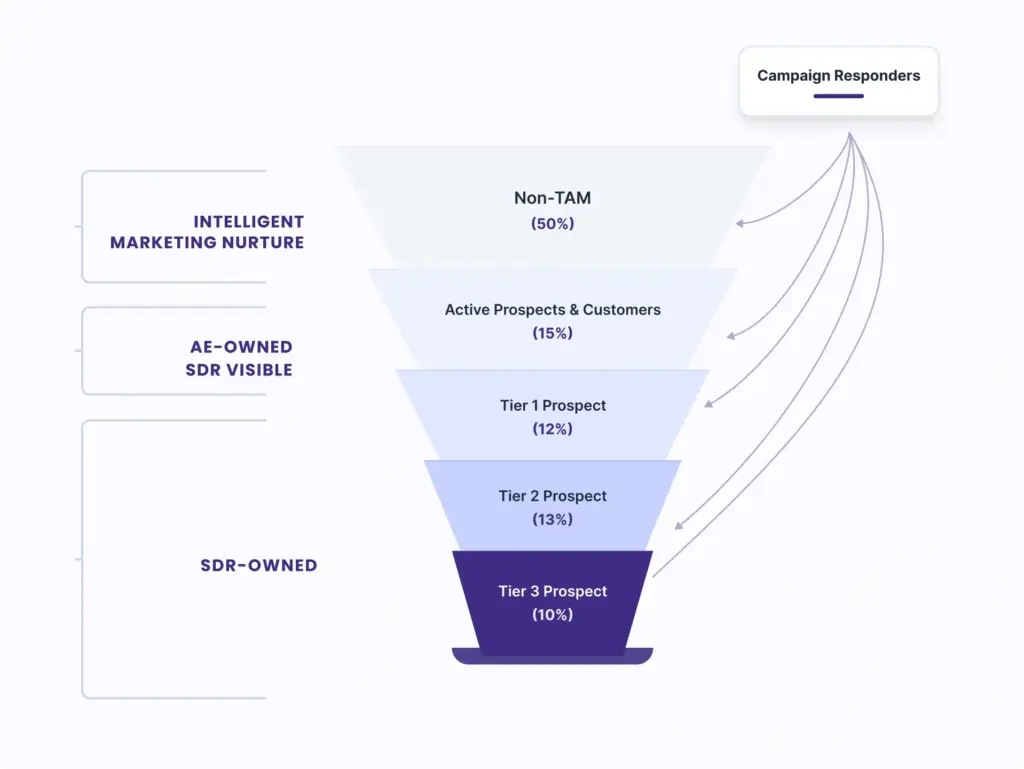
Segement your TAM by breaking into 3 Tiers - every account in your TAM should fall cleanly into one of these three tiers.
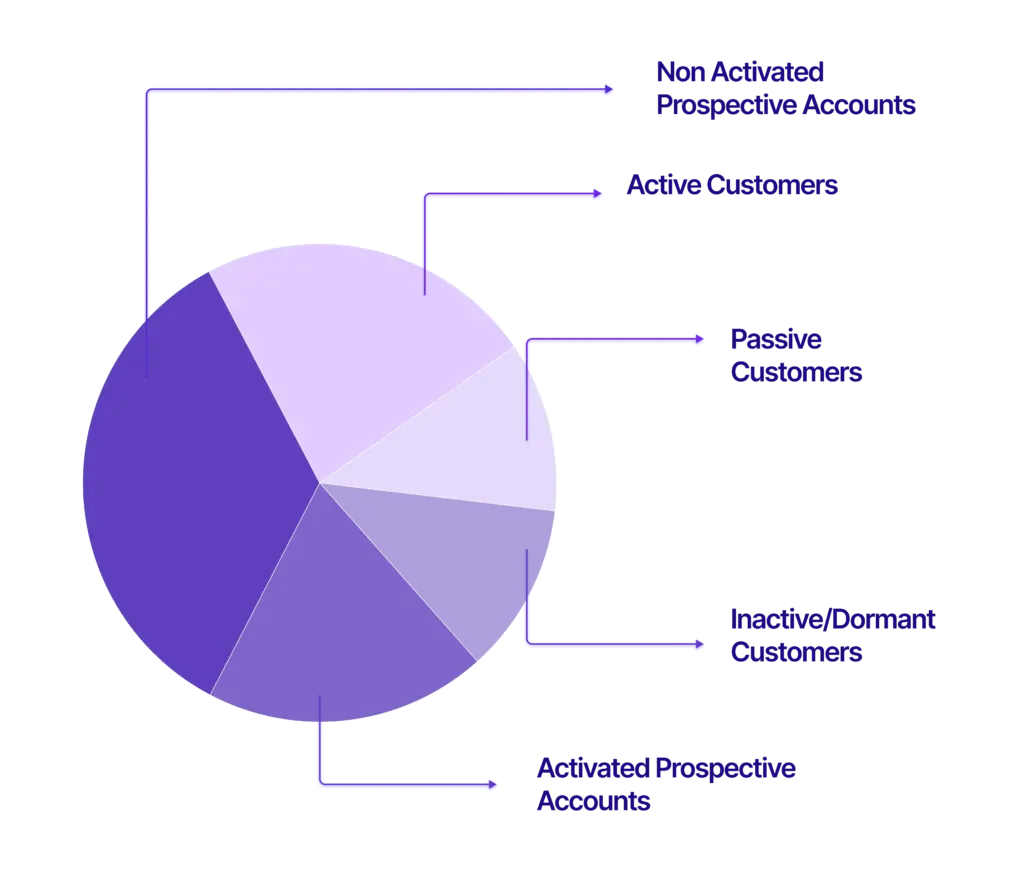
Tier 1: Customers (Active, Passive, Dormant)
These accounts already trust you or know you. They are prime candidates for expansion, cross-sell, upsell, or reactivation plays.
This tier includes:
- a) Active customers - Accounts currently using your product or service. These are expansion, cross-sell, and upsell opportunities waiting to happen.
- b) Passive customers - Accounts on usage-based or irregular contracts where usage fluctuates. Spend exists, but it’s unpredictable.
- c) Inactive or dormant customers - Accounts that churned, paused, or went quiet. The problem didn’t disappear — the timing or priority changed.
These accounts should never be treated like cold outbound. You should not be introducing yourself. You shoube be trying to re-enter a conversation. The messaging here is about reactivation, expansion, or a problem resurfacing - not who you are.
Tier 2: Activated Prospective Accounts
These are Accounts with history of previous engagement.
An opportunity was created at some point — by you or someone else on the team. Calls happened. Emails were exchanged. Objections were raised. Interest existed.
Maybe the deal stalled. Maybe timing wasn’t right. Maybe budget got pushed.
But these Account are not completely cold.
These accounts already have buying signals in the past, which makes them far more valuable than untouched prospects. They should be worked with reactivation plays — referencing past context, new triggers, or changes that make the conversation relevant again.
Tier 3: Non-Activated Accounts
These are true cold accounts.
No conversations. No opportunities. No history.
They require more work - deeper research, stronger triggers, better timing, and more patience. This is where classic outbound skills matter most.Tier 3 accounts aren’t bad. They’re just harder. And they should never be prioritized over accounts where intent already existed.
3. Account Research
Once you’ve segmented your accounts and know who you should be spending time on, the next step in Account-Based Selling is Account Research.
This is where good SDRs separate themselves from great ones. Account research isn’t about collecting surface level facts about the company. It’s about building context—context that helps you sound relevant on your first email, intelligent on your first call, and credible in front of a buying committee that doesn’t owe you their time.
At a high level, Account Research has two clear parts:
- Mapping the buying committee and finding the right contacts
- Understanding what’s happening at the company level
a) Mapping the Buying Committee and Finding Contact Details
— Gartner
Buying committee mapping is the foundation of Account Research. You are not just reaching out to a person-you are navigating a group of people with different goals, fears, incentives, and influence levels.
This is how you map your buying committee - Some people approve budgets. Some people influence decisions. Some people are end users who can refer to the right person.
As a sales rep, your job is to:
- Identify economic buyers - Executives
- Identify technical or operational influencers - Mobilizers
- Identify end users who feel the pain daily - Users
After you have identified the right personas and mapped your buying committee, the next step is to understand what each persona/role cares about in their day-to-day job-so your outreach actually lands.
- What success looks like for that person
- What problems they’re measured on
- What risks they’re trying to avoid
- What makes them say “this is worth my time”
As you research personas within an account, you want to document insights you can reuse across emails, calls, LinkedIn touches, and follow-ups.
Here’s a simple persona research table you can use internally:
| Persona / Role | What They Care About Daily | Key KPIs / Metrics | Common Frustrations | What Gets Their Attention | How You Should Position |
|---|---|---|---|---|---|
| CFO | Cost control, predictability | Budget variance, ROI | Unplanned spend, low visibility | Financial impact, risk reduction | Cost efficiency, forecasting |
| VP Sales | Pipeline, quota coverage | Win rate, pipeline value | Low connect rates, slow cycles | Revenue impact, speed | Pipeline acceleration |
| Head of Ops | Process reliability | SLA adherence, errors | Manual work, breakages | Automation, consistency | Operational leverage |
| IT / RevOps | Systems stability | Data accuracy, uptime | Tool sprawl, integrations | Architecture, scalability | Clean integration story |
Once the buying committee is mapped and after you have learned about the right personas, the next step is getting accurate contact data—email IDs and phone numbers.
You can use tools like Zoominfo, Lusha, Klenty AI List Builder to find the contact details.
b) Company-Level Research: Understanding the Business Context
Persona-level insights tell you who to talk to. Company-level research tells you what to talk about.
This part of account research focuses on understanding the company’s priorities, pressures, and direction-using publicly available information.
Real account research answers deeper questions:
- What is this company trying to change right now?
- What risks are leadership trying to mitigate?
- Where is execution breaking down as they scale?
Company research can be done using:
- Annual reports or 10-K filings
- Investor presentations or earnings calls
- Press releases and product announcements
- Leadership interviews
- News articles and industry coverage
These sources reveal what the company is actively investing in, worried about, or trying to fix.
4. Cadence Strategy + Messaging + Channels
A sales cadence is a planned sequence of touches—across email, phone, social, and other channels—designed to move an account forward by delivering a clear Point of View (PPOV) over time. Sales Cadences are the primary vehicle through which sales reps educate, influence, and earn attention inside target accounts.
In Account-Based Selling, cadences take on an even more strategic role. Instead of blasting the same sequence to everyone, SDRs use different cadences to deliver different PPOVs to different people inside the same account. The goal is not volume—it’s alignment. Each cadence is designed around who the audience is, what they care about, and how much is already known about the account.
Sales engagement platforms like Klenty and Outreach.io help SDRs build, organize, and execute cadences at scale. But the real skill is not learning the tool—it’s knowing which cadence to use, when to use it, and why.
Types of Sales Cadences
The effectiveness of a cadence depends on who it’s going to and what point of view it’s carrying.Every sales cadence can be mapped across these two simple dimensions. The first is how broad or specific the audience is. The second is how broad or specific the PPOV is.
We have four different types of cadences when you look through this lens.
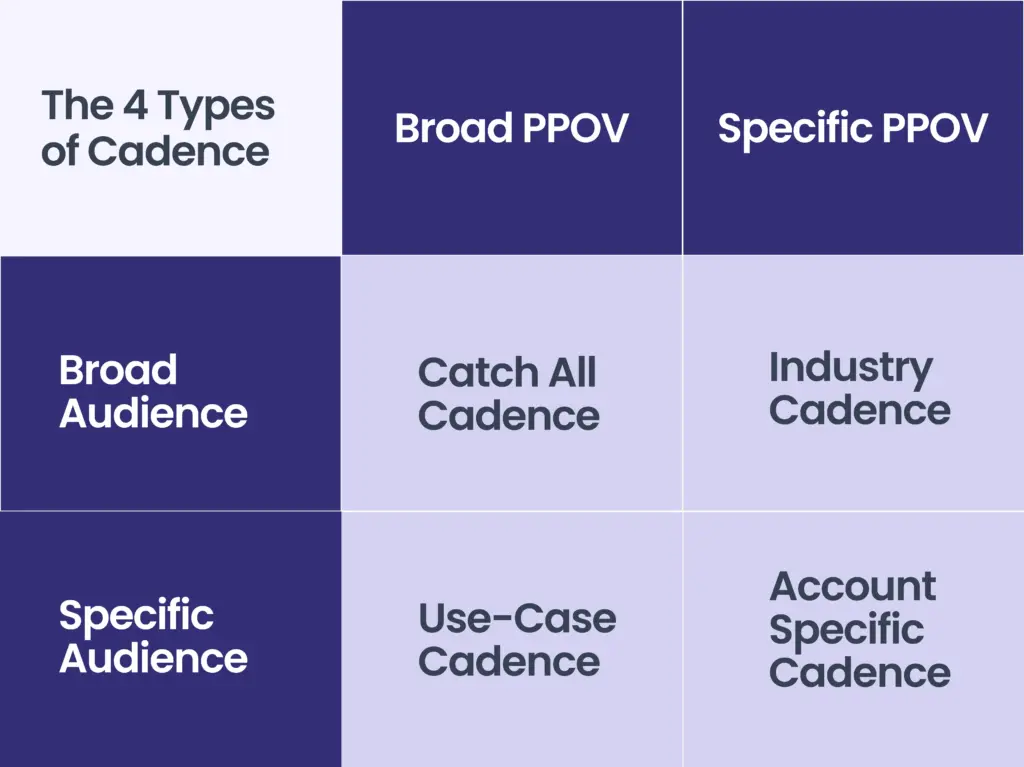
a) Catch-All Cadences (Broad Audience + Broad PPOV)
Catch-all cadences sit at the broadest end of the spectrum. They use the company’s core messaging and are sent to a wide audience where neither a specific use case nor an industry-specific message applies.
These cadences are useful when:
- The account has very little data available
- The account is low priority
- No meaningful personalization is justified
However, catch-all cadences should always be treated as the cadence of last resort. They exist to maintain coverage, not to drive high-quality opportunities.
b) Use-Case Cadences (Specific Audience + Broad PPOV)
Use-case cadences focus on how a specific function or role derives value from your product.
Instead of speaking to the company as a whole, the message is framed around how a particular team solves a particular problem. For example, sales operations teams across many industries may care deeply about analytics and reporting, even though the businesses themselves are very different.
Use-case cadences work well when:
- The role is known
- The account-level context is limited
- You want relevance without deep research
They allow SDRs to be specific without over-investing early in the account.
c) Industry Cadences (Broad Audience + Specific PPOV)
Industry cadences tie the PPOV to prevailing trends within an industry.
Rather than leading with product value, these cadences lead with external pressure: competition, regulation, technology shifts, or changing buyer behavior. Executives are often already aware of these forces, which makes industry cadences particularly effective at senior levels.
For example, a news and media company facing digital disruption may not yet be evaluating tools—but they are thinking about how to compete in a crowded digital landscape. An industry cadence connects your solution to that broader challenge.
d) Account-Specific Cadences (Specific Audience + Specific PPOV)
Account-specific cadences are the most targeted and the most demanding.
They rely on research that applies only to that account and those contacts. This could include leadership changes, strategic initiatives, M&A activity, or public statements made by executives.
For instance, if a newly appointed CEO has publicly stated that growth through acquisitions is a priority, an SDR can anchor their outreach around how operational complexity increases post-M&A and why that matters now.
Because these cadences require effort, they should be reserved for accounts that merit it. This is where the “measure twice, cut once” mindset applies.
How to Use Different Types of Cadences to Target Your Accounts
Accounts don’t buy as a single unit. Decisions are shaped across different levels of influence—executives, mobilizers, and end users—and each group responds to very different messages.
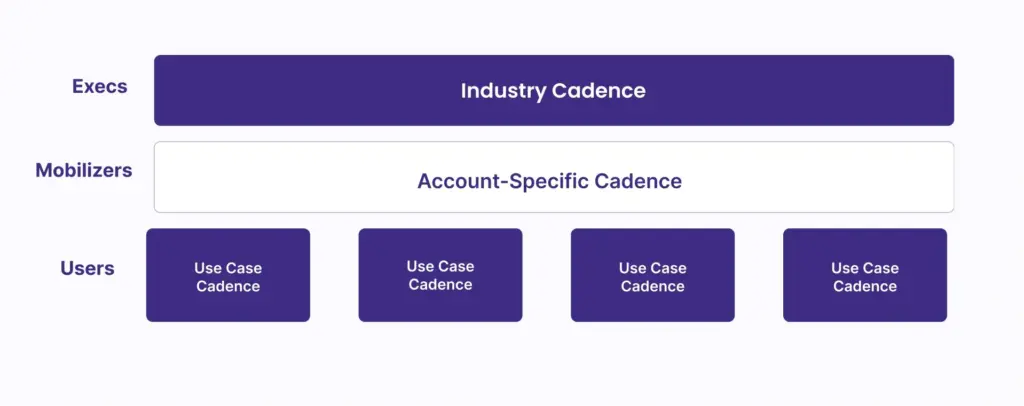
At the top of the account are Executives. Their world revolves around strategy, growth, risk, and long-term outcomes. This is where industry cadences belong. The message here should anchor on external pressure—market shifts, competitive threats, regulatory changes, or strategic priorities that already exist in their head. The goal is not to sell. It’s to establish relevance and signal that this conversation matters at their altitude.
The middle layer of the account is where Mobilizers sit. These are the people who connect $the dots internally. They understand the problem, influence stakeholders, and often guide the buying process forward. Mobilizers respond best to account-specific cadences. This is where SDRs bring in research that applies directly to the account—recent initiatives, leadership changes, growth plans, or operational challenges unique to that business. The messaging here should feel informed and intentional, not generic.
At the bottom of the account are Users. These are the people closest to the day-to-day pain. They experience the inefficiencies, the workarounds, and the friction firsthand. This is where use-case cadences do the heavy lifting. Instead of pitching the company, the outreach focuses on how a specific role solves a specific problem. The message is practical, relatable, and grounded in execution.
The core idea is simple: different people inside the same account require different conversations, running in parallel.
Sales Cadence Strategies for Account-Based Selling
In Account-Based Selling (ABS), cadence design is not about sequencing touches-it’s about choosing the right motion for the account you are targeting.
Different accounts require different levels of investment, context, and precision. Before an SDR sends the first email or makes the first call, they should be clear on what type of outcome the cadence is designed to achieve.
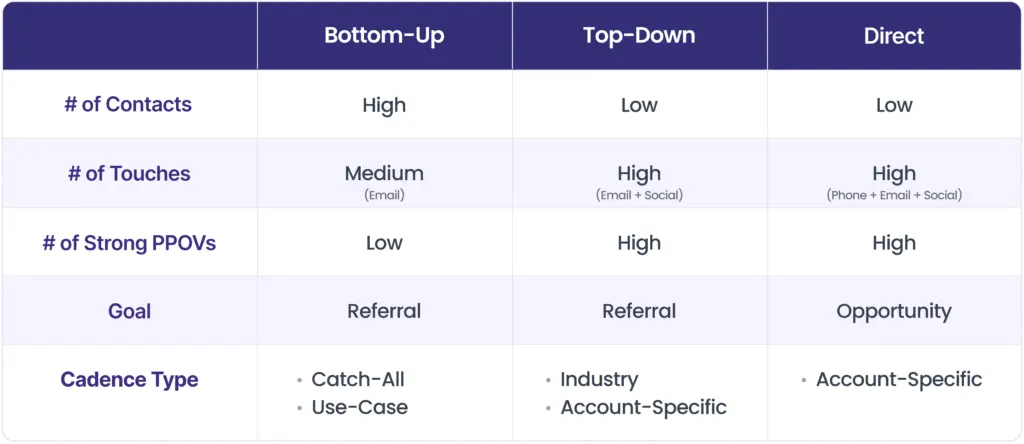
Broadly, ABS cadences fall into three strategic categories:
- 1. Bottom-up cadences are about gathering referrals and building a relationship across multiple levels within the account.
- 2. Top-down cadences leverage executive awareness to drive a referral, connecting the account to broader industry trends.
- 3. Direct cadences target mobilizers with personalized, account-specific outreach, aiming to create opportunities with key stakeholders.
Let’s look at each of these in detail:
1. Bottom-Up Cadence:
A bottom-up cadence focuses on reaching a wide range of contacts within an account to build a referral path to the right decision-maker. This approach works best when there is limited information about the account, or when the decision-maker is unclear.
Use-case-specific cadences are particularly useful here, as they demonstrate how your product can address specific functions within the organization. The SDR’s objective is not to sell—it’s to start a relevant conversation that naturally leads to a referral.
Characteristics of a Bottom-Up Cadence:
- Number of Contacts: High
- Number of Touches: Medium (Primarily calls and emails)
- Goal: Referral, aiming to get referred to the right decision-maker
- Cadence Type: Catch-All, Use-Case
In a practical scenario, this could involve an SDR reaching out to sales teams, for example, with the aim of connecting with a sales enablement leader. By showcasing how a product can enhance sales performance (such as crushing quota), the SDR is more likely to get a referral to the right mobilizer within the company.
2. Top-Down Cadence:
A top-down cadence involves targeting senior executives within an account. The goal is to engage an executive, who will then direct a trusted individual to investigate the SDR's point of view (POV). This type of cadence is particularly effective for reaching decision-makers who are high-level but difficult to contact. These individuals typically understand the broader business strategy but don’t have time to dive into tactical evaluation.
The intent is to spark recognition—“Yes, this is something we’re thinking about”—and prompt the executive to delegate follow-up to someone they trust.
Characteristics of a Top-Down Cadence:
- Number of Contacts: Low (fewer high-level decision-makers)
- Number of Touches: High (primarily emails and calls)
- Goal: Referral, but focusing on broader strategic alignment
- Cadence Type: Industry, Account-Specific
For example, an SDR reaching out to an executive could tie the product’s value to industry trends, such as the adoption of new sales methodologies like The Challenger Sale, which the executive might already be familiar with. The aim is to get an introduction to the relevant team, such as sales enablement or training departments, to further the conversation.
3. Direct Cadence:
A direct cadence is a more straightforward approach aimed directly at the mobilizer or person in a key role who can make things happen. This strategy is about targeting specific individuals who are already known to have influence within the account. The approach is more personalized, aiming for deeper engagement and a clearer opportunity path.
Because the target is known, the outreach must be deeply researched and tightly aligned to what’s happening inside the account.
Characteristics of a Direct Cadence:
- Number of Contacts: Low (targeting key mobilizers)
- Number of Touches: High (phone, email, and social media)
- Goal: Opportunity, directly pushing toward a sale or key conversation
- Cadence Type: Account-Specific
In a direct cadence, an SDR might contact a newly-appointed CEO who has public statements on plans for expansion or mergers. Here, the SDR can tailor the message around how their solution can ease the operational complexity post-merger, making a strong case for immediate engagement.
Different Channels to Use in Sales Cadences
In Account-Based Selling (ABS), using multiple channels within your sales cadences is crucial for engaging prospects effectively and moving them through the pipeline. By combining email, phone, social media, and voicemail, sales development reps (SDRs) can ensure that their message is not only heard but resonates with the right prospects at the right time. Below is a breakdown of how different channels can be used effectively within an ABS cadence.
Cold Emails
Cold emails are a cornerstone of PPOV (Point of View) messaging in Account-Based Selling. Each email should not be a generic pitch but instead, a tailored message that addresses the prospect's unique pain points, goals, and challenges. The email sequence should include PPOV Emails, Follow-up Emails, and Nurture Emails, each serving a specific purpose in moving the conversation forward.
1. PPOV Emails
The goal of a PPOV email is to present a well-researched point of view that speaks directly to the prospect’s challenges and needs. A PPOV email can include up to 7 key value points that should be logically presented:
- A compelling reason to reach out.
- The relationship between that reason and a value proposition.
- Relevant product functionality to deliver the value prop.
- Customer story demonstrating that functionality.
- The result from the customer story.
- The prospect’s potential gain if given a result.
- Why you, why now?
Here is an example of a PPOV email:
[Your Name]
2. Follow-up Emails
Follow-up emails are essential to reinforce the value shared and ensure that the conversation continues. These emails should remind the prospect of the key benefits they can gain by engaging further.
Here is an example of a Follow-up email:
[Your Name]
3. Nurture Emails
As part of the final stage in a cadence, a break-up email provides a gentle nudge for the prospect to respond, especially if they’ve been unresponsive throughout the sequence. These emails can also be a humorous way to re-engage the prospect and keep the conversation going.
Here’s an example of a Break-up email:
[Your Name]
Cold Calling
Cold calling is the most important real-time channel for engaging high-value accounts. Unlike email or social, calls allow SDRs to demonstrate expertise in the moment, build human rapport, uncover context quickly, and course-correct based on live feedback. For strategic accounts, no other channel compresses learning and momentum as effectively.
In ABS, cold calling is not about pitching. It’s about delivering the right Provocative Point of View (PPOV) to the right person at the right level, based on their role in the account.
That means the objective of a call changes depending on who you are speaking with.
Within a target account, there are three broad audiences an SDR will speak to:
- Users – closest to the day-to-day pain
- Executives – focused on strategy and outcomes
- Decision Makers / Mobilizers – responsible for evaluation and execution
Each requires a different conversation, a different PPOV, and a different success metric.
1. Calling Users: Discovering Pain and Mapping the Account
Objective of the call:
- Gather account intelligence
- Understand how work actually gets done
- Identify the real decision maker or mobilizer
When calling users or frontline managers, the goal is not to sell or book a meeting. It’s to learn. These conversations help SDRs validate assumptions, uncover internal language, and map influence inside the account.
What to Focus On
- Day-to-day challenges and workarounds
- Tools currently in use
- What’s broken, slow, or frustrating
- Who owns decisions related to that problem
Sample Call Script – User
Success is not a meeting. Success is walking away with:
- Better account knowledge
- Internal processes
- A name and path to the right owner
2. Calling Executives: Earning Direction and Sponsorship
Objective:
- Establish relevance at a strategic level
- Anchor the conversation in outcomes
- Earn a referral to the right owner
Executives are difficult to reach and have limited time. They don’t want tactics—they want clarity and signal. A strong executive call respects their time, speaks in outcomes, and makes it easy for them to delegate.
What to Focus On
- Strategic goals (growth, efficiency, risk)
- External pressure (market shifts, competition, regulation)
- Why this conversation matters now
- Who on their team should explore further
Success is not pitching. Success is direction and permission.
3. Calling Decision Makers / Mobilizers: Creating the Opportunity
Objective:
- Validate pain you’ve already uncovered
- Deliver a clear, account-specific PPOV
- Secure a meeting with purpose
These calls happen after research and context have been gathered—from user conversations, executive outreach, or prior engagement. This is where cold calling becomes precise.
What to Focus On
- Confirmed pain points
- Business impact (time, cost, risk, revenue)
- Why current approaches fall short
- A clear next step
Success is a clear, well-qualified meeting. Not curiosity—commitment.
In recent years, LinkedIn has become an integral part of the sales outreach process. Specifically, using LinkedIn for connection requests, liking posts, etc to build relationships in a non-intrusive way and set the stage for more formal outreach.
1. Connection Requests and InMails
A connection request can serve as an excellent opportunity to initiate a conversation and present a PPOV. LinkedIn allows you to engage with prospects on a personal level, showcasing your understanding of their business or industry. By making your request intentional and relevant, you can create meaningful dialogue.
Here’s how to structure your LinkedIn connection request:
- Personalized message: Instead of a generic connection request, tailor your message to the prospect by referencing a relevant pain point or industry challenge.
- PPOV follow-up: After the connection is accepted, send an InMail that builds on the conversation. This is your opportunity to present a well-researched PPOV and provide value to the prospect.
2. Optimizing LinkedIn Profiles
For SDRs, having a strong, customer-oriented LinkedIn profile is essential. The profile should reflect a deep understanding of the prospect's business and the value you can provide. Strong recommendations, a professional picture, and a focus on how you help customers can make a significant difference in building trust with prospects.
- Showcase your value: Focus on how you can help prospects rather than just showcasing personal accomplishments.
- Content sharing: Regularly share valuable content that showcases your thought leadership and keeps you visible to your target accounts.
A well-crafted LinkedIn profile becomes your second landing page where prospects can learn more about you before engaging in deeper conversations.
5. Account-Based Selling Plays
Account-Based Selling plays can be broken down into three primary types: One-to-One Plays, One-to-Few Plays, and One-to-Many Plays. These plays allow sales teams to adjust their strategies based on the size, complexity, and priority of the account.
1. One-to-One Plays: High-Touch, Customized Engagement
One-to-One plays are reserved for must-win accounts—accounts that have significant revenue potential, a complex sales process, or strategic importance. These accounts are often referred to as “needle movers” and require highly personalized, resource-intensive outreach. This type of play focuses on deepening relationships, leveraging existing connections, and using tailored messaging to address each account’s specific needs and challenges.
Who You're Talking to (Personas)
For One-to-One Plays, identifying the right personas is critical. Typically, these are high-level decision-makers such as executives, senior leadership, or heads of key departments (e.g., CIOs, CMOs, CFOs). Engaging with these personas requires the sales team to have a deep understanding of the account’s internal structure and the challenges the decision-maker faces.
What You're Telling Them (Message)
The message should be focused on problem education, value proposition alignment, and demonstrating how your solution uniquely solves the account’s pain points. The communication should emphasize the prospect's specific challenges and your solution’s ability to drive measurable outcomes. One-to-One Plays require SDRs to demonstrate an understanding of the customer’s internal processes, needs, and competitive landscape.
How You Will Communicate the Message (Content)
For One-to-One Plays, the content should be hyper-targeted and high quality. This can include:
- Customized presentations or tailored proposals.
- Case studies or whitepapers specifically relevant to the account's industry or unique needs.
- Personalized videos or messages addressing specific pain points and goals.
Content should be shared via email, LinkedIn, and phone calls. SDRs should use social selling to engage decision-makers directly on platforms like LinkedIn, providing personalized value and establishing credibility.
How You Will Deliver the Message (SDR/Sales Plays, Marketing Channels)
SDRs should work closely with AEs to ensure a seamless transition between stages, using LinkedIn messages, emails, and phone calls. Personalized outreach via InMail and direct calls is essential. After initial outreach, SDRs can engage in deeper conversations by setting up meetings with product experts or executives, bringing added credibility and authority to the conversation.
Timing
One-to-One Plays rely heavily on precise timing. Engage the account as soon as you detect signals of change (e.g., leadership shifts, major company initiatives, or industry disruptions). The first meeting in a One-to-One Play can take longer to schedule, so it’s important to follow up regularly but strategically.
Goal: Secure a first meeting with the senior decision-maker and build relationships across departments.
2. One-to-Few Plays: Targeted Outreach to Account Segments
One-to-Few Plays are designed for a smaller group of accounts within a specific segment or industry. These accounts typically share common characteristics, such as being in the same industry or experiencing similar challenges. The strategy is more scalable than One-to-One Plays but still allows for a targeted, personalized approach.
Who You're Talking to (Personas)
The personas for One-to-Few Plays can include mid-level decision-makers or influencers within the organization who are responsible for specific departmental goals. These are often people who have direct influence over purchasing decisions, but who may not have final approval.
What You're Telling Them (Message)
In a One-to-Few Play, the message should focus on industry trends, use cases, and solutions that address common pain points. Since these accounts are grouped based on shared challenges, the message can speak to broader industry or vertical trends while still tying the solution to each account’s specific needs.
How You Will Communicate the Message (Content)
The content in One-to-Few Plays should be segmented based on the industry or challenge of the accounts. This can include:
- Targeted content such as webinars or industry reports addressing specific needs.
- Customer success stories or case studies from similar accounts or industries.
Delivering this content through email, social media posts, and targeted ads allows for scalable outreach while maintaining a personal touch. SDRs can also use content microsites or landing pages to give prospects easy access to personalized resources.
How You Will Deliver the Message (SDR/Sales Plays, Marketing Channels)
SDRs should leverage email campaigns, LinkedIn outreach, and webinars to engage with multiple accounts at once. Use targeted ads or social posts to capture interest and re-engage leads. Automated tools can help scale outreach efforts while ensuring personalization.
Timing
One-to-Few Plays are often driven by industry shifts or new initiatives within the targeted segment. Use intent data and third-party signals (such as news stories, regulatory changes, or product launches) to identify the right time to engage.
Goal: Move accounts into the opportunity stage and foster long-term relationships.
3. One-to-Many Plays: Scalable Outreach to Larger Account Groups
One-to-Many Plays are designed for larger groups of accounts that share broad characteristics, such as being in the same vertical or facing similar problems. This play focuses on scalability by targeting hundreds or even thousands of accounts at once, but still allows for some level of personalization.
Who You're Talking to (Personas)
In One-to-Many Plays, the personas are often more generalized and can include individual contributors or department heads who share a common need. These accounts may not have as much potential as One-to-One Plays, but they are still valuable for expanding your reach.
What You're Telling Them (Message)
The message should focus on educating prospects about a common challenge they face or industry trend. Since this play involves engaging multiple accounts, the messaging should be relevant but more generalized.
How You Will Communicate the Message (Content)
The content should be scalable and educational, focusing on industry trends and common challenges. Examples of content include:
- Educational blog posts and eBooks.
- Webinars and product demos designed to highlight how your solution can solve industry-specific problems.
This content can be delivered through email, social media ads, and paid digital campaigns. Using a drip campaign can also help maintain engagement over time.
How You Will Deliver the Message (SDR/Sales Plays, Marketing Channels)
In One-to-Many Plays, SDRs should use automated email sequences, targeted ads, and social media to engage large numbers of accounts at scale. Content-driven outreach should be supported by retargeting ads or remarketing campaigns to drive further engagement.
Timing
One-to-Many Plays typically focus on broad timing triggers such as seasonal trends, industry events, or product releases. Engage with accounts when they are likely to be exploring solutions for specific pain points or when market conditions make them more likely to invest in new technologies.
Goal: Drive awareness and early-stage interest across a large set of target accounts.
Account-Based Selling Signals
In Account-Based Selling, timing is as important as targeting. Even the most thoughtful cadences and messaging won’t land if an account isn’t ready to engage. Account-based signals help teams understand when to reach out, why the conversation matters now, and what has changed inside the account that creates urgency.
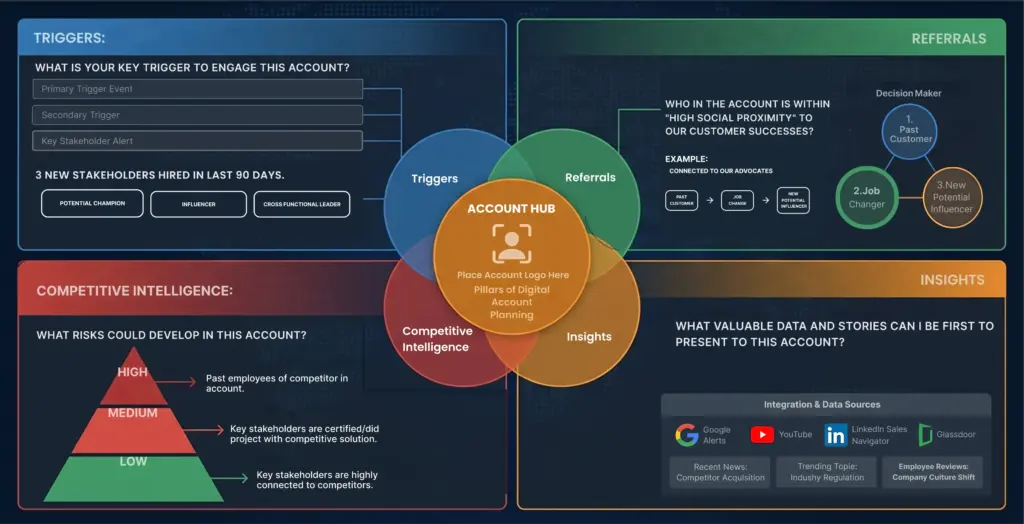
Rather than relying on static account lists, signals turn ABS into a dynamic, intelligence-driven motion. Executive changes, company growth or contraction, technology shifts, and competitive movement all indicate moments when prospects are more open to new conversations. We woll cover the 4 key signal categories in detail below.
1. Triggers: Identifying the Right Time to Engage
Triggers are external or internal factors that can significantly influence change within a customer account. By identifying the right trigger, sales teams can know when to engage accounts more effectively. These include:
- Executive Job Changes: When key decision-makers move, it often signals a time to engage with new leadership who may have different priorities or problems.
- Company Expansion and Retraction: A company growing or shrinking can provide valuable insights into their needs. For example, an expansion may mean they are seeking technology solutions to scale quickly.
- Technology Integrations: If a customer’s technology stack is evolving, it’s a great trigger for proposing integrations or solutions that complement their existing systems.
- Competitor Moves: If a competitor launches a new product, it can prompt a customer to look for alternative solutions.
To gather triggers effectively, sales organizations can leverage tools like Google Alerts, Crunchbase, Gartner, and Glassdoor to track company movements and stay informed about potential changes in customer environments.
2. Referrals: Leveraging Relationships for Warm Engagement
Referrals remain one of the most powerful tools in ABS. By leveraging social proximity and relationships within your network, you can broker introductions to key stakeholders within target accounts. Sales teams can identify these referral opportunities by:
- Mapping out the sphere of influence: Use LinkedIn or other networks to see where employees, partners, or customers have strong relationships within the target account.
- Identifying advocates within the organization: Often, your existing customers or partners can help facilitate introductions to the right people.
By gaining referrals, SDRs can bypass cold outreach and initiate conversations with higher credibility, setting the stage for more fruitful interactions.
3. Competitive Intelligence: Understanding Risks and Opportunities
Competitive intelligence involves tracking and understanding potential threats within an account. This includes:
- High Risk: Employees from competitors who join the target account may have strong influence over decision-making. These individuals can have inside knowledge that shapes buying behavior.
- Medium Risk: Key stakeholders within an account showcasing skills or projects from competitors. This signals potential interest in alternative solutions.
- Low Risk: General engagement with competitors within the account that doesn’t directly affect decision-making.
By understanding the competitive landscape within each account, sales teams can better navigate the engagement process, position themselves effectively, and adjust their approach accordingly.
4. Insights: Using Data to Shape Engagement
Insights provide actionable, data-driven intelligence that can guide your engagement strategies. Sales teams can leverage:
- Internal Insights: These are often gathered from marketing, CRM systems, or previous interactions. Insights from email opens, previous meetings, and other touchpoints can inform the next step in the engagement process.
- Third-Party Insights: External data sources such as Gartner, Forrester, and Form 10-K filings can provide key insights into company initiatives, financial health, and industry trends.
For example, if an account shows an increased interest in digital transformation, this insight can shape the messaging and content shared with that prospect, ensuring that the conversation aligns with their business priorities.
6. Managing Accounts by Stages
In Account-Based Selling (ABS), pipeline management looks fundamentally different from traditional lead-based models. Instead of optimizing for volume at the top of the funnel, ABS focuses on orchestrating progress across a defined set of high-value accounts. The unit of progress is not a lead—it’s the account.
This shift requires an account-based funnel that reflects real buying behavior inside complex organizations. Accounts move forward not because one person clicks a link, but because multiple stakeholders engage, align, and commit over time.
Managing accounts by stage gives sales and marketing a shared operating model to:
- Understand where each account stands
- Align on what action is required next
- Allocate effort and resources intentionally
At a high level, the account funnel consists of six stages, each representing a meaningful shift in engagement and intent.
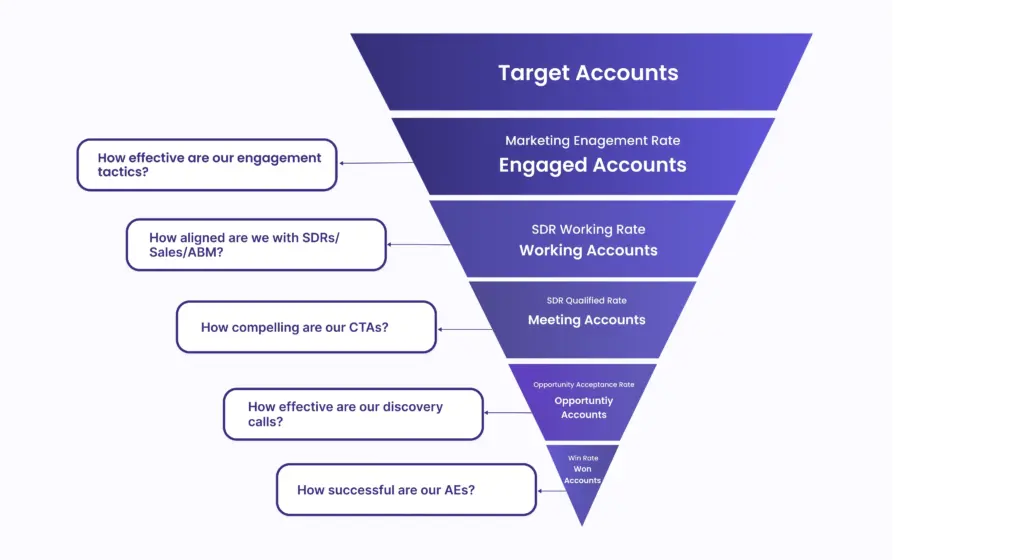
a) Target Accounts
Target Accounts are accounts receiving some form of account-based treatment. These accounts are selected based on fit and potential value but may not yet show active buying signals.
At this stage, the focus is on coverage and relevance, not conversion. Teams are testing assumptions and introducing initial points of view.
Key characteristics:
- Identified based on ICP, industry, size, or strategic value
- Limited or no engagement yet
- Broad, exploratory outreach and content
b) Engaged Accounts
Engaged Accounts have shown early signs of interest. These signals suggest that messaging is resonating with at least part of the buying group.
Engagement may include:
- Content consumption
- Webinar or event participation
- Email replies and Call conversations
- Social interactions
At this stage, accounts warrant prioritization. SDRs begin sharpening outreach and focusing on conversations that can uncover ownership and urgency.
c) Working Accounts
An account becomes a Working Account once there is active sales development motion. This typically means logged SDR or AE activity within a defined period.
The emphasis here is on discovery and validation:
- Understanding how the account operates internally
- Identifying mobilizers and influencers
- Confirming whether the perceived problem is real and owned
Working Accounts represent the transition from interest to intent.
d) Meeting Accounts
Meeting Accounts have completed at least one meeting with the sales team. This marks a critical shift from informal engagement to structured dialogue.
At this stage, conversations focus on:
- Business challenges and priorities
- Success criteria and constraints
- Alignment on whether a real opportunity exists
The quality of discovery during this stage often determines whether the account progresses or stalls.
e) Opportunity Accounts
Opportunity Accounts have at least one formally opened opportunity. Intent is clear, and the buying process is underway.
Typical characteristics include:
- Multiple stakeholders involved
- Defined evaluation criteria
- Active solution comparison and validation
ABS efforts here expand to support the full buying group, maintain momentum, and reduce risk.
f) Won Accounts
Won Accounts have completed the buying cycle. In ABS, this is not the end—it’s a transition point.
The focus shifts to:
- Onboarding and adoption
- Value realization
- Expansion and long-term growth
Strong ABS programs treat won accounts as strategic assets that fuel future pipeline.
7. Account-Based Selling Qualification
In Account-Based Selling, qualification is not a one-time discovery exercise—it’s a handover moment. By the time an account moves from SDR ownership to an AE, the goal is not to ask “can this account buy?” but to validate “have we proven this account is worth full-cycle investment?”
This qualification framework is designed as a checkpoint system for SDR-to-AE handoff. Each section answers one question: Did we achieve this before advancing the account?
1. Ideal Target Profile (ITP): Did We Confirm Strategic Fit?
Before handoff, the SDR should be able to confirm that the account fits the Ideal Target Profile based on real-world conditions, not assumptions.
This means answering:
- Did we validate that the account is undergoing a transformation we can help with?
- Did we confirm the pressures or constraints driving potential change?
- Did we rule out accounts that look good on paper but lack urgency or relevance?
If the account is not facing a meaningful problem aligned to your solution, it should not move forward—regardless of engagement.
2. Reason to Engage: Did We Identify Why This Account Is Talking to Us Now?
Every qualified account needs a clear entry point into the conversation.
At handoff, the SDR should document:
- What triggered engagement (outbound response, inbound signal, referral, market event)
- Why now is the right time for this conversation
- What specific topic or issue resonated enough to earn attention
If the AE cannot clearly articulate why this account engaged, the deal is already at risk.
3. Potential Business Value (PPOV): Did We Establish a Clear Point of View?
Before passing the account, the SDR should have validated a working Point of View—not a pitch, but a hypothesis.
This answers:
- Did we articulate what outcome the account could achieve by changing?
- Did the prospect acknowledge the problem or opportunity?
- Did our POV resonate enough to continue the conversation?
The AE should inherit an account with a directional narrative, not a blank slate.
4. Business Impact: Did We Tie the Problem to Measurable Outcomes?
Interest alone is not qualification. Before handoff, there should be alignment on how success would be measured.
The SDR should confirm:
- What metrics matter to the account (revenue, efficiency, risk, cost)
- Whether the prospect agrees those metrics are worth improving
- Whether impact is framed in business terms, not product features
If impact cannot be quantified—even loosely—the opportunity is not real yet.
5. Mobilizer: Did We Identify Someone Who Can Drive Change?
A qualified account must have a mobilizer, not just a friendly contact.
At handoff, the SDR should answer:
- Do we know who owns the problem?
- Does this person influence decisions or access decision-makers?
- Have they shown intent to move the conversation forward internally?
Without a mobilizer, AEs inherit education cycles—not opportunities.
6. Commitment: Did the Account Take a Concrete Next Step?
The final qualification gate is behavioral proof.
Before handoff, the SDR should confirm:
- Did the account agree to a meaningful next step?
- Was that step mutually valuable (not just “send info”)?
- Did the prospect invest time, data, or internal coordination?
A meeting alone is not commitment. Action is.
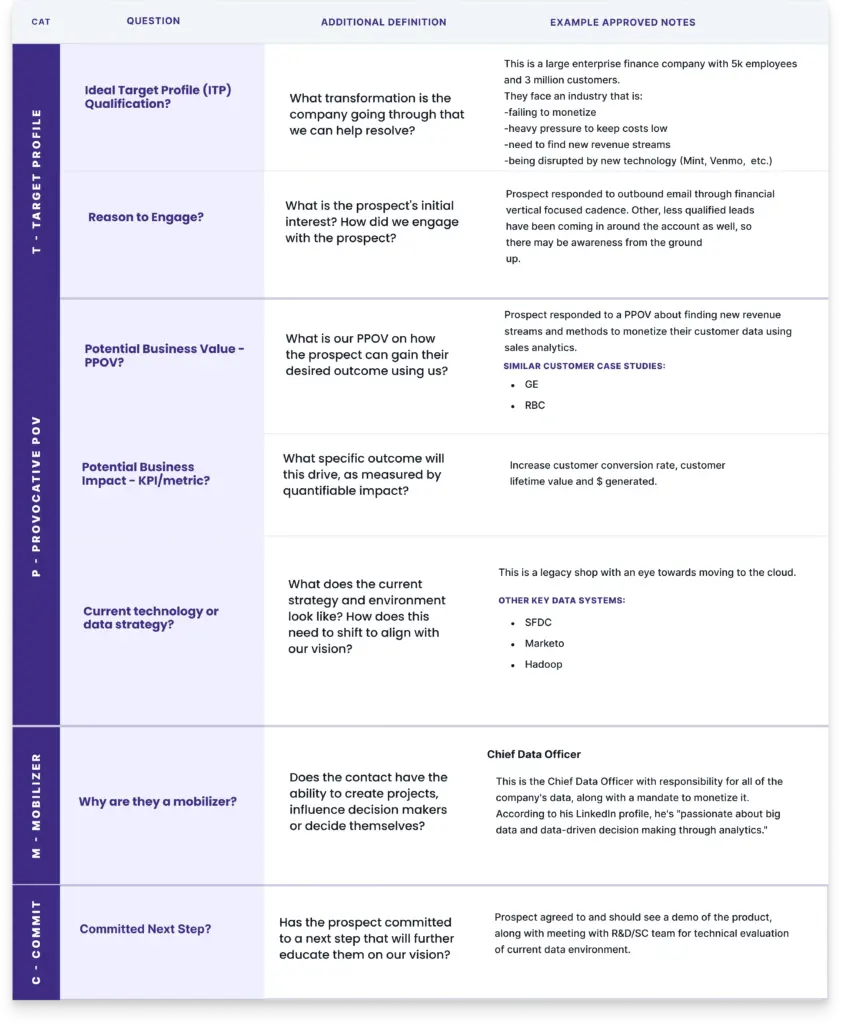
This framework ensures that AEs don’t inherit activity, but momentum. It creates a shared definition of “qualified,” reduces re-discovery friction, and aligns sales teams around progress—not volume.
In Account-Based Selling, the quality of the handoff determines the quality of the pipeline. This qualification model makes that handoff intentional, repeatable, and accountable.
8. Account-Based Selling Metrics
Managing accounts by stage only works when teams track how accounts move between stages, not just how many exist in each bucket. Account-based metrics provide visibility into whether strategy, messaging, and execution are aligned.
At the top of the funnel, teams assess:
- Target Account quality and ICP alignment
- Engagement rates across prioritized accounts
As accounts move deeper, stage-to-stage conversion becomes the primary indicator of health:
- Engaged → Working
- Working → Meeting
- Meeting → Opportunity
- Opportunity → Won
Let’s walk through a simple example.
Assume a team starts a quarter with 200 Target Accounts that fit their ICP.
At the top of the funnel, they measure engagement quality, not just activity. If 25% of those accounts show meaningful engagement—through email replies, content consumption, or event attendance—that gives:
- 200 Target Accounts
- 50 Engaged Accounts (25% engagement rate)
This immediately tells the team whether their targeting and messaging are working. If engagement is low, adding more accounts won’t fix the problem—better relevance will.
Next, the team looks at how many Engaged Accounts convert into Working Accounts, meaning SDRs are actively having conversations and logging activity. If 60% of engaged accounts progress:
- 50 Engaged Accounts
- 30 Working Accounts (60% conversion)
At this stage, SDR effectiveness becomes visible. Low conversion here often signals weak follow-up, poor call execution, or unclear entry points into the account.
From Working Accounts, the focus shifts to meeting quality. If half of working accounts result in at least one completed meeting:
- 30 Working Accounts
- 15 Meeting Accounts (50% conversion)
This conversion rate reflects discovery quality. If meetings are happening but not converting, the issue is often misaligned messaging or shallow problem definition.
Next comes the critical jump from Meetings to Opportunities. If 40% of meeting accounts progress to a qualified opportunity:
- 15 Meeting Accounts
- 6 Opportunity Accounts (40% conversion)
This is where account qualification discipline matters. Strong ABS teams would rather have fewer, well-qualified opportunities than inflated pipeline.
Finally, assume a 30% win rate on opportunities:
- 6 Opportunity Accounts
- 2 Won Accounts (≈30% win rate)
If the average deal size is $100,000, the outcome of the original 200 Target Accounts is:
- 2 deals × $100,000 = $200,000 in revenue
This example shows why account-based metrics are powerful. At every stage, teams can diagnose where the funnel is breaking:
- Low engagement → targeting or POV problem
- Low Working conversion → SDR execution issue
- Low Meeting → Opportunity conversion → poor qualification
- Low win rate → deal strategy or positioning
9. Sales & Marketing Alignment in Account-Based Selling
Sales and marketing alignment is not a supporting function in Account-Based Selling—it is the operating system. ABS only works when sales, SDRs, and marketing teams are tightly coordinated around the same accounts, the same priorities, and the same definition of success. Unlike traditional demand generation, where marketing hands off leads and steps back, ABS requires continuous collaboration across the entire account lifecycle.
The goal of this alignment is simple but demanding: ensure that every interaction an account has—whether through content, outbound outreach, or live conversations—feels intentional, relevant, and connected to a single narrative. When alignment breaks down, accounts experience disjointed messaging, SDRs lack context, and sales conversations stall. When alignment works, accounts move through the funnel faster with less friction.

a) How should Sales and Marketing Collaborate?
In an account-based model, sales teams play an active role in shaping marketing strategy. Rather than marketing defining personas and campaigns in isolation, sales brings forward accounts that matter—based on territory knowledge, deal history, expansion potential, and strategic importance. Marketing then uses this input to segment accounts, prioritize resources, and tailor messaging to the realities of each buying group.
This collaboration extends beyond account selection. Sales teams inform marketing which problems resonate in live conversations, which objections slow deals, and which competitors appear most frequently. Marketing, in turn, equips sales and SDRs with content that reflects those insights—ensuring outreach is grounded in real buyer concerns, not abstract personas.
The result is a shared account plan where sales knows what to say and marketing knows why it matters.
b) Designing Content for Account-Based Selling
Content sits at the center of any effective ABS motion, but it must be designed differently than traditional marketing assets. In ABS, content is not created to attract anonymous traffic—it is created to support specific conversations inside named accounts.
At the top of the account funnel, content should focus on problem education. These assets help prospects recognize challenges they may not yet be prioritizing and create space for a new point of view. Examples include industry trend reports, problem-focused blog posts, executive briefs, and short thought-leadership pieces that frame external pressures such as market shifts, regulatory changes, or operational inefficiencies.
As accounts move deeper into engagement, content shifts toward solution research. At this stage, marketing assets should help buyers explore options without feeling sold to. This includes customer stories, use-case breakdowns, comparison guides, webinars, and practical frameworks that show how similar organizations approached the problem. These assets give SDRs and AEs credibility and allow prospects to self-educate between conversations.
Near the bottom of the funnel, content becomes more solution-specific. These assets are designed to support decision-making and consensus building within the buying group. Examples include product demos, ROI calculators, technical documentation, security briefs, implementation timelines, and executive summaries tailored to finance, operations, or IT stakeholders. At this stage, content should reinforce why your solution is the best choice—not just a viable one.
c) Marketing Assets Required for Account-Based Selling
To support this journey, marketing teams must build a modular content library that sales and SDRs can deploy flexibly. This includes:
- Account-specific landing pages or microsites that centralize content for a target account or buying group
- Persona-aligned one-pagers tailored for executives, mobilizers, and users
- Industry POV decks that SDRs and AEs can reference in early conversations
- Case studies mapped to specific use cases, industries, or account segments
- Email and LinkedIn message frameworks aligned to account stages and roles
- Short-form content (videos, posts, insights) that SDRs can use for social engagement
- Bottom-funnel assets such as ROI models, pricing narratives, and implementation guides
These assets should not live in isolation. They must be easy for SDRs and AEs to find, understand, and deploy at the right moment in the account journey.
Conclusion
Account-Based Selling is a way of operating. The shift to account-based selling requires more than new tools or processes. It requires a change in mindset—from volume to focus, from individual leads to buying groups, from meetings booked to qualified pipeline created.
When done right, it transforms how your team picks accounts, engages buying committees, and builds pipeline.
If you are just getting started with Account-Based Selling - Start with your best accounts. Tier them. Research them. Run coordinated plays across the buying committee. And measure what matters: accounts moving through stages.
The shift from prospect-based to account-based selling isn't incremental. It's a different operating model that produces fundamentally different results.