- High-volume outbound breaks upmarket. When your TAM shrinks and deal sizes grow, generic outreach and single-threaded deals won’t work.
- Account-Based Selling (ABS) shifts focus from prospects to accounts — engaging 10–20+ stakeholders and optimizing for account progression.
- The three-thread strategy (top-down, bottom-up, and direct) creates urgency and alignment inside complex accounts.
- Execution requires stage-based progression, not linear cadences — each stage demands coordinated actions across threads.
- Context beats volume. Research-driven, signal-based outreach turns cold conversations into strategic discussions.
- Klenty enables account-level orchestration, structured multi-threading, AI next steps, stage tracking, and account reporting.
If you are an SDR selling into mid-market or enterprise accounts, you have probably noticed this: the playbook that worked when you were closing $5K deals stops working when deal sizes hit $50K, $100K, or more.
High-volume outbound- build a massive prospect list, blast sequences, move fast, works perfectly fine in SMB sales. You can afford low connect rates because your TAM is huge. You can pitch early because buying cycles are short. You can focus on one contact per account because decisions happen fast.
But as you move upmarket, or start selling into specific verticals with limited addressable markets, that approach breaks down fast. You are no longer working an endless list of prospects. You are working on a finite list of target accounts. And if you burn through those accounts with generic outreach and weak follow-up, you do not get a second chance.
This is where an account-based selling strategy becomes essential. It is a complete shift in how you build lists, execute outreach, and measure success.
Here is what needs to change:
| Normal Approach (High-Volume Outbound) | What You Actually Need (Account-Based Selling) |
|---|---|
| Build a big list of prospects | Build a defined list of target accounts |
| Call and email a few times, then move on | Consistent, structured outreach across multiple months |
| Calls and emails focused on replies and meetings | Education and awareness before you ever pitch |
| One to two prospects per account (fine for low-ticket sales) | Engage the entire buying committee: typically 10–20+ prospects per account in mid-market and enterprise deals |
| Pitch immediately, stick to calling decision-makers only | Discovery across all levels before you pitch to the C-suite |
| Focus on volume; you can afford low connect rates | Focus on the connect rate — your TAM is limited, so you need every conversation with every account |
| No structured follow-up; pitch and move to the next list | Structured follow-up with context, research, and relevance tied to changing business priorities |
This blog is built for SDRs and revenue leaders running account-based outbound motions. We are going to focus on execution- how to actually engage accounts systematically, multi-thread across buying committees, and run coordinated plays that create pipeline predictably.
Why High-Volume Outbound Stops Working When You Sell Into Target Account Lists/Verticals/Segments
Most SDR teams operate on a volume-based model: load up the CRM with thousands of leads, run automated sequences, and measure success by activity metrics- calls made, emails sent, meetings booked.
This works when you are selling into SMB. Your TAM is huge, and deals close fast. Because buying committees are small, one or two touches per account is often enough.
But when deal sizes grow, or you shift to selling into enterprise accounts or specific verticals, the game changes completely.
Here is what breaks:
Your TAM shrinks dramatically. Instead of 50,000 potential prospects, you might only have 500 target accounts that actually fit your ICP. You cannot afford to burn through them with spray-and-pray outreach.
Buying committees expand. In mid-market and enterprise deals, you are not selling to one person. You are navigating 6, 10, sometimes 15+ stakeholders across multiple departments. Reaching just one contact per account leaves you blind to the real decision-making process.
Sales cycles get longer. Deals that used to close in 30 days now take 90, 120, or 180 days. You need sustained engagement over months, not weeks. A five-touch sequence won't cut it.
Pitching early kills deals. In complex sales, buyers do not want to be sold to on the first call. They want education. They want to understand the problem before they evaluate solutions. Leading with a pitch signals that you do not understand how they buy.
Connect rate becomes critical. When your TAM is finite, every conversation matters. Low connect rates are not acceptable anymore. You need systematic coverage, persistent follow-up, and multiple channels working together.
Generic outreach gets ignored. C-suite executives and senior decision-makers do not respond to checking in emails or cold pitches about features. They respond to relevance, insights tied to their business priorities, industry pressures, or strategic initiatives.
The shift to account-based selling is the only way to engage complex accounts systematically and build a pipeline predictably.
In the next section, we will break down exactly how to execute an account-based selling strategy, and how to engage the full buying committee, run coordinated multi-channel plays, and build the infrastructure that makes this repeatable at scale.
Account-Based Selling Strategy - Execution
This is where most account-based programs fail. Not because teams lack a plan, but because execution in ABS requires a fundamentally different operating model than high-volume outbound, and most teams try to force the old playbook into a new motion.
Here is what breaks:
Traditional sales engagement tools are built around prospect-based cadences. You load prospects into a sequence, and each prospect moves through the same set of touches on the same timeline. This works fine when you are running volume plays across thousands of leads.
But in account-based selling, the unit of work is not the prospect; it is the account. And accounts do not move through linear sequences. They require:
- Coordinated engagement across 10-20+ buying committee members
- Stage-based actions that adapt as the account progresses
- Connected conversations where what you learn from one stakeholder informs how you engage the next
- Persistent coverage across weeks and months, not 5-touch sequences
Most sales engagement platforms cannot do this. They are designed for prospect-level execution, not account-level orchestration.
This is the execution gap that kills ABS programs.
The Account Development Gap
When you shift from high-volume outbound to account-based selling, three major execution challenges surface:
| Challenge | What It Means | Why It Matters |
|---|---|---|
| TAM Constraints | You are working 500–2,000 accounts, not 10,000+ prospects | Every burned conversation costs you. You cannot afford low connect rates or generic messaging. |
| Relationship Selling Challenges | 11+ stakeholders are involved in every purchase decision | You are not reaching one person; you are navigating a buying committee with conflicting priorities and different pain points. |
| Coaching Limitations | Managers need to coach on account strategy, not just activity | Legacy tools show "calls made" but not "account progress," making strategic coaching impossible. |
The Three-Thread Account Engagement Strategy
In a modern account-based motion, you do not choose between top-down, bottom-up, or direct outreach. You design an outreach plan that threads all three, so different stakeholders hear the right message at the right time.
Top-down gives you air cover. Bottom-up gives you champions. Direct gets you to the budget.
Think of it as a sequence across the account, not a menu of tactics for an individual SDR to pick from.
Thread 1: Top-Down - Create Air Cover
Start by identifying the executive who owns the outcome your product impacts most: pipeline growth, revenue efficiency, cost reduction, or operational scale.
Your goal is not to close them in an email. Your goal is to get permission and context:
"Yes, this is a priority. Talk to these people on my team."
When to use top-down:
- You need urgency or a mandate (new category, big change, competitive rip-out)
- The buying decision requires executive sponsorship
- You are introducing a strategic shift, not just a tool swap
How it connects to the other threads:
Once an exec engages, every bottom-up and direct touch references that executive's priorities or quote:
"Your VP of Sales flagged [X] as a priority. Here is how we can help your team hit it."
This is not about pitching the executive. It is about earning air cover that makes every other conversation in the account easier.
Thread 2: Bottom-Up - Build Champions
In parallel, your SDRs work bottom-up with the people who live the problem daily- the end users, the practitioners, the team leads who feel the pain every single day.
The goal here is not budget approval. The goal is to:
- Uncover real workflows and pain points
- Collect the language your prospects actually use
- Create internal champions who will defend the deal when it hits the buying committee
How bottom-up connects to the other threads:
Bottom-up gives you proof points and anecdotes you can surface in exec and direct outreach:
"Your SDR team spends 15 hours a week dealing with [specific pain point]..."
Champions also tell you:
- How decisions really get made inside the account
- Who the blockers are
- When to time your direct approach to the budget holder
Without bottom-up, you are flying blind. You have no idea how work actually gets done or who will support you in committee.
Thread 3: Direct - Convert the Buying Moment
Once you have air cover from leadership and real stories from the field, you go directly to the economic buyer- the person with budget authority, with a tight, ROI-led narrative:
"Your VP cares about X, your team is struggling with Y. Here is the impact of doing nothing and a clear path to Z."
When direct works best:
Direct works when you can reference both sides: leadership goals and user pains.
Without exec context (top-down) and champions (bottom-up), direct outreach feels like any other cold pitch and stalls in committee. But when you can connect the dots across all three threads, you create urgency and credibility.
When to Use What: The Playbook
| Situation | Lead With | Support With | Close With |
|---|---|---|---|
| New logo, big change management | Top-down (air cover) | Bottom-up (proof points) | Direct (ROI + timeline) |
| Land-and-expand or PLG accounts | Bottom-up (users already engaged) | Top-down ("your team already uses us") | Direct (budget owner) |
| Renewal or competitive displacement | Direct (time-bound ROI + risk) | Top-down (strategic alignment) | Bottom-up (user validation) |
This is not about choosing your favorite style. It is about assembling a coordinated play across the account.
The key insight: you are not prospecting into individuals. You are orchestrating a narrative across a buying committee.
How to Execute the Three-Thread Strategy: The 4-Phase Framework
Executing this strategy in practice requires breaking the work into four connected phases:
Let us walk through each phase.
Phase 1: Initial Account Engagement
The first job is to get into the account. This means identifying available prospects across all three threads and executing initial outreach.
At this stage, your SDRs are not trying to multi-thread or pitch. They are trying to:
- Confirm the account is worth pursuing
- Identify who owns the problem
- Gather intelligence that will inform subsequent outreach
What this looks like in practice:
Your SDR identifies 5-7 contacts in the target account, distributed across three levels of the buying structure:
- Executive level (VP, C-suite): 1-2 contacts who control budget and strategic direction
- Mid-level managers or directors: 2-3 contacts who hold purchasing authority within their function
- End-users or practitioners: 2-3 contacts who experience the problem firsthand every day
They begin outreach using phone and email, focused on discovery, not pitching.
Key principle: Talk like a consultant, not a vendor.
At this stage, your messaging should be problem-focused and exploratory:
- "We work with companies like yours dealing with [specific challenge]. I am curious how your team handles [related process]."
- "I have been researching how [industry] companies approach [problem area]. Would you be open to a quick conversation?"
The goal is to:
- Start a conversation
- Understand if the problem exists
- Identify who else should be involved
Phase 2: Account Research & Context Building
As conversations start, your SDRs should be building context on the account, and not just logging activities in the CRM.
Research is what separates relevant outreach from generic spam. And in account-based selling, context is currency.
Before reaching out to any stakeholder, your SDR should understand what is actually driving the business right now. That means going beyond looking at sources that reveal strategic intent: job postings, recent announcements, industry news, and for public companies, earnings calls or investor reports.
The goal is to walk into every conversation with a point of view on what the account is trying to achieve and how you fit into that picture.
What research should SDRs be gathering?
| Research Area | What to Look For | Why It Matters |
|---|---|---|
| Hiring Trends | Are they expanding the team? New roles posted? | Signals growth, budget availability, and urgency |
| Business Priorities | What did leadership say in earnings calls, press releases, and investor updates? | Tells you what executives care about right now (fuels top-down thread) |
| Technology Stack | What tools are they currently using? Recent adoptions or changes? | Identifies integration opportunities or competitive displacement angles |
| Department Insights | How is the team structured? What workflows exist? | Helps you speak to day-to-day realities, not assumptions (fuels bottom-up thread) |
Why this matters:
The more your SDR knows about the account, the more relevant every subsequent conversation becomes, across all three threads.
This is where Klenty's Account Research becomes critical. Instead of SDRs manually digging through company websites and news articles, Klenty consolidates account research insights in one place, giving reps context at their fingertips before every call and email.
Example of context in action:
An SDR calls a prospect at a company that just raised Series B funding. Instead of leading with a generic pitch:
(Wrong) "Hi, we help sales teams be more productive..."
They open with context:
(Correct) "I saw [Company] just closed your Series B. Congrats. One pattern we see with companies at this stage is that scaling the SDR team becomes a bottleneck before you can capitalize on the new budget. Is that something your team is thinking about?"
That is not a cold call. That is a contextual conversation.
Phase 3: Multi-Threading Across the Buying Committee
Once your SDR has initial conversations and context, the next phase is multi-threading- engaging multiple stakeholders across the account in a coordinated way.
But here is the critical distinction:
Multi-threading is not random outreach to 15 people at once.
Multi-threading means building connected conversations where what you learn from one stakeholder informs how you engage the next. Each thread is connected and not isolated.
This is where the three-thread strategy comes to life.
Example of connected multi-threading:
| Step | Thread | Who | What You Say | What You Learn |
|---|---|---|---|---|
| 1 | Bottom-up | End-User (SDR Team Lead) | "What is your biggest challenge with outbound right now?" | "Our reps spend half their day dealing with call quality issues." |
| 2 | Direct | Sales Ops Manager | "I was speaking with [Team Lead] about calling infrastructure challenges. On the ops side, how much time are you spending troubleshooting vs. building scalable processes?" | "We have three different tools that do not talk to each other. It is a mess." |
| 3 | Top-down | VP of Sales | "I have been speaking with a few people on your team about SDR productivity. A consistent theme: your team is losing 30–40% of productive time to infrastructure issues. I have seen this at other companies your size — it is usually a signal that the sales engagement stack needs an upgrade. Worth exploring what a fix looks like?" | Meeting booked. |
Notice how each conversation builds on the previous one. This is not three separate sequences running in parallel. This is one coordinated account strategy threaded across the buying committee.
By the time the SDR reaches the VP (top-down), they are not pitching cold. They are synthesizing what the team has already told them.
How Klenty enables multi-threading:
In Klenty, multi-threading is built into the account workflow:
| Traditional Tools (Prospect-Based) | Klenty (Account-Based) |
|---|---|
| SDRs manage 15 separate prospect sequences | SDRs manage one account with 15 connected threads |
| No visibility into what other prospects in the account have said | Full engagement history across all prospects is visible in one view |
| Each prospect gets generic messaging | Messaging adapts based on context from prior conversations across threads |
| Managers coach on activity ("make more calls") | Managers coach on account strategy ("who have you engaged? what have you learned? what is the next thread?") |
This is what makes multi-threading scalable. Your SDRs are managing one account with 15 connected threads.
Phase 4: Stage-Based Account Actions
In an account-based selling strategy, accounts do not move through a linear sequence. They move through stages, and each stage requires different actions.
Here is how accounts typically progress:
| Stage | What It Means | Actions Required | Goal |
|---|---|---|---|
| Not Contacted | Account is in your TAM, but no outreach has happened yet | Execute initial outreach to 5–7 prospects across the three threads | Start conversations and gather intel |
| Contacted | Outreach has been executed, but no response yet | Follow up with engaged prospects; add new contacts based on research | Identify the mobilizer or decision-maker |
| Engaged | At least one prospect has responded or shown interest | Multi-thread across the buying committee; share relevant content tied to their thread | Build awareness and consensus across stakeholders |
| Responded | Multiple stakeholders are engaged; momentum is building | Schedule discovery calls; involve AE if needed; connect the threads | Qualify the opportunity and move to the pipeline |
The key insight: Each stage requires coordinated actions across all three threads, not just random activity.
For example, in the Engaged stage, your SDR might:
- Top-down: Share an industry report with the exec
- Bottom-up: Send a product demo video to the end-user
- Direct: Schedule a discovery call with the budget holder
All happening in parallel, all reinforcing the same narrative.
How this works in Klenty:
Klenty lets you set custom stages for each account and define action windows for each stage.
For example:
- Accounts in "Not Contacted" stage: SDRs have 4 days to complete initial outreach across threads
- Accounts in "Contacted" stage: SDRs have 3 days to execute follow-up actions
- Accounts in "Engaged" stage: SDRs have 5 days to multi-thread and expand coverage
This creates forcing functions that ensure accounts do not sit idle. SDRs know exactly what actions are required at each stage, and managers can see which accounts are progressing and which are stalled.
Messaging in Account-Based Selling
Let us address how to actually write emails and structure calls in an account-based motion.
Most ABS resources give you "templates" that are either too generic or too specific to be useful. Here is what actually works:
Principle 1: Reference the account, not just the persona
Bad example: "Hi [Name], I help VPs of Sales improve SDR productivity..."
Better example: "Hi [Name], I noticed [Company] just expanded into the UK market. One challenge we see with companies making that move is that SDR teams struggle to maintain connect rates across time zones..."
Principle 2: Lead with a point of view, not a pitch
Bad example: "We have a sales engagement platform that helps teams book more meetings..."
Better example: "Most B2B SaaS companies we work with are still running SDR teams on tools built for call centers, not account-based selling. The result: reps spend 40% of their day on tasks that have nothing to do with talking to buyers."
Principle 3: Connect to the thread
Each email or call should reflect which thread you are working on:
- Top-down thread: Reference business outcomes, strategic priorities, industry trends
- Bottom-up thread: Reference daily pain points, workflow frustrations, team challenges
- Direct thread: Reference ROI, timeline, risk of inaction
Email Template Framework: Thread-Specific Outreach
Top-Down Thread (Executive-Level)
Bottom-Up Thread (End-User/Practitioner)
Direct Thread (Budget Holder/Decision-Maker)
Call Script Framework: Discovery-Focused
This is a framework, not a rigid script. Adapt it based on what you learn in real time and which thread you are working on.
Opening (Permission-Based): "Hi [Name], this is [Your Name] from [Company]. I know I am catching you out of the blue- do you have 30 seconds for me to explain why I called, and you can decide if it is worth continuing?"
Problem Framing (Tied to Account Context + Thread):
For top-down: "I have been looking at [Company Name], and I noticed [strategic observation]. One thing we are seeing with companies at your stage is [strategic problem]. Is that something on your radar?"
For bottom-up: "I have been talking to [role] teams at companies like yours, and the consistent challenge is [daily pain point]. Is that something your team deals with?"
For direct: "I have been speaking with a few people on your team, and [specific insight from prior conversations]. That usually signals [root cause]. Is that resonating?"
Discovery Questions:
- "How is your team currently handling [related process]?"
- "What have you tried so far to address this?"
- "Who else on your team is involved in solving this?"
Next Step (Low Commitment): "Based on what you have shared, I think there might be a fit here. Would it make sense to set up a quick 15-minute call where I can show you how [Reference Customer] approached this?"
How Klenty Helps You Execute Your Account-Based Selling Strategy
Klenty is built to help sales teams develop accounts into a qualified pipeline through account-based orchestration.
Unlike traditional sales engagement tools that focus on prospect-level outreach, Klenty is designed to execute account-level strategies, enabling you to multi-thread across buying committees, maintain context across conversations, and systematically progress accounts through stages.
Here is how Klenty enables account-based execution:
Build Your Target Account Universe
ICP Account Mapping and List-Building
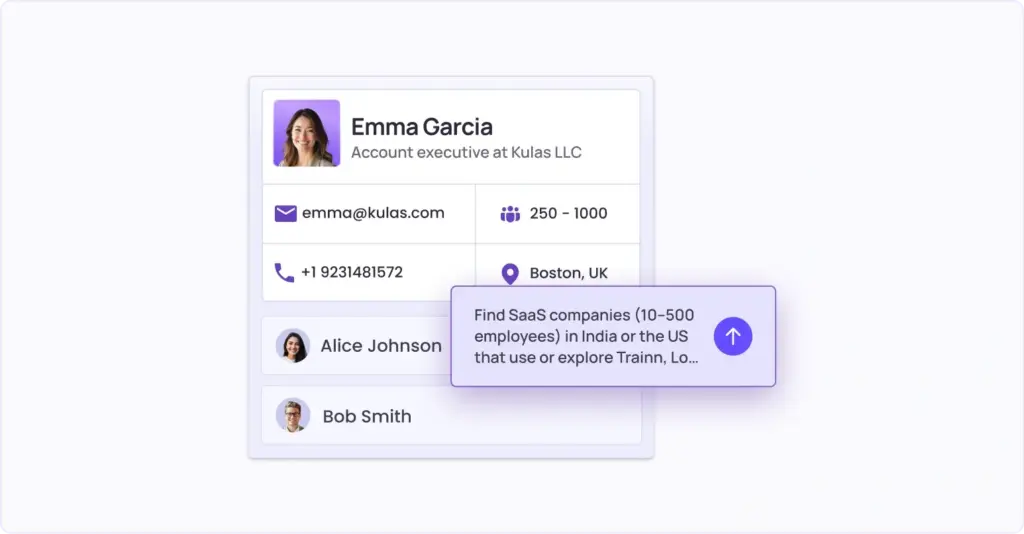
Describe your ICP in natural language and build your target account list in seconds. AI-powered account discovery eliminates manual research and ensures you are targeting the right accounts from day one, so your reps spend time on accounts that actually convert, not on building spreadsheets.
Orchestrate Coordinated Engagement Across Buying Committees
Account Action Window
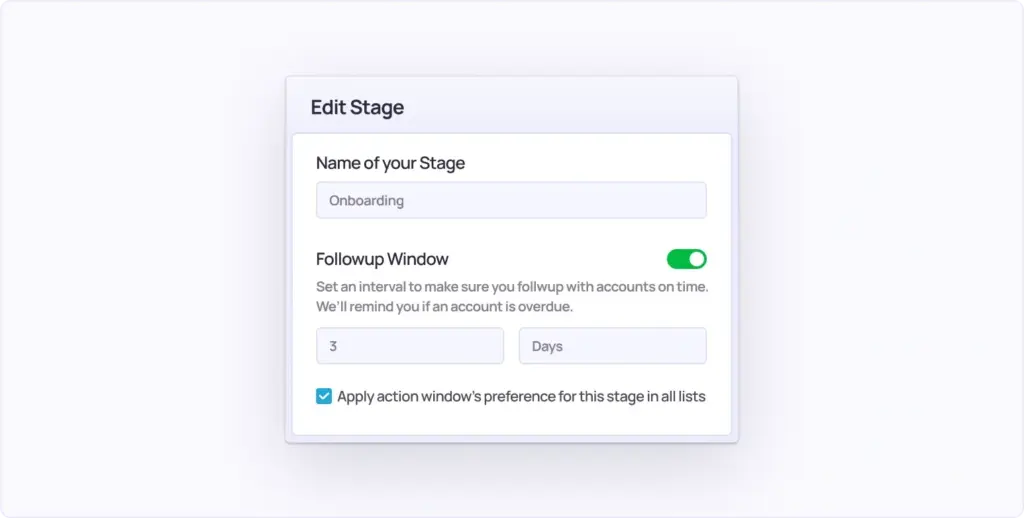
Every target account is at a different stage in its buying journey. Some need urgent action and immediate follow-up to turn into an opportunity - they are in-market. Others need more time, a longer nurture cycle before they are ready to talk to sales.
The problem is that all account actions pile up on your dashboard, leaving no room for prioritization. With traditional sales engagement tools, there's never been a way to control the velocity of rep execution against a set of accounts.
Account Action Windows changes that.
Choose the time period within which actions need to be taken for accounts in each stage. Klenty alerts you when they are overdue. The deeper an account is in its buying journey, the faster reps execute - systematically progressing cold accounts toward an opportunity by following up at set intervals.
Here is what you can do with Account Action Windows:
- Set the frequency, messaging, and channels for every prospect in an account to be engaged.
- Control the velocity of rep execution based on where each account sits in the buying journey.
- Ensure coordinated outreach across the entire buying committee so emails, calls, and LinkedIn touches hit the right people at the right time, not in random bursts.
- Get alerted when action windows are overdue so no account slips through the cracks.
Outreach Methodology (Multi-Threading)
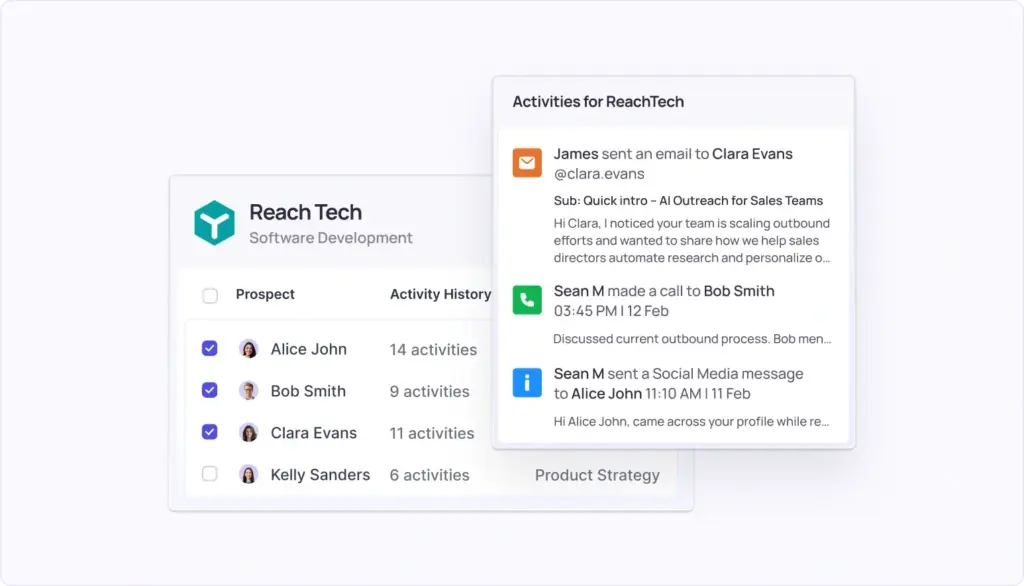
Enforce adherence to top-down, bottom-up, or custom multi-threading workflows. Systematically engage executives, mobilizers, and users within each account based on your preferred approach, ensuring no key stakeholder is left untouched, and every account gets full buying committee coverage.
AI Next Step Execution
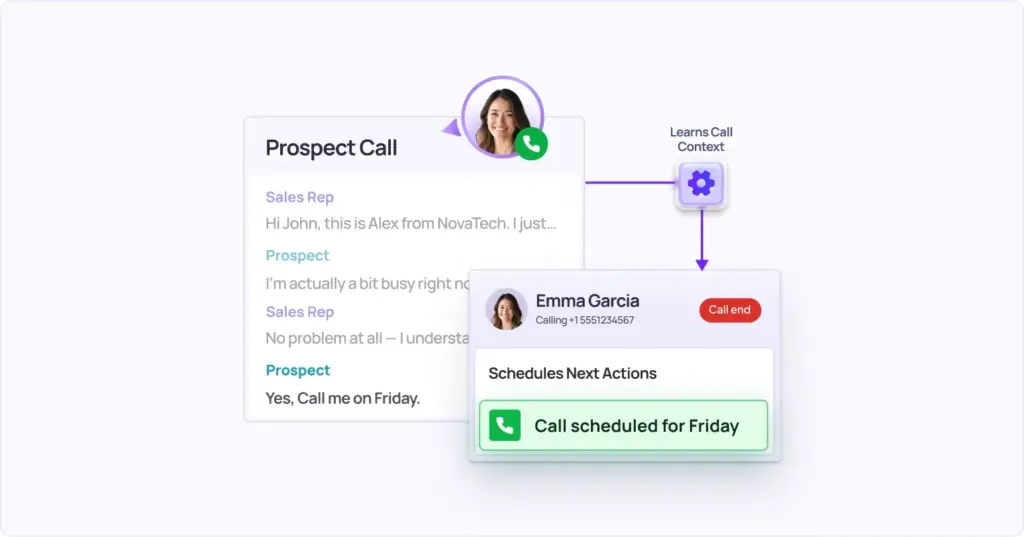
Klenty’s Action AI listens to your sales conversations, understands what was discussed on the call, and intelligently generates the next action. You can focus on dialing, not managing next steps, execute the right tasks at the right time, and save time with auto-generated follow-up messaging.
Time-Based Next Actions
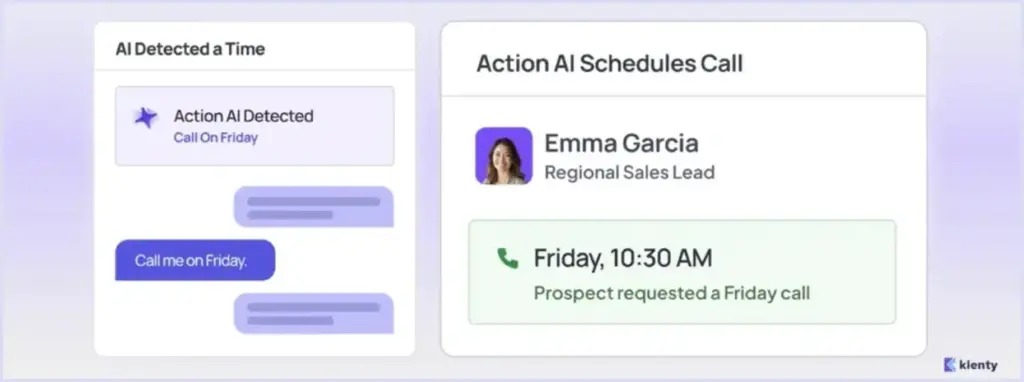
Prospect says, “Call me on Friday.” → Action AI schedules a call for Friday with the prospect.
Channel-Based Next Actions
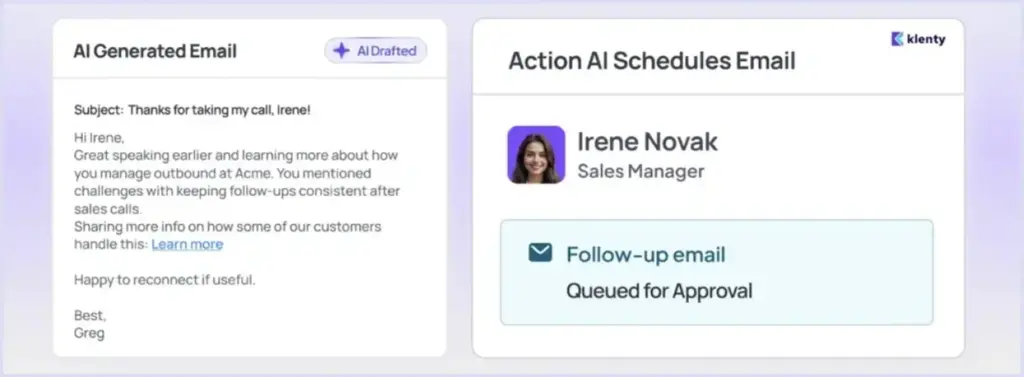
Prospect says, “Send me an email.” → Action AI creates a personalized email and queues it up for approval.
Context-Based Next Actions
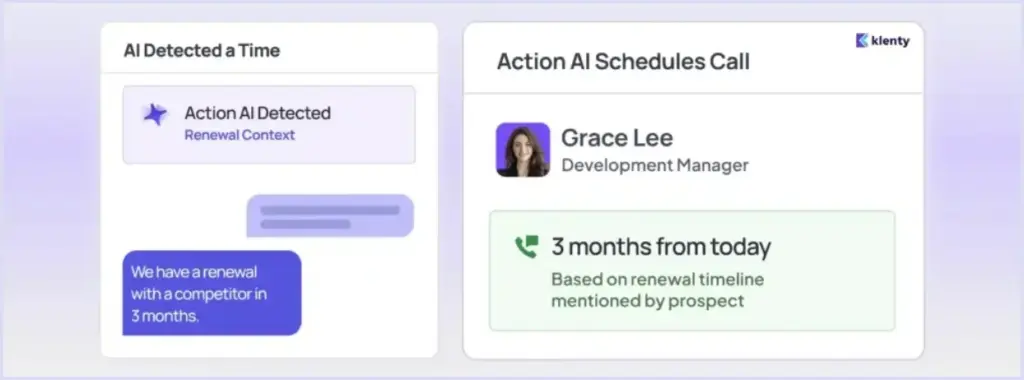
Prospect says, “We have a renewal with a competitor in 3 months.” → Action AI schedules a call in 3 months with a call context.
Account Playbooks
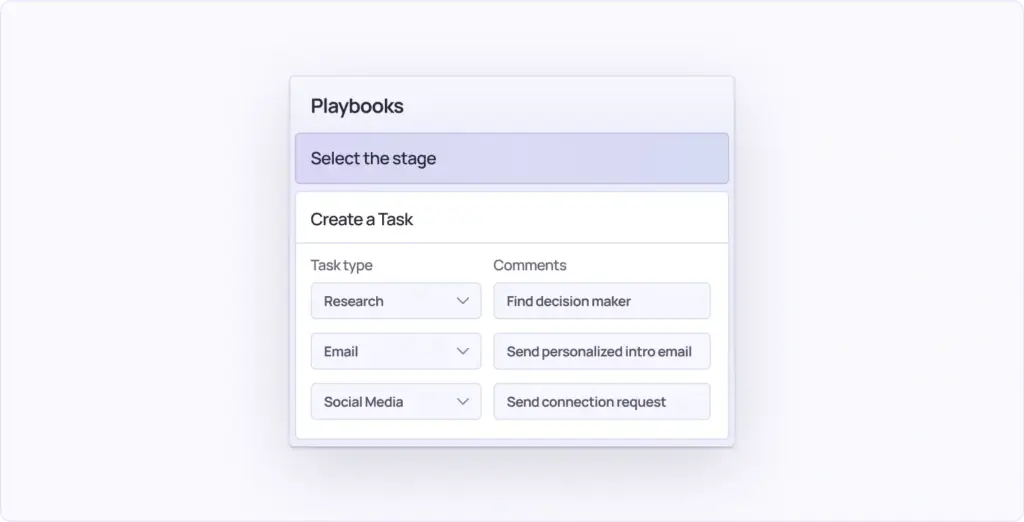
Not all accounts are alike. Only 3% of your cold accounts are in-market at any given time; the rest need outreach that adapts to their needs, timing, and fit.
Traditional sales outreach tools are built purely for demand capture, leaving the other 97% of accounts without a structured way to be nurtured toward a buying decision.
Account Playbooks are built for both - helping you capture demand and create it.
Trigger the Right Play at the Right Stage
Set entry and exit criteria for each account stage and define the activities that need to happen as soon as accounts meet the criteria - across emails, calls, and tasks. When accounts show specific signals or reach certain stages, the right plays trigger automatically, so your team responds to buying intent in real time instead of discovering it weeks later in a pipeline review.
Control Velocity and Urgency of Execution
Not all stages carry the same urgency. Set Account Action Windows for each stage to control how fast reps execute. For instance, accounts in a "Decision-Maker Contacted" or "Meeting Booked" stage can be set to require execution instantly or within 24 hours, while earlier-stage accounts follow a longer, more measured cadence.
Orchestrate Playbooks Account-by-Account
Label accounts as "interested," "right contact identified," or "good fit, not now," and execute the right sequence of activities for an entire account before moving on to the next. This ensures outreach is coordinated across the entire buying committee - enrolling every prospect in customized follow-ups based on org-wide engagement level, so no account context is lost mid-play.
Account Panel
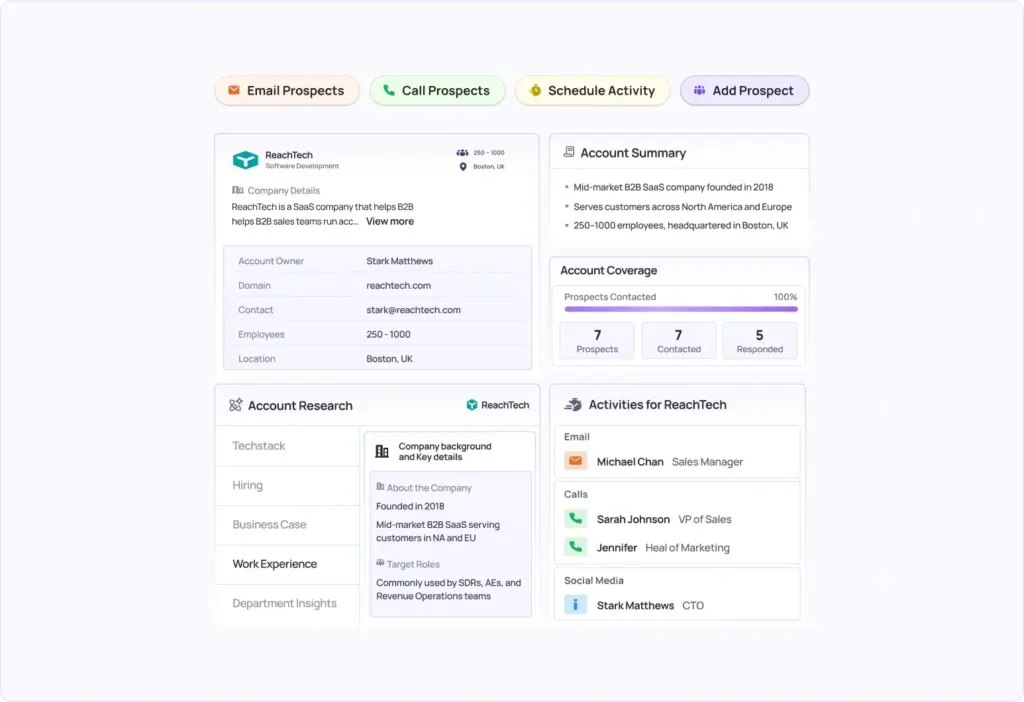
Klenty’s Account Panel helps you to -
Execute Outreach Account-by-Account
Unlike traditional sales engagement tools that are built around individual prospects, the Account Panel lets you group prospects by account and execute emails, calls, and tasks at the account level. Reps can move through research, sending emails, making calls, and finding fresh prospects - all without jumping between tools or losing context mid-execution.
Review the Entire Account's Engagement History
Rather than patching together individual prospect interactions in a spreadsheet, get a consolidated picture of every interaction across all stakeholders in an account, out of the box. Reps walk into every call informed, and managers see the full picture without chasing updates.
Multi-Thread Across the Buying Committee
Know exactly which prospects exist in an account, track coverage across hierarchies, roles, and titles, and add fresh prospects to ensure all relevant stakeholders are being engaged. No contact goes untracked, and no decision-maker falls through the cracks.
Run a Well-Researched, Consultative Sales Process
Basic account details, past conversation summaries, and AI-powered account research insights surface at the moment of dial, so every outreach stays relevant, timely, and specific to the account your rep is working on.
Track Account Progression and Optimize Coverage
Account Stages
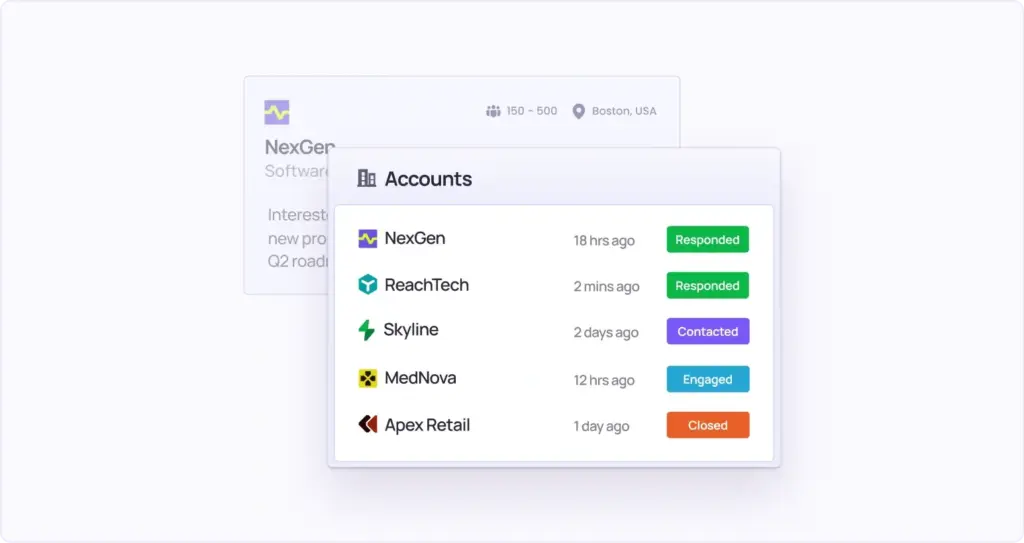
Traditional sales outreach tools leave you with an Account Development Gap - you do not know which accounts are moving toward an opportunity and which are stuck, you can't define tailored strategies for each stage, and there's no systematic way to nurture demand across accounts that aren't ready yet.
Klenty's Account Stages fixes this with CRM-like stages built specifically for sales outreach.
Define a Custom Pipeline for Account-Based Outreach
Create a custom pipeline for each account list and set up stages that reflect the actual steps accounts go through before turning into an opportunity. Every account has a defined place in the journey; nothing falls into a grey area.
View and Drill Into Accounts at Every Stage
With one click, dig into all accounts sitting at any stage of your pipeline. Drill deeper into account-level details like prospects contacted, notes, next steps, and activity history, all consolidated in a single table view so nothing needs to be chased down manually.
Set Custom Strategies for Each Stage
Define entry and exit criteria for each account stage and prescribe the series of actions that need to happen as soon as an account moves in. Each stage gets its own tailored outreach strategy, so reps always know exactly what to do next, for every account, at every step.
Prescribe the Urgency of Execution at Each Stage
Prevent account rotting. Set deadlines for actions to occur at each stage of the pipeline so accounts at advanced stages get immediate attention, and no high-intent account sits idle waiting for a rep to take action.
Account Coverage Analysis
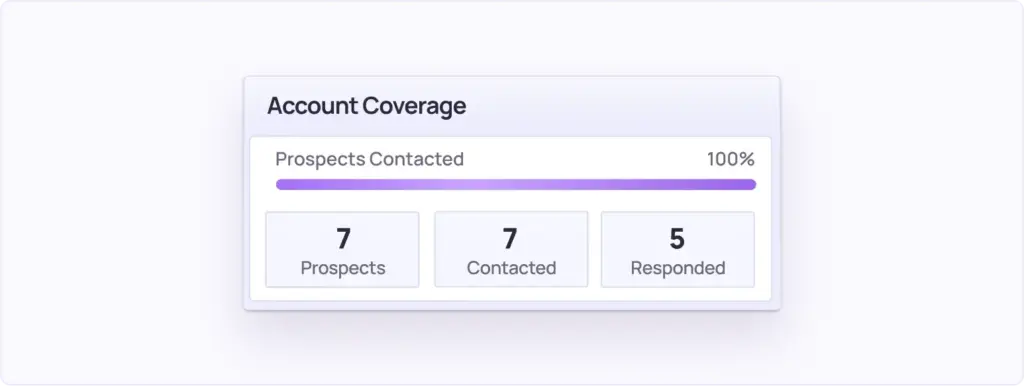
Review the percentage of ICP prospects engaged in any given account and identify gaps for deeper multi-threading. This ensures you are not leaving key stakeholders untouched, the single biggest reason ABS deals stall or die in the pipeline.
Account-Level Reporting
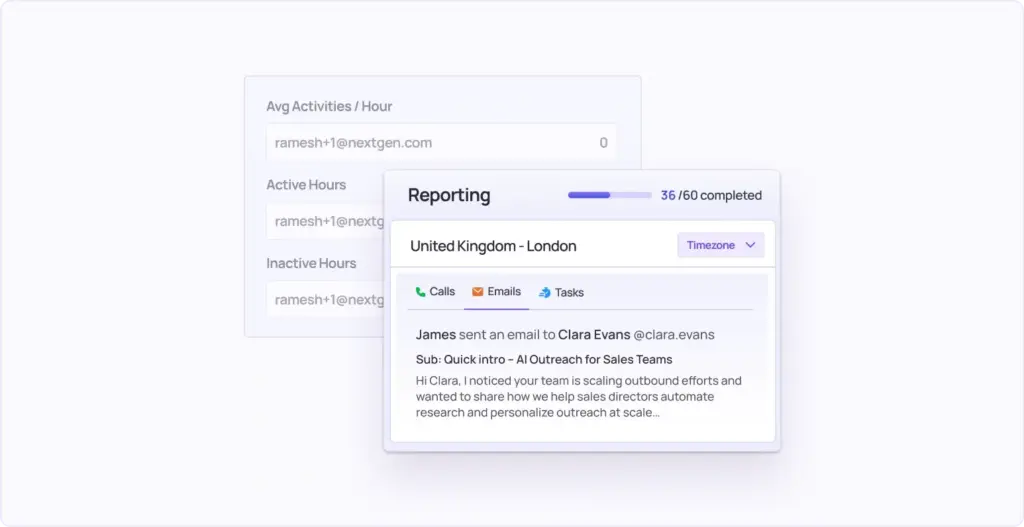
Track SDR activity across daily, weekly, and monthly timelines and contrast it against target account progression. You measure what actually matters, account movement and pipeline created, not just email volume or call counts that look busy but produce nothing.
Key Takeaways
Here is what matters most from this guide:
- ABS is a different operating model, not a new tactic. The unit of work shifts from the individual lead to the account, and your tools, coaching, and reporting must reflect that.
- The three-thread strategy is non-negotiable in an enterprise. Top-down creates air cover. Bottom-up builds champions. Direct converts the buying moment.
- Context is your competitive advantage. Generic outreach burns a finite TAM. Winning SDRs lead with insight, not assumptions.
- Stage-based progression beats linear sequences. Accounts move based on readiness, not your cadence timeline.
- Multi-threading separates pipeline from stalled deals. One engaged contact is a conversation, not an opportunity.
- Activity metrics are the wrong scorecard. Focus on account engagement, buying committee coverage, and pipeline created.
Conclusion
The shift to an Account-Based Selling Strategy requires three things: coordinated engagement across buying committees, stage-based account progression, and tools that organize work by account, not by prospect.
Most sales engagement platforms were not built for this. They were built for prospect-based, high-volume outbound. They optimize for speed and scale, not depth and coordination. That is why most ABS programs fail at execution- teams try to run an account-level strategy using prospect-level tools.
Klenty solves the execution gap.
With Klenty, your SDRs can:
- Multi-thread systematically across entire buying committees using top-down, bottom-up, and direct approaches, ensuring no key stakeholder is left untouched
- Maintain context from conversation to conversation, so every call builds on the last instead of starting from zero
- Progress accounts through stages with clear visibility into where each account stands and what actions are needed to move it forward
- Execute coordinated plays with AI-generated next steps, account-specific playbooks, and automated follow-up that ensures nothing falls through the cracks
- Get coached on strategy, not just activity, because managers can see account-level execution and identify exactly where coverage is weak or momentum is stalling
If your team is ready to shift from spray-and-pray outbound to a structured Account-Based Selling Strategy that systematically develops accounts into a qualified pipeline, Klenty gives you the infrastructure to execute it at scale.
Book a demo to see how Klenty powers account-based selling execution for teams moving upmarket.
Frequently Asked Questions - Account-Based Selling Strategy
1. What is an Account-Based Selling Strategy?
2. How is the Account-Based Selling Strategy different from traditional sales?
3. Who should use an Account-Based Selling Strategy?
4. What are the main benefits of an Account-Based Selling Strategy?
5. How do you identify the right accounts for an Account-Based Selling Strategy?
6. What tools are needed for an Account-Based Selling Strategy?
7. How long does it take to see results from an Account-Based Selling Strategy?
8. What are common mistakes to avoid in an Account-Based Selling Strategy?
9. Can small sales teams use an Account-Based Selling Strategy?
10. How can you measure the success of an Account-Based Selling Strategy?
About the Author