Buying the right sales engagement software is hard, as most platforms promise efficiency, but in reality they fall short of solving the real bottlenecks SDR teams face.
Sales outreach itself has changed. Single-channel outreach is not enough anymore, prospects expect to hear from you across email, calls, and LinkedIn.
Generic outreach no longer works, buyers are harder to engage and take longer to respond.
Cold call connect rates and email reply rates have dropped, which means the bar to booking a meeting is higher than it’s ever been.
Traditional sales engagement softwares haven’t kept up. They don’t guide reps on which accounts to prioritize or who within those accounts to engage. Instead, reps are left to figure it out themselves, building lists, filtering data, and hoping they’re targeting the right opportunities.
On top of that, most sales engagement softwares force a standardized process for every account. Whether you’re reaching out to a high-intent buyer or a cold lead, the same rigid cadence is applied, leaving little room for meaningful personalization.
And even with all the automation they advertise, most platforms still push the execution burden back onto reps. Writing emails, sequencing steps, updating CRMs, SDRs spend more time as task managers than actual sellers.
This guide will help you understand what to look for in a modern sales engagement software, one that removes busywork, adapts to your prospects, and unlocks true sales capacity.
What is Sales Engagement Software?
Sales engagement software helps you deliver high-quality, personalized interactions with prospects at scale. By automating the repetitive functions of your sales process, like running hundreds of outreach campaigns, multichannel engagement, and analyzing engagement metrics, a sales engagement platform helps you focus on meaningful engagement with prospects such as building relationships, finding solutions, and closing deals.
Traditional sales engagement software mainly tracked activities: logging emails, recording calls, and syncing tasks with the CRM.
It saved some time but left reps doing most of the heavy lifting, finding accounts, prioritizing outreach, and deciding what to send next. Over time, these platforms have matured into full-fledged execution hubs.
Modern Sales Engagement Softwares do more than manage tasks; they guide reps on where to spend time, automate follow-ups across email, calls, and LinkedIn, and surface insights that help tailor every conversation.
Today’s leading Sales Engagement Softwares even use AI to build better lists, craft personalized messages at scale, and optimize cadence timing, so sales teams spend less time on admin work and more time in actual conversations.
This shift turns sales engagement from “managing activity” into “multiplying capacity.”
Solutions like Klenty’s Sales Engagement Software represent this new approach, combining automation, multichannel outreach, and actionable insights to help reps engage the right accounts, at the right time, with the right message.
The Problem With Traditional Sales Engagement Softwares
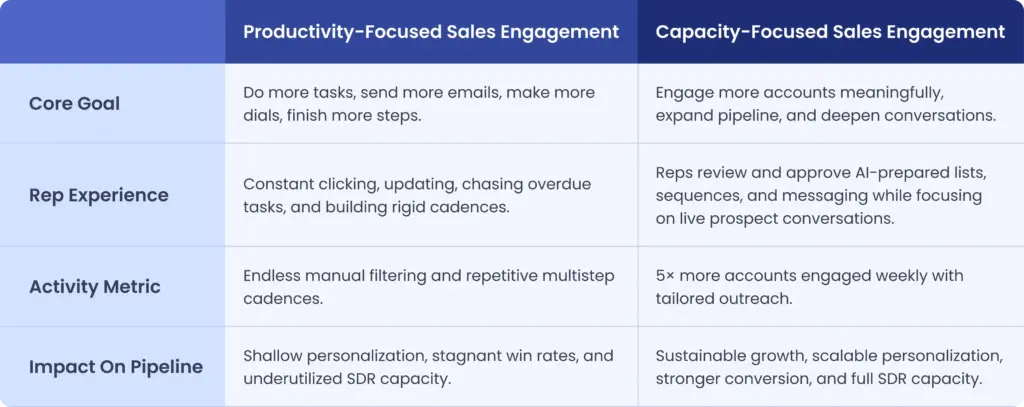
The biggest problem with traditional sales engagement softwares is that they leave SDR capacity underutilized.
These platforms were built around productivity, tracking activities like emails sent, calls made, or tasks completed, rather than helping reps engage the right accounts.
Because of this, SDRs spend much of their time on low-value work.
They run endless filters to build lists, drop prospects into rigid sequences, and manually update CRMs, all while struggling to decide which accounts actually deserve attention. Instead of amplifying their ability to sell, these tools reduce reps to task executors.
When capacity is trapped in admin work, SDRs can’t spend their time where it matters, having conversations with the right prospects and building a stronger pipeline.
Productivity-based SEPs don’t just slow down progress; they keep sales teams from realizing the true potential of their people.
Capacity vs Productivity – The Real Shift When Choosing a Sales Engagement Software
What to Look For in a Modern Sales Engagement Software
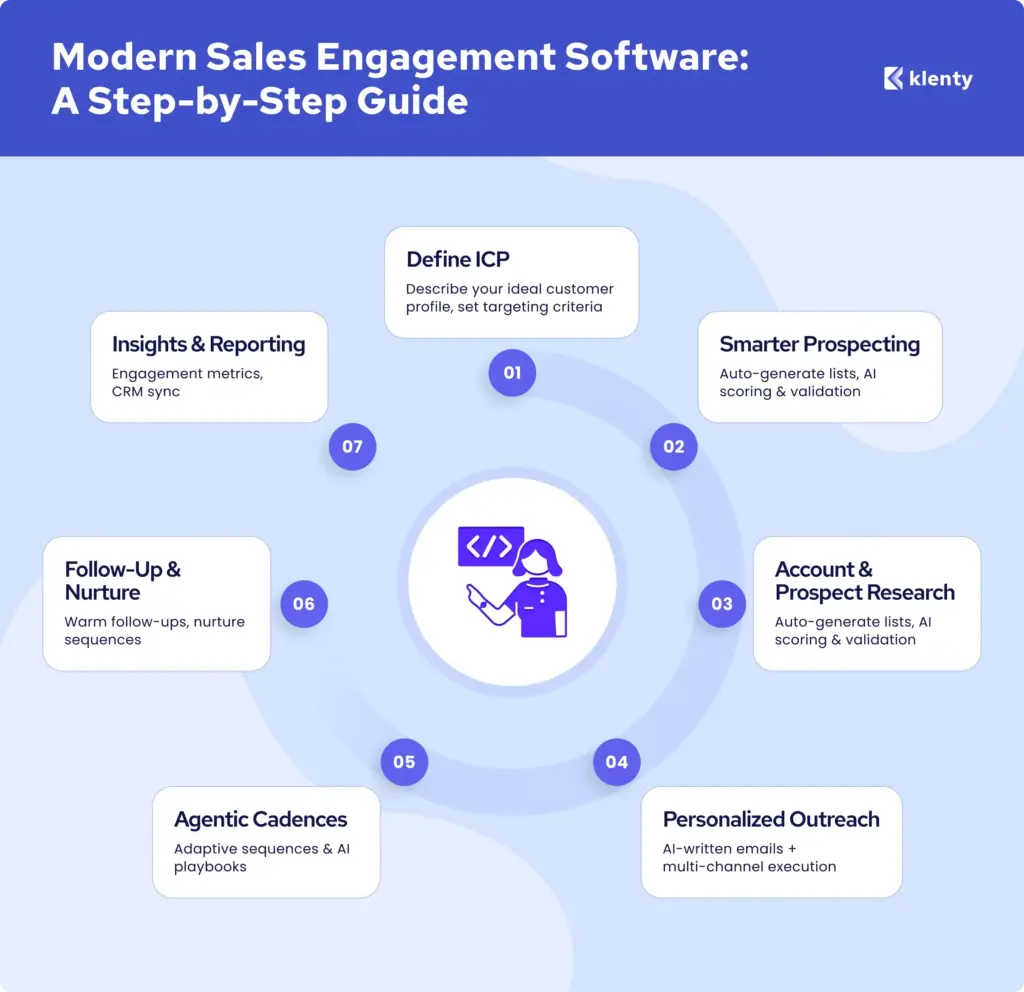
Choosing a Sales Engagement Software isn’t about “how many steps can I run” anymore. A modern software should help your team engage more accounts without adding busywork.
The right software guides reps on who to reach out to, how to engage them, and when to follow up, while keeping every interaction connected back to your CRM.
Here’s how to evaluate if a platform is actually built to increase rep capacity:
1. Does it have multi-channel capabilities?
Multi-Channel Execution: True engagement happens across email, LinkedIn, and calls. The right platform blends all three into one cadence, covering cold outreach, warm follow-ups, and longer nurture sequences.
2. Does it allow me to consolidate my outbound tech stack?
Account & Prospect Research: A modern platform must compile insights like funding rounds, tech stack, hiring trends, and decision-maker details. That way, every outreach starts with context, not guesswork.
Dialer Flexibility: The platform must give teams control with single-line, power, or parallel dialing depending on the campaign.
Deliverability Setup: Done-for-you domain warm-up, rotation, and safeguards ensure emails land in the inbox, not spam.
3. Does it let me build precise ICP lists?
ICP Identification & List Building: Instead of wasting hours on filters and static CSVs, the platform should let you describe your ICP in plain English and instantly generate fresh account lists.
These lists must update continuously as new prospects matching your ICP appear.
List Refinement & Validation: AI should de-duplicate, score, and enrich accounts before reps ever touch them. This ensures SDRs only focus on the most relevant prospects.
4. Does it let me engage prospects without friction once you build the list?
AI-Written, Personalized Emails: Reps shouldn’t have to start from scratch. The platform should generate copy in your brand tone, personalized with research-backed variables like LinkedIn summaries, job changes, or account-level insights.
5. Does it help my reps prioritize the high-impact actions for the day?
Agentic Cadences & Playbooks: Every outbound scenario can have its own unique playbook: at the cadence level, step level, or even call level.
Sequences adapt automatically to prospect behavior (opens, replies, booked meetings), with triggers and actions moving hot leads into immediate follow-ups while colder leads shift into AI-written nurture playbooks.
6. Is it built for standardized execution or does the platform support custom strategy for every account?
Custom Playbooks: A modern platform must support flexibility so that every account can have its own unique engagement strategy, rather than forcing one-size-fits-all cadences.
7. Does it help execution or put burden of execution on my reps?
CRM Sync & Reporting: Every open, click, call note, and cadence step should sync instantly to your CRM.
Detailed reporting helps sales leaders see which accounts engage, which messages perform, and where to optimize, removing manual work from reps’ plates.
8. Is it making my reps do more work for the sake of work or is it improving their capacity to actually engage accounts?
A modern Sales Engagement Software should surface the right accounts, prepare the research, personalize the message, execute across channels, and keep your CRM fully updated. Reps spend their hours where revenue happens: talking to prospects.
How Klenty’s Sales Engagement Software Multiplies Rep Capacity
Most teams lose hours because the tools they use force them into low-value work. Endless filtering, copy-pasting, and chasing overdue steps keep SDRs locked in screens instead of in front of prospects.
Klenty’s Sales Engagement Software is built to flip that equation: its AI removes the grunt work and gives reps ready-to-go accounts, insights, and messaging so they can engage five times more accounts every week.
1. Who to Reach Out To — AI List Building & Refinement
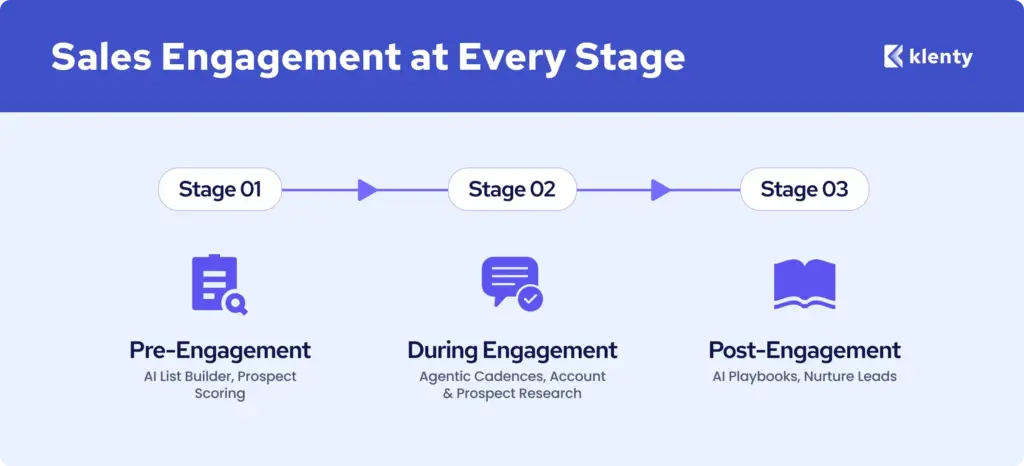
In most sales motions, teams waste hours figuring out which accounts to prioritize and which stakeholders to contact. Klenty flips that by automating every stage of the process: pre-engagement, during engagement, and post-engagement, so reps can stay focused on conversations instead of admin.
- Pre-Engagement: Klenty’s AI List Builder auto-generates account lists based on your ICP, validates contact details, removes duplicates, and ranks prospects by fit and intent.
Reps don’t spend time building static lists or cleaning data; they simply approve a prioritized account queue. - During Engagement: With AI Multi-Threading, Klenty identifies and maps multiple decision-makers and influencers inside each account.
Instead of relying on a single contact, reps can engage the full buying committee, increasing the chances of advancing deals. - Post-Engagement: As soon as intent signals surface, AI Playbooks step in. Hot prospects are automatically routed into tailored follow-up strategies, whether that’s a meeting sequence, leadership-level messaging, or a nurture flow, ensuring no opportunity slips through the cracks.
By structuring prospecting around these three stages, Klenty ensures reps always know who to reach, how to engage them, and how to follow up.
2. Go From Standard Process to Custom Process for Each Account
Traditional SEPs push every account through the same fixed sequence. Klenty shifts this with AI-driven workflows that adapt to each account, so no two processes look the same.
Agentic Cadences : Reps can use AI in three ways, generate entire cadences personalized to each account, create specific email or research steps inside a cadence, or insert account and prospect research directly into templates using AI Variables.
Instead of manually drafting sequences, reps just review and approve AI-prepared work.
Unique Playbooks for Every Outbound Scenario: Every outbound situation, whether cold outreach, follow-ups, or stalled conversations, gets its own AI-generated playbook.
Reps no longer rely on static templates but execute strategies designed for the specific scenario at hand.
Custom Scenarios With Triggers & Actions: At the cadence, step, or call level, AI can execute different actions depending on prospect engagement.
For example, a reply might trigger a change in sequence, a call outcome can schedule the next step, and unresponsive prospects can be routed into new actions automatically.
Nurture Playbooks Written by AI: For prospects who aren’t ready yet, AI-generated nurture playbooks keep engagement alive.
These ensure cold or inactive accounts continue receiving relevant, contextual touches until the timing is right.
With these layers working together, sales teams move from a standardized, one-size-fits-all process to a custom outbound strategy for each account, executed at scale.
3. From Manual Tasks to AI-Driven Execution
Even with the right lists and playbooks, SDRs often get stuck in the mechanics of sending, researching, and dialing.
Klenty removes this layer of busywork, turning reps into approvers of AI-prepared workflows.
Agentic Cadence: Instead of manually pushing every step, AI executes the cadence end-to-end. Reps only step in to approve or adjust, while the system handles sending, branching, and follow-ups automatically.
Account and Prospect Research: Klenty compiles research at the account and prospect level, funding updates, tech stack, leadership changes, and contextual signals, so reps walk into every conversation informed, without hours of prep.
Business Case Building: AI prepares a clear business case for every account, showing why outreach is relevant now. This helps SDRs lead with value, not generic pitches, and focus conversations on the prospect’s priorities.
Parallel & Power Dialer: Calling isn’t a bottleneck anymore. Reps can switch between Power and Parallel dialing modes depending on their campaign, balancing speed with personalization while still keeping full context for every call.
With these capabilities, the heavy lifting shifts to AI. Reps spend their time approving, engaging, and conversing, not on repetitive tasks that slow pipeline growth.
Customer Success Stories
PipeCandy increased response rates by 300%.
Before using Klenty, PipeCandy struggled with low email deliverability. Their SDRs spent hours on manual data entry and lacked detailed reports to test and improve outreach.
After switching to Klenty, emails consistently landed in inboxes, SDRs saved over 10 hours every week, and detailed cadence reports showed where prospects engaged. This visibility allowed the team to experiment confidently, and response rates improved by 300%.
Read the full story →
Customeer booked more meetings than ever before.
Customeer’s sales team found it hard to connect with prospects at scale and lacked a way to tailor messages to different intent levels.
With Klenty’s Intent Playbooks, prospects were classified based on buying intent and automatically routed into the right cadence. Hot leads received immediate, focused follow-ups, while colder prospects were nurtured with longer sequences. As a result, each rep booked up to five meetings per week.
Read the full story →
Conclusion
Is your current sales engagement software just helping your team be more productive, or is it actually unlocking their capacity to engage more accounts and build pipeline?
If you’ve followed this guide, you now understand why picking the right sales engagement software is more about freeing your SDRs from repetitive tasks and giving them the capacity to have real conversations that build a pipeline.
The right Sales Engagement Software helps you engage prospects, build a pipeline, and grow revenue. It automates the busywork, provides AI-driven intelligence at every stage, and helps your reps focus on what matters: talking to prospects and closing deals.
Klenty’s Sales Engagement Software drives rep capacity in three distinct ways: AI List Building simplifies pre-engagement by surfacing and refining the right accounts, so SDRs start with a clean, prioritized pipeline.
Agentic Cadences transform engagement by creating unique, account-specific strategies and automating execution across channels, allowing reps to focus on live conversations instead of manual steps.
Finally, AI Playbooks adapt post-engagement by analyzing prospect behavior and moving them into the right follow-ups, ensuring no opportunity slips through the cracks.
If you’re ready to move beyond activity metrics and unlock true sales capacity, it’s the right time to experience Klenty for yourself.
About the Author