- Traditional SDR metrics measure activity, not progress. Metrics like calls made, emails sent, and meetings booked track effort, but in account-based selling the real unit of measurement is the account, not individual touchpoints.
- Contact-to-S2 and Account-to-S2 are the key efficiency ratios. These metrics reveal how effectively your team converts outreach effort into qualified opportunities rather than simply measuring how busy they are.
- Four core metric categories define ABS performance: Account Coverage, Account Progression, Engagement Quality, and Pipeline replace traditional vanity dashboards and give a clearer view of pipeline health.
- Persona Coverage Rate and Multi-Threading Score show real engagement depth. These metrics reveal whether your team is engaging key decision-makers or only interacting with the most responsive contacts.
- Meeting Hold Rate and Pipeline Acceptance Rate signal qualification discipline. These metrics help determine whether booked meetings are actually progressing toward real sales opportunities.
- Klenty supports the entire ABS workflow. From ICP list building to account-level reporting, Klenty enables teams to focus on measuring outcomes and pipeline impact instead of just activity.
If you are still celebrating "100 dials today!" or "50 emails sent!" while your pipeline sits empty, this blog is for you.
Account-Based Selling (ABS) fundamentally changes what you measure. The old playbook of tracking calls, emails, and meetings booked? That is volume thinking in a world that rewards precision.
This is your field manual for the metrics that actually drive pipeline in account-based selling. You will get the frameworks, benchmarks, and tracking systems that top-performing SDR teams use to crush quota.
Why Traditional SDR Metrics Fail in Account-Based Selling
Let us be honest: most SDR dashboards are vanity metric factories.
Traditional SDR metrics look like this:
- Calls made: 80/day
- Emails sent: 100/day
- Meetings booked: 3/week
- Connect rate: 12%
- Reply rate: 4%
These numbers tell you how busy your team is. They do not tell you if you are making progress on the accounts that matter.
What Top-Performing SDR Teams Track Differently
Most SDR teams track volume - calls, emails, meetings, and pipeline. But the top-performing ones track efficiency. Specifically, two ratios: how many contacts in an account do you touch before a qualified opportunity? And how many accounts does it take to generate one?
Those two numbers let you spot your top performers instantly, set data-backed goals, and give every rep a clear path to success. Volume still matters. But efficiency is where world-class SDR teams are built.
Here is the core problem: in account-based selling, the unit of measure is the account, not the activity. When you are working a defined list of 50–200 high-value accounts instead of blasting thousands of prospects, success is no longer about volume. It is about:
- Account progression - Are target accounts moving through stages?
- Buying committee coverage - Are you reaching mobilizers and decision-makers?
- Pipeline quality - Are meetings converting to qualified opportunities?
- Multi-threading - Are multiple stakeholders engaged per account?
| Transactional Outbound | Account-Based Selling | |
|---|---|---|
| Who you target | One contact at a time | The full buying group, mapped by role and influence |
| What you measure | Dials made and emails sent | Pipeline generated per account |
| How you engage | One-off touchpoints that stop when the sequence ends | Coordinated, multi-stakeholder outreach that builds over time |
| What success looks like | Meetings booked | Qualified opportunities with multiple stakeholders engaged |
The Efficiency Metrics That Actually Predict Pipeline
This is a rep's full metrics scorecard that gives us a ground-level look at what these numbers actually look like in practice for a non-ramped SDR running an account-based motion:
| Metric | Rep Result |
|---|---|
| Accounts Touched (Outreach) | 622 |
| Contacts Touched | 1,065 |
| Contacts Touched Per Account | 3.0 |
| Calls | 4,136 |
| Connected | 323 |
| Connect Rate | 7.81% |
| Conversations (>1 min) | 126 |
| Conversation % | 39.01% |
| Meetings Booked | 58 |
| Meetings Held | 41 |
| Hold Rate | 71% |
| Meetings Accepted (S2) | 38 |
| Acceptance Rate | 93% |
| Contact to S2 | 3.57% |
| Account to S2 ← THE KEY RATIO | 8.28% |
| Ramp | No (not yet ramped) |
The key insight: The two ratios that tell you everything are Contact-to-S2 and Account-to-S2. These are efficiency metrics; they measure how well you convert your effort into a qualified pipeline, not just how much effort you put in.
The Missing Layer: Who Are Your Calls Actually Going To?
The scorecard shows 4,136 calls made. But here is the question most teams never ask: of those 4,136 calls, what was the persona breakdown? Were they going to executives, mobilizers, or user-level contacts?
This matters enormously. An SDR making 4,000 calls but directing 70% of them at users and individual contributors will have a low Account-to-S2 rate, not because of poor effort, but because they are calling the wrong people.
The Account-Based Selling Metrics Framework
Account-based selling metrics fall into four categories, each answering a specific question about your motion:
| Metric Category | Question It Answers | What You Optimize For |
|---|---|---|
| Account Coverage Metrics | Are we reaching the right people? | Buying committee penetration, stakeholder diversity |
| Account Progression Metrics | Are accounts moving through our funnel? | Stage conversion rates, velocity by tier |
| Engagement Quality Metrics | Are our interactions creating momentum? | Meeting completion, response depth, next-step commitment |
| Pipeline Metrics | Is our ABS motion creating qualified revenue? | Pipeline acceptance rate, ACV by source, win rate by tier |
1. Account Coverage Metrics: Are You Reaching the Right People?
Traditional outbound is built around the individual. You find a contact, run them through a sequence, and move on. Account-based selling requires a fundamentally different mental model: the account is the unit of work, not the person.
Gartner research consistently shows that B2B purchase decisions involve multiple stakeholders, often six or more, depending on deal size and organizational complexity.
That means a single conversation, no matter how good, represents an incomplete picture of how the buying decision will actually be made. When your entire strategy rests on one relationship inside an account, you are exposed the moment that person goes quiet, changes roles, or simply does not have the authority you assumed they had.
Also read: Top 20 Account-Based Selling Tools
A) Contacts Per Account
This measures how many unique people you are engaging with in each account. Real-world data from a non-ramped SDR scorecard shows 3.0 contacts per account across 622 accounts, a solid starting baseline. For accounts where you are actively buildinga pipeline, push for 4–7.
| Contacts Per Account = Total Unique Contacts Engaged ÷ Total Active Accounts |
B) Persona Coverage Rate
Target: 70%+ of key personas engaged per account
Coverage volume is not the same as coverage quality. This metric forces a distinction between contacts who are present in the buying process and contacts who actually shape its outcome.
An account where you have had ten conversations with individual contributors but zero engagement with VP-level or C-level stakeholders is not well-covered; it is well-socialized but structurally underserved. Persona Coverage Rate measures how well your outreach maps to the decision-making hierarchy, not just the most reachable layer of the org chart.
| Persona Coverage Rate = (Key Personas Engaged ÷ Key Personas Identified) × 100 |
| Account | Economic Buyer | Mobilizer | End User | Coverage % |
|---|---|---|---|---|
| Account A | ✓ Engaged | ✓ Engaged | ✓ Engaged | 75% |
| Account B | ✗ Not reached | ✓ Engaged | ✓ Engaged | 50% |
| Account C | ✓ Engaged | ✗ Not reached | ✓ Engaged | 50% |
If persona coverage is below 60%, you are likely experiencing longer sales cycles, lower win rates, and more ghost situations when your one contact goes dark.
C) Multi-Threading Score
Target: 2+ active threads per account
This measures how many simultaneous conversations you are having in an account. One conversation means one thread. Three different stakeholders actively engaged means three threads.
For tracking purposes, a thread is considered active when the stakeholder has engaged within a defined recency window - a reply, a completed meeting, or a scheduled next step within the past two weeks.
Multi-Threading Score = Active Conversations Per Account
| Account | Active Threads | Thread Owners | Risk Level |
|---|---|---|---|
| Account A | 4 | VP Sales, Dir Ops, SDR Manager, AE | Low |
| Account B | 2 | Director RevOps, Manager SDR | Medium |
| Account C | 1 | SDR only | High — deal at risk |
2. Account Progression Metrics: Are Accounts Moving Forward?
Coverage metrics tell you who you are reaching. Progression metrics tell you if those conversations are actually advancing accounts through your funnel.
| Target Accounts → Engaged → Working → Meeting → Opportunity → Won |
A) Stage Conversion Rates
| Conversion Rate = (Accounts Progressed to Next Stage ÷ Accounts in Previous Stage) × 100 |
| Stage Transition | Benchmark | What Good Looks Like | What Poor Looks Like |
|---|---|---|---|
| Target → Engaged | 25–40% | 30%+ with a strong ICP fit | <20% = poor targeting or weak messaging |
| Engaged → Working | 50–70% | 60%+ with systematic follow-up | <40% = weak follow-up discipline |
| Working → Meeting | 40–60% | 50%+ with strong discovery | <30% = wrong personas being engaged |
| Meeting → Opportunity | 30–50% | 40%+ with tight qualification | <25% = unqualified meetings booked |
| Opportunity → Won | 25–35% | 30%+ in focused account motions | <20% = weak account plans |
B) Account Velocity by Tier
| Average Days in Stage = Sum of Days in Stage for All Accounts ÷ Number of Accounts |
| Account Tier | Target → Meeting | Meeting → Opp | Opp → Won |
|---|---|---|---|
| Tier 1 (Enterprise) | 30–45 days | 14–21 days | 60–90 days |
| Tier 2 (Mid-Market) | 21–30 days | 10–14 days | 30–60 days |
| Tier 3 (SMB / Exploration) | 14–21 days | 7–10 days | 21–30 days |
Tier 1 accounts naturally move more slowly - more stakeholders, longer evaluation, higher security scrutiny. Tier 3 accounts should move fast. If they are stalling, they are not real opportunities.
C) Account Activation Rate
An account is activated when your SDR team has hit a minimum threshold: at least 5 unique contacts attempted, at least 3 personas engaged, and at least 10 total touches across email, call, and LinkedIn. One email to one person is not working on an account.
| Activation Rate = (Accounts Meeting Threshold ÷ Total Target Accounts) × 100 |
| SDR | Assigned Accounts | Accounts Activated | Activation Rate |
|---|---|---|---|
| Alex | 50 | 40 | 80% ✓ Excellent |
| Mike | 50 | 25 | 50% ⚠ Needs work |
| Jessica | 50 | 35 | 70% ✓ On track |
3. Engagement Quality Metrics: Are Interactions Creating Momentum?
You can have high activity and strong coverage and still lose deals if engagement quality is poor. Quality metrics measure whether your outreach is creating real conversations, uncovering pain, and earning next-step commitments.
A) Meeting Hold Rate
This measures how many booked meetings actually happen. Real-world data from a non-ramped SDR shows 41 out of 58 booked meetings held - a 71% hold rate. That is your baseline for someone still ramping. A fully ramped SDR with strong qualifications should be hitting 80–90%.
| Hold Rate = (Meetings Held ÷ Meetings Booked) × 100 |
| Hold Rate | What It Signals | Common Cause | Fix |
|---|---|---|---|
| 90%+ | Excellent qualification | Strong ICP fit, clear context set | Keep doing what you are doing |
| 80–90% | Good – normal range | Solid follow-through | Optimize confirmation cadence |
| 70–80% | Needs improvement | Weak qualification or no reminders | Tighten pre-meeting confirmation |
| Below 70% | Poor – non-ramped baseline | Wrong personas booked or no context set | Rebuild qualification criteria |
B) Pipeline Acceptance Rate (S2 Acceptance)
Real-world data shows a non-ramped rep getting 38 out of 41 held meetings accepted as qualified opportunities - a 93% acceptance rate.
That is an elite-level qualification. It means that when the meeting happened, the account was genuinely ready for sales to take over.
| Acceptance Rate = (Meetings Accepted as S2 ÷ Meetings Held) × 100 |
| Month | Meetings Held | Accepted (S2) | Acceptance Rate |
|---|---|---|---|
| January | 15 | 14 | 93% |
| February | 14 | 13 | 93% |
| March | 12 | 11 | 92% |
C) Next-Step Commitment Rate
After every interaction - call, email reply, or meeting, did the prospect commit to a concrete next step? Vague responses are not commitments.
| Next-Step Rate = (Interactions with Clear Next Step ÷ Total Interactions) × 100 |
| Counts as Commitment ✓ | Does NOT Count ✗ | Your Move |
|---|---|---|
| "Let's talk on Thursday at 2 pm." | "Send me some info." | Push for a specific day and time |
| "I'll intro you to our VP Sales." | "Let me think about it." | Ask: Who else should be on this call? |
| "I'll review with the team by Friday." | "Circle back next quarter." | Pin it to a date, or it is not real |
4. Pipeline Metrics: Is ABS Creating Qualified Revenue?
All the coverage, progression, and engagement metrics lead to one question: Are you creating a pipeline that closes?
A) ACV by Source
| Average ACV = Total Contract Value ÷ Number of Deals (segment by source) |
| Source | Average ACV | What It Signals |
|---|---|---|
| Account-Based (Tier 1) | $80K–$150K+ | Deep research + multi-threaded outreach leads to larger deal sizes |
| Account-Based (Tier 2) | $40K–$80K | Strong product-market fit with shorter sales cycles |
| Inbound (Self-serve) | $10K–$30K | Smaller deal sizes but typically faster close velocity |
| Referrals | $50K–$120K | High intent buyers with strong close rates |
B) Win Rate by Account Tier
| Win Rate = (Deals Won ÷ Total Opportunities) × 100 (segment by tier) |
| Account Tier | Win Rate | Why? |
|---|---|---|
| Tier 1 (High-value, strong fit) | 30–40% | Deep research, multi-threaded engagement, and strong ICP alignment |
| Tier 2 (Mid-value, good fit) | 25–35% | Solid product fit but with less strategic investment compared to Tier 1 |
| Tier 3 (Exploration) | 15–25% | Testing new markets, segments, or less validated ICP assumptions |
Cold Call and Warm Call Scripts for Each Metric
Here are four scripts, each designed to move a specific metric. Use them as frameworks - adjust for your product and persona.
Script 1: Coverage Play - Mapping the Buying Committee
Script 1: Coverage Play — Mapping the Buying Committee
Goal: Increase Contacts Per Account and Persona Coverage Rate
Context: You have already spoken to a user-level contact. Now you need to find the mobilizer.
Hi [Name], [Your Name] here from [Company]. We spoke recently about [pain point] - I appreciated the context you shared. Based on that conversation, I want to make sure I am talking to the right people on your end. Who typically owns [initiative/function] decisions at [Company]? I want to make sure whoever that is has the same information we discussed.
That would be [Name/Title]
That is helpful. Is [Name] actively driving this initiative right now, or is it more of a horizon item for later this year?
Script 2: Progression Play - Moving Engaged to Working
Script 2: Progression Play — Moving Engaged to Working
Goal: Improve Engaged → Working conversion rate
Context: They replied to your email but did not commit to a meeting.
Hey [Name], [Your Name] here. I saw you replied to my note about [pain point]. Appreciate you taking the time. Here is why I am following up - most [persona] teams I talk to are dealing with [specific challenge], and I wanted to see if that is something you are running into too?
Got it. What is the impact of that on your team right now? Is this slowing down [outcome] or creating extra work somewhere?
Script 3: Engagement Quality Play - Securing the Next Step
Script 3: Engagement Quality Play — Securing the Next Step
Goal: Increase Next-Step Commitment Rate and Hold Rate
Context: End of discovery call. Pain uncovered. Do not let them leave without a commitment.
"Okay [Name], here is what I am hearing: [summarise pain in 1–2 sentences]. And it sounds like this is costing you [time/money/efficiency]. Did I get that right?"
"Yeah, that is accurate."
"Cool. Here is what makes sense as a next step - I want to get you on a call with [AE/SE] who can walk through exactly how we solved this for [similar company]. They will show you the actual workflow. Does [specific day/time] work for 30 minutes?"
"I get it, calendars are packed. What if I send you a few options and you pick what works? I just want to keep momentum while this is top of mind."
Script 4: Pipeline Quality Play - Qualifying Before You Book
Script 4: Pipeline Quality Play — Qualifying Before You Book
Goal: Increase Acceptance Rate (S2) and Account-to-S2 ratio
Context: They want a demo. Qualify hard before you book - this is how top reps hit 93% acceptance rates.
"I appreciate the interest, [Name]. Before I get [AE] on the calendar, quick questions so I am not wasting your time or theirs. First: What is driving this conversation right now? Is there a specific initiative or deadline making this a priority?"
"Got it. Second: if you saw a solution that solved [pain], who else besides you would need to weigh in on the decision?"
"Last one: are you actively evaluating other tools, or is this more exploratory at this stage?"
How Klenty Helps You Execute and Measure Account-Based Selling
Knowing the right metrics is step one. Executing the motion that produces those metrics consistently - that is where most teams fall short. Klenty is built specifically to help sales teams develop accounts into qualified pipeline through account-based orchestration.
Unlike traditional sales engagement tools that focus on prospect-level outreach, Klenty is designed to execute account-level strategies, enabling you to multi-thread across buying committees, maintain context across every conversation, and systematically progress accounts through stages.
Here is how Klenty enables account-based execution:
Build Your Target Account Universe
ICP Account Mapping and List-Building
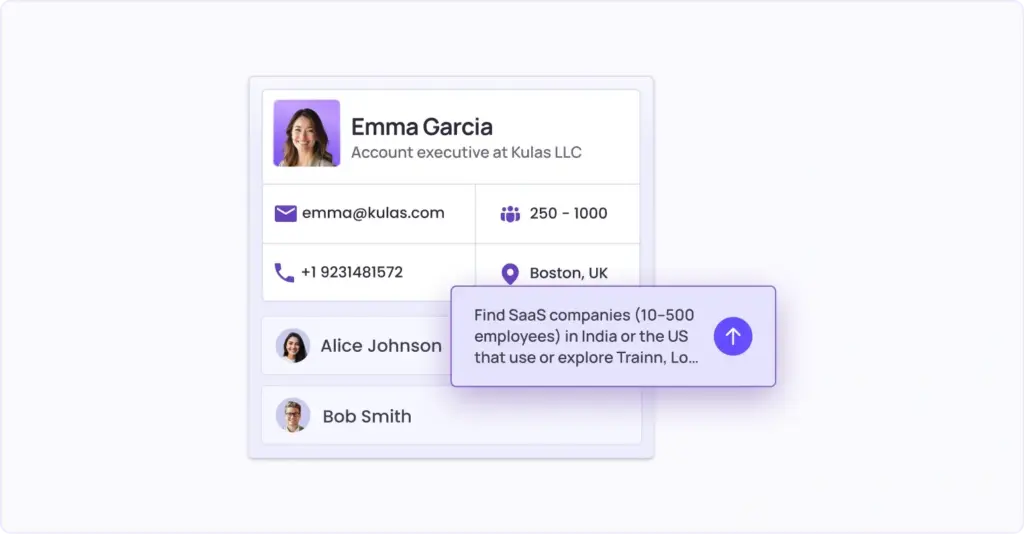
Describe your ICP in natural language and build your target account list in seconds. AI-powered account discovery eliminates manual research and ensures you are targeting the right accounts from day one, so your reps spend time on accounts that actually convert, not on building spreadsheets.
Orchestrate Coordinated Engagement Across Buying Committees
Account Action Window
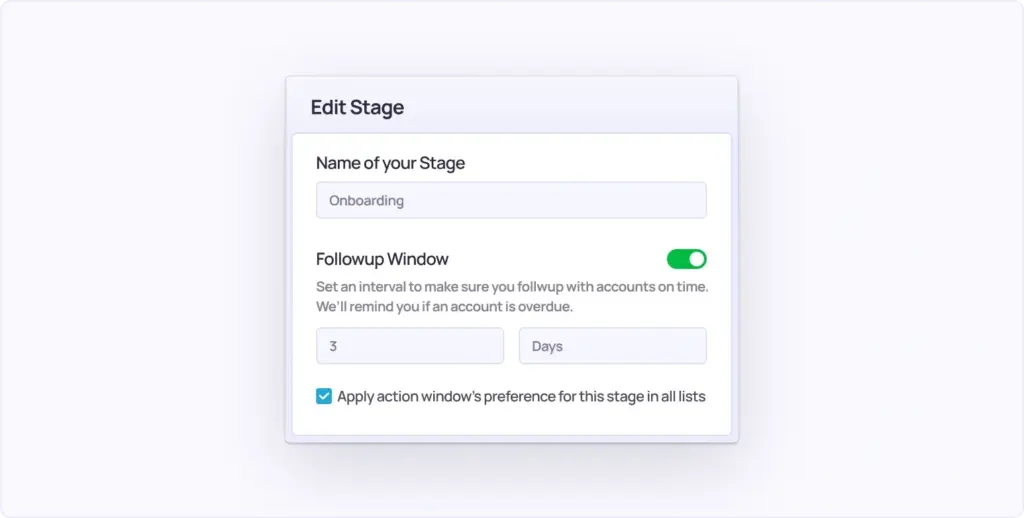
Every target account is at a different stage in its buying journey. Some need urgent action and immediate follow-up to turn into an opportunity - they are in-market. Others need more time, a longer nurture cycle before they are ready to talk to sales.
The problem is that all account actions pile up on your dashboard, leaving no room for prioritization. With traditional sales engagement tools, there's never been a way to control the velocity of rep execution against a set of accounts.
Account Action Windows changes that.
Choose the time period within which actions need to be taken for accounts in each stage. Klenty alerts you when they are overdue. The deeper an account is in its buying journey, the faster reps execute - systematically progressing cold accounts toward an opportunity by following up at set intervals.
Here is what you can do with Account Action Windows:
- Set the frequency, messaging, and channels for every prospect in an account to be engaged.
- Control the velocity of rep execution based on where each account sits in the buying journey.
- Ensure coordinated outreach across the entire buying committee so emails, calls, and LinkedIn touches hit the right people at the right time, not in random bursts.
- Get alerted when action windows are overdue so no account slips through the cracks.
Outreach Methodology (Multi-Threading)
Enforce adherence to top-down, bottom-up, or custom multi-threading workflows. Systematically engage executives, mobilizers, and users within each account based on your preferred approach, ensuring no key stakeholder is left untouched, and every account gets full buying committee coverage.
AI Next Step Execution
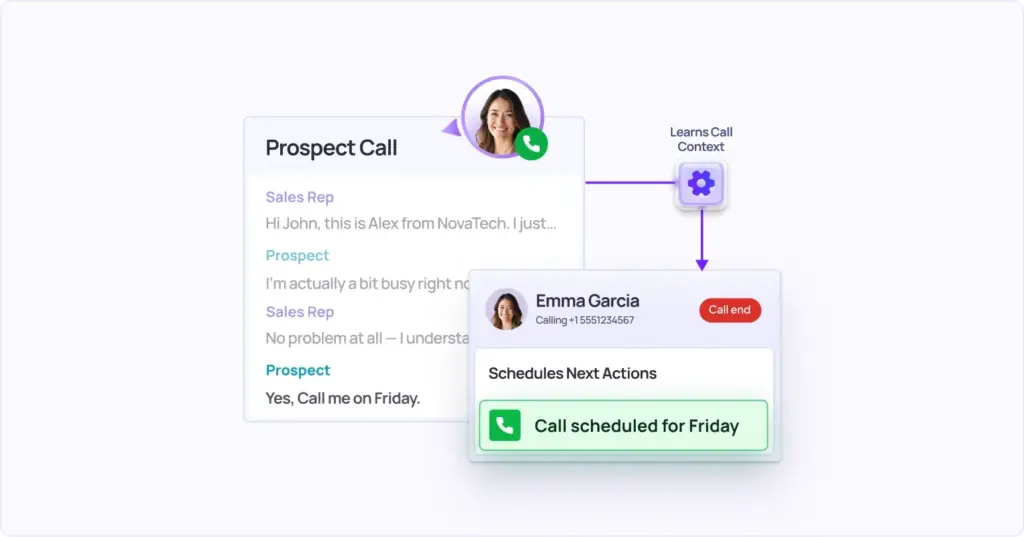
Klenty’s Action AI listens to your sales conversations, understands what was discussed on the call, and intelligently generates the next action. You can focus on dialing, not managing next steps, execute the right tasks at the right time, and save time with auto-generated follow-up messaging.
Time-Based Next Actions
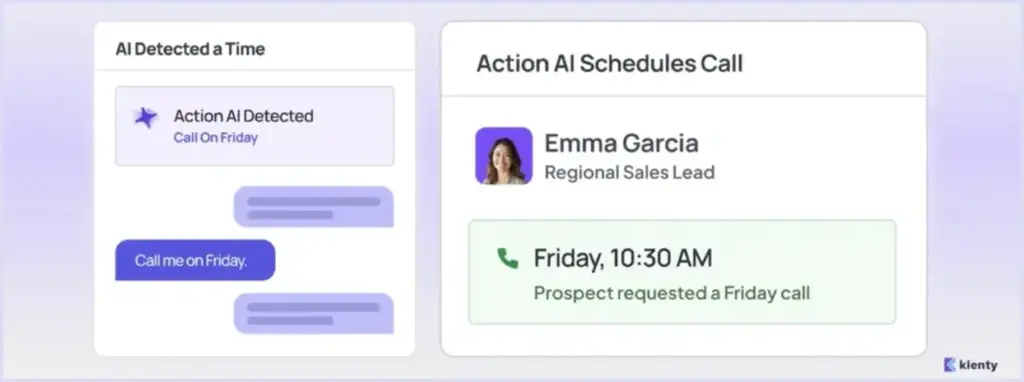
Prospect says, “Call me on Friday.” → Action AI schedules a call for Friday with the prospect.
Channel-Based Next Actions
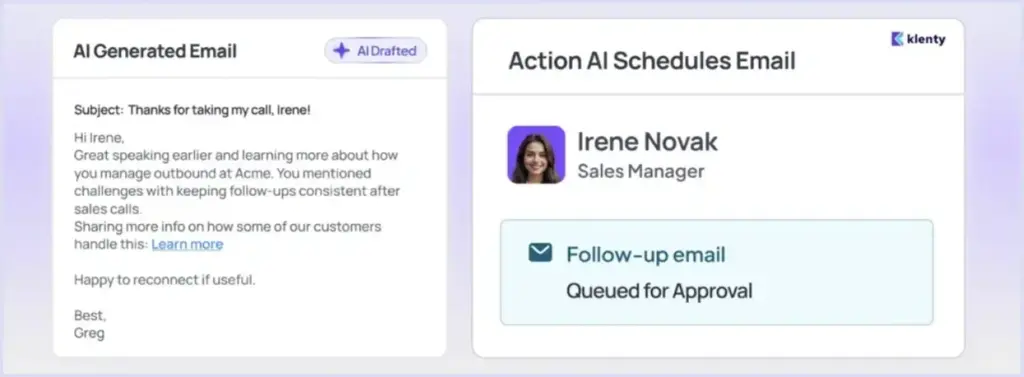
Prospect says, “Send me an email.” → Action AI creates a personalized email and queues it up for approval.
Context-Based Next Actions
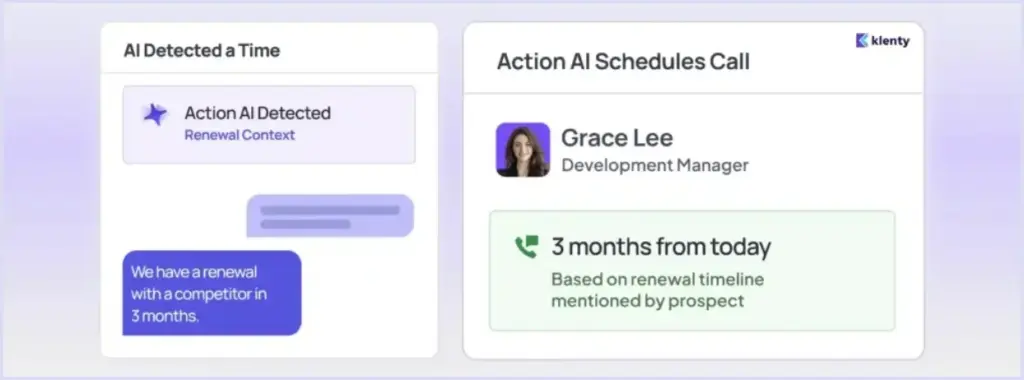
Prospect says, “We have a renewal with a competitor in 3 months.” → Action AI schedules a call in 3 months with a call context.
Account Playbooks
Not all accounts are alike. Only 3% of your cold accounts are in-market at any given time; the rest need outreach that adapts to their needs, timing, and fit.
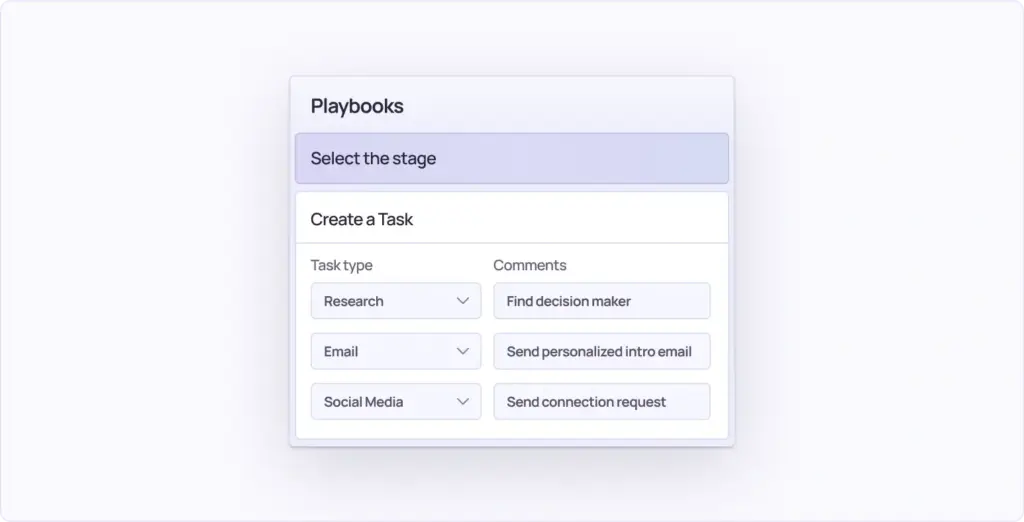
Traditional sales outreach tools are built purely for demand capture, leaving the other 97% of accounts without a structured way to be nurtured toward a buying decision.
Account Playbooks are built for both - helping you capture demand and create it.
Trigger the Right Play at the Right Stage
Set entry and exit criteria for each account stage and define the activities that need to happen as soon as accounts meet the criteria - across emails, calls, and tasks. When accounts show specific signals or reach certain stages, the right plays trigger automatically, so your team responds to buying intent in real time instead of discovering it weeks later in a pipeline review.
Control Velocity and Urgency of Execution
Not all stages carry the same urgency. Set Account Action Windows for each stage to control how fast reps execute. For instance, accounts in a "Decision-Maker Contacted" or "Meeting Booked" stage can be set to require execution instantly or within 24 hours, while earlier-stage accounts follow a longer, more measured cadence.
Orchestrate Playbooks Account-by-Account
Label accounts as "interested," "right contact identified," or "good fit, not now," and execute the right sequence of activities for an entire account before moving on to the next. This ensures outreach is coordinated across the entire buying committee - enrolling every prospect in customized follow-ups based on org-wide engagement level, so no account context is lost mid-play.
Account Panel
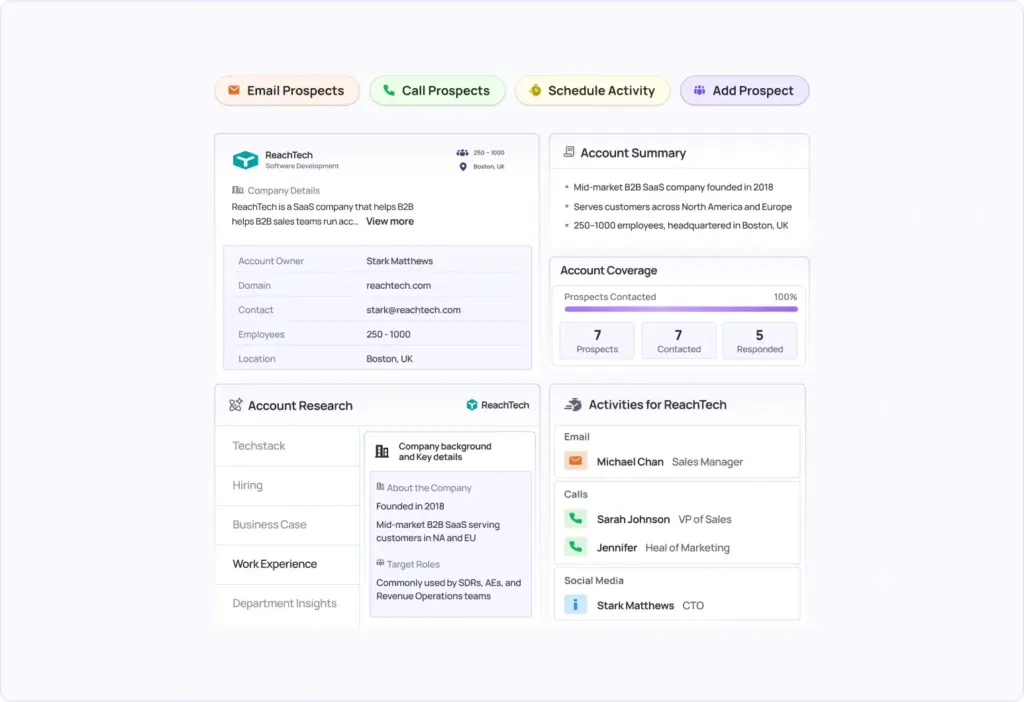
Klenty’s Account Panel helps you to -
Execute Outreach Account-by-Account
Unlike traditional sales engagement tools that are built around individual prospects, the Account Panel lets you group prospects by account and execute emails, calls, and tasks at the account level. Reps can move through research, sending emails, making calls, and finding fresh prospects - all without jumping between tools or losing context mid-execution.
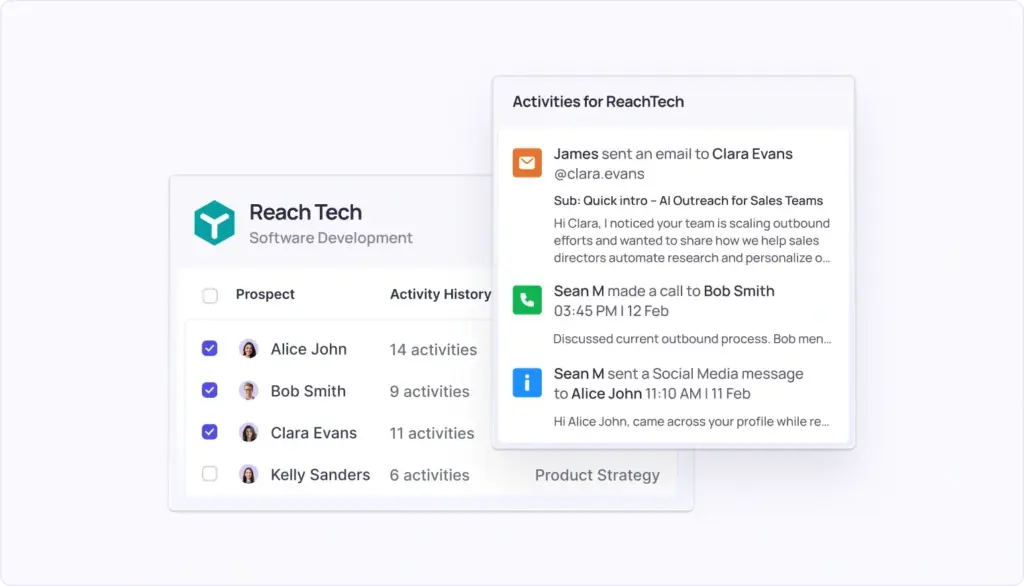
Review the Entire Account's Engagement History
Rather than patching together individual prospect interactions in a spreadsheet, get a consolidated picture of every interaction across all stakeholders in an account, out of the box. Reps walk into every call informed, and managers see the full picture without chasing updates.
Multi-Thread Across the Buying Committee
Know exactly which prospects exist in an account, track coverage across hierarchies, roles, and titles, and add fresh prospects to ensure all relevant stakeholders are being engaged. No contact goes untracked, and no decision-maker falls through the cracks.
Run a Well-Researched, Consultative Sales Process
Basic account details, past conversation summaries, and AI-powered account research insights surface at the moment of dial, so every outreach stays relevant, timely, and specific to the account your rep is working on.
Track Account Progression and Optimize Coverage
Account Stages
Traditional sales outreach tools leave you with an Account Development Gap - you do not know which accounts are moving toward an opportunity and which are stuck, you can't define tailored strategies for each stage, and there's no systematic way to nurture demand across accounts that aren't ready yet.
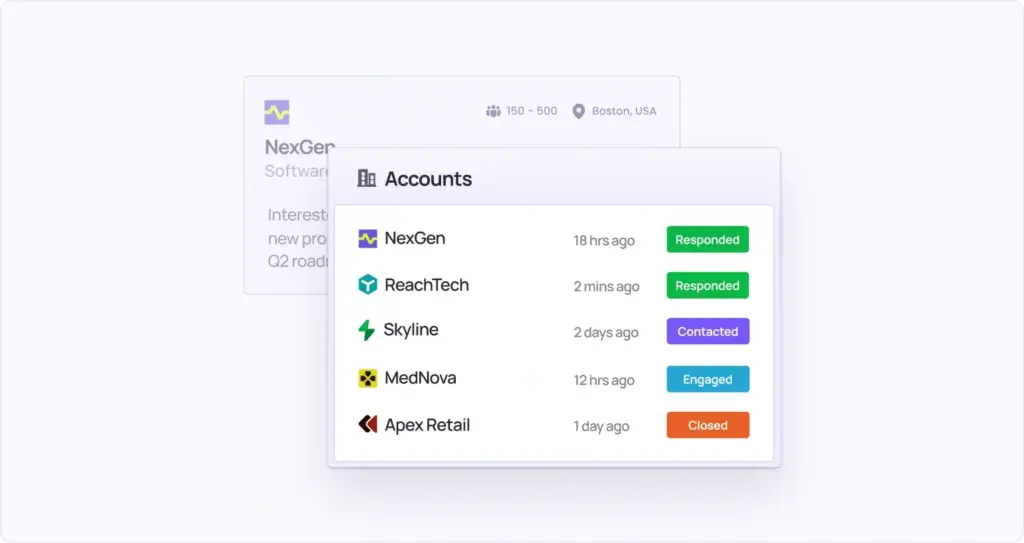
Klenty's Account Stages fixes this with CRM-like stages built specifically for sales outreach.
Define a Custom Pipeline for Account-Based Outreach
Create a custom pipeline for each account list and set up stages that reflect the actual steps accounts go through before turning into an opportunity. Every account has a defined place in the journey; nothing falls into a grey area.
View and Drill Into Accounts at Every Stage
With one click, dig into all accounts sitting at any stage of your pipeline. Drill deeper into account-level details like prospects contacted, notes, next steps, and activity history, all consolidated in a single table view so nothing needs to be chased down manually.
Set Custom Strategies for Each Stage
Define entry and exit criteria for each account stage and prescribe the series of actions that need to happen as soon as an account moves in. Each stage gets its own tailored outreach strategy, so reps always know exactly what to do next, for every account, at every step.
Prescribe the Urgency of Execution at Each Stage
Prevent account rotting. Set deadlines for actions to occur at each stage of the pipeline so accounts at advanced stages get immediate attention, and no high-intent account sits idle waiting for a rep to take action.
Account Coverage Analysis
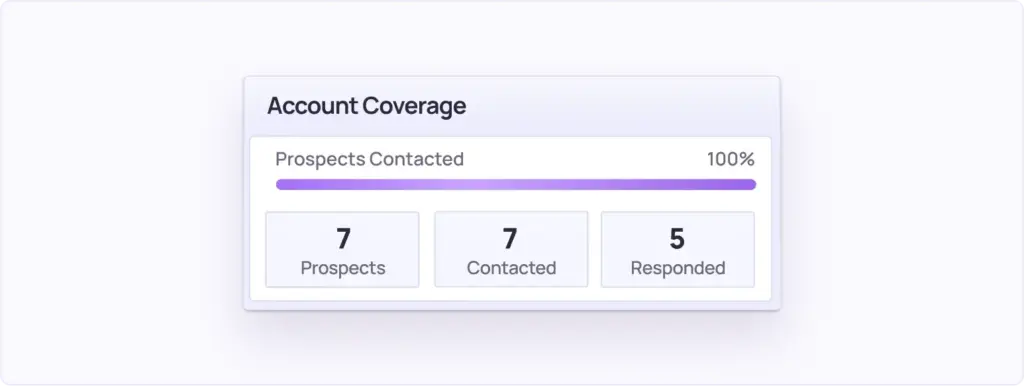
Review the percentage of ICP prospects engaged in any given account and identify gaps for deeper multi-threading. This ensures you are not leaving key stakeholders untouched, the single biggest reason ABS deals stall or die in the pipeline.
Account-Level Reporting
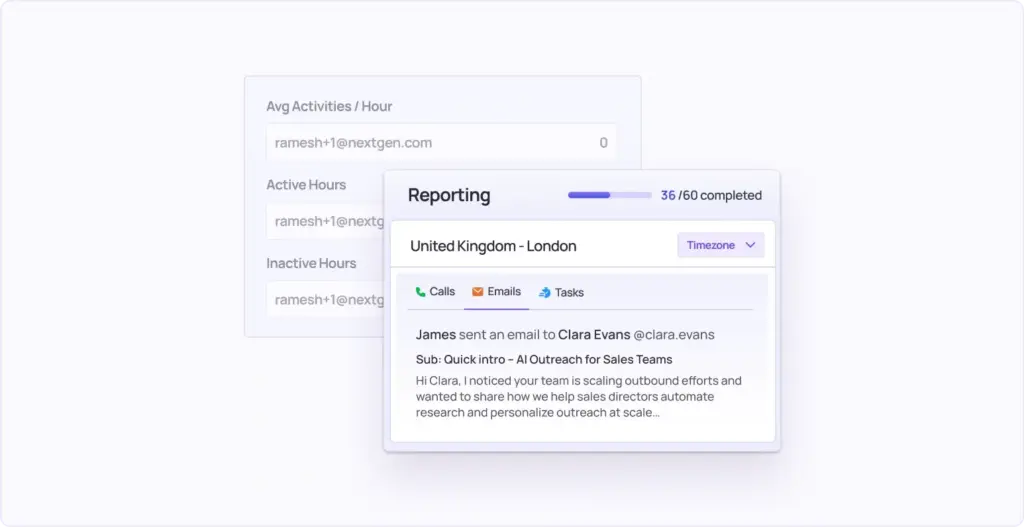
Track SDR activity across daily, weekly, and monthly timelines and contrast it against target account progression. You measure what actually matters, account movement and pipeline created, not just email volume or call counts that look busy but produce nothing.
Best For- B2B sales teams running Account-Based Selling motions who need to systematically engage buying committees, maintain context across conversations, and track account progression from target to closed deal. Ideal for organizations selling $20K+ ACV products with complex buying groups and sales cycles that require multi-threaded engagement.
- Account-to-S2 is your north star metric. It tells you how efficiently your team is converting target accounts into a qualified pipeline. Start here before you look at anything else.
- Activity without persona targeting is wasted effort. 4,000 calls directed at individual contributors will produce a fraction of the pipeline that 2,000 calls directed at mobilizers and economic buyers will. Who you call matters more than how many calls you make.
- Coverage quality beats coverage volume. Touching 10 people in an account means nothing if none of them are decision-makers. Persona Coverage Rate and Multi-Threading Score are the checks on this.
- Hold Rate and Acceptance Rate expose qualification gaps faster than anything else. If the hold rate drops below 70%, your reps are booking meetings with the wrong people. If the acceptance rate drops below 80%, your qualification criteria need to be tightened before the meeting, not after.
- Stage conversion benchmarks give you a shared language for pipeline health. Target-to-Engaged at 25–40%, Meeting-to-Opportunity at 30–50% — these numbers let managers and reps have the same conversation about what "good" looks like.
- Multi-threading is a risk management tool, not just a coverage strategy. An account with one active thread is a deal at risk. When that contact goes dark, the account goes cold. Two or more active threads give you optionality.
- The scripts only work if the metrics are guiding them. Use your Account-to-S2 and Persona Coverage Rate to identify which script to deploy — coverage play, progression play, engagement play, or pipeline quality play — at each account and stage.
Conclusion
The teams that win with ABS are not the ones with the biggest account lists or the highest call volumes. They are the ones who know exactly where each account stands, who they have engaged inside it, and what needs to happen next to move it forward. That requires both the right metrics and the right system to execute against them.
The Efficiency Principle
Volume still matters. But efficiency is where world-class SDR teams are built. Start with your Account-to-S2 ratio. That single number will tell you more about your team's ABS health than any activity report ever will.
Klenty gives your team both the execution layer to run coordinated, multi-threaded account plays, and the reporting layer to measure exactly what is moving and what is stalling. From ICP list building to account stage tracking to AI-generated next steps, every feature is built around one outcome: more accounts developed into a qualified pipeline, faster.
And if you want to see what account-based execution looks like in practice, book a demo with Klenty today.
FAQs: Account-Based Selling Metrics
What are account-based selling metrics?
How are account-based selling metrics different from traditional SDR metrics?
Where a traditional SDR dashboard might celebrate 100 dials in a day, an ABS dashboard asks how many of those dials reached a mobilizer or economic buyer, which accounts progressed as a result, and what the Account-to-S2 conversion rate looks like across the team. The shift is from measuring effort to measuring efficiency.
What is the most important account-based selling metric for SDRs to track?
A real-world benchmark from a non-ramped SDR running an account-based motion is 8.28%. This number is more revealing than any activity metric because it cannot be inflated by volume. You either converted the account, or you did not.
What do Contact-to-S2 and Account-to-S2 mean, and why do both matter?
Contact-to-S2 reveals how well your reps are identifying and engaging the right individuals within accounts - a low rate often signals that outreach is concentrated on lower-influence contacts. Account-to-S2 reveals how effective the overall account strategy is. Used together, they let you diagnose whether a pipeline problem is a persona-targeting problem, an account-selection problem, or a qualification problem, three very different root causes that require three very different fixes.
How do you measure buying committee coverage in account-based selling?
Multi-Threading Score counts the number of simultaneous active conversations running inside an account, where active means the stakeholder has replied, completed a meeting, or has a next step scheduled within the past two weeks. An account with a multi-threading score of one is a single-threaded deal, high risk. Two or more active threads are the minimum for a well-covered account.
What is a good meeting hold rate for account-based selling, and what does it signal?
Hold rate is a leading indicator of qualification quality: when reps book meetings with the right persona, with genuine pain identified, and with a confirmed next step, prospects show up. When the hold rate drops below 70%, it typically signals one of three problems: meetings are being booked with the wrong persona, urgency has not been established before the booking, or the next-step commitment was vague rather than confirmed.
How do you know if your account-based selling motion is actually working?
Stage conversion benchmarks to use as a baseline: 25–40% for Target to Engaged, 40–60% for Engaged to Working, and 30–50% for Meeting to Opportunity. If conversion rates are within benchmark but Account-to-S2 is low, the account list itself may need refinement. If conversion rates drop at a specific stage consistently across reps, that stage has a process or messaging problem.
About the Author