
- Most SDR teams run sequences to a smaller list and call it ABS. Real account-based selling is coordinated, signal-triggered plays across an entire buying committee — top-down, bottom-up, and direct running together.
- Every play maps to one of three structural types: Top-Down for air cover, Bottom-Up for champions, and Direct for the budget holder. The situation dictates where you start, not your preference.
- The five plays that move accounts — Sphere of Influence, Stack-Ranking, Market Trends, Emerald City, and Career — each have a specific trigger and a defined execution path across the buying committee.
- Without an enforced multi-threading methodology, plays become suggestions. Ten SDRs running their own version means ten different messages in the market and no way to diagnose what is working.
- Klenty runs all five plays from one platform — enforced threading, AI-personalized messaging, auto-triggered follow-ups, and account coverage tracking so no stakeholder gets left behind.
Here is what account-based selling looks like in most teams: a curated list of target accounts, everyone dropped into the same sequence, and a reply rate check on Friday.
That is spray and pray with better targeting.
The reason it does not work is the absence of a coordinated strategy behind it. Account-based selling requires you to know which signal triggered the play, who across the buying committee you are running it through, and how each thread, top-down, bottom-up, and direct, feeds the next conversation.
This blog breaks down the five account-based selling plays that move accounts through the pipeline, what triggers each one, who you target at each level of the buying committee, and exactly how to execute.
What Is an Account-Based Selling Play?
A play is a coordinated, signal-triggered set of actions across an entire buying committee. It is not a sequence you enroll a prospect into; it is a strategy you run across an account. The difference sounds small, but the pipeline impact is huge.
| What Most Teams Call a ‘Play’ | What an Account-Based Selling Play Is |
|---|---|
| A sequence enrolled to one prospect | A coordinated set of actions across a buying committee |
| Triggered by “let's try this account.” | Triggered by a specific signal — funding, hire, intent, competitive move |
| One person, one channel | Multiple threads, multiple personas, multiple channels connected |
| Ends when the sequence ends | Ends when an account is activated, stalled, or replaced |
Why this matters at scale: If you have 10 SDRs each running their own version of outreach with no shared methodology, you have 10 different voices in the market, 10 different results, and zero ability to diagnose what is working.
Centralized plays give you one playbook, consistent execution, and a real feedback loop.
The Three Core Account-Based Selling Play Types
Before you get into specific plays, you need to understand the three structural play types. Every Account-Based Selling play maps to one of these three, and every one of them targets a different part of the buying committee.
Play Type 1: Top-Down
Who you target: VP-level and C-suite. The executive who owns the outcome your product impacts.
What you are trying to do: You are not trying to close them, you are trying to get a mandate - a signal from the top that makes every conversation below it easier.
"Your VP of Sales flagged [X] as a priority. Here is how we can help your team hit it."
When to lead with this:
- New logo where you need executive sponsorship
- Competitive displacement requiring change management
- Strategic shift - not just a tool swap
Every bottom-up and direct conversation now references the executive's priorities. You are no longer cold. You have air cover.
Play Type 2: Bottom-Up
Who you target: End-users, team leads, practitioners. The people living the problem daily.
What you are trying to do: You are not chasing budget; you are building internal advocates who will defend the deal when it hits the committee, and giving yourself proof points for exec and direct conversations.
When to lead with this:
- PLG or land-and-expand accounts where users already exist
- Accounts where you need to understand how work actually gets done before going to leadership
- Situations where you need champions before you have air cover
You walk into every executive conversation with real data from the field, not a generic pitch.
Play Type 3: Direct
Who you target: Economic buyer. The person with budget authority.
What you are trying to do: Close with an ROI-led narrative that connects leadership goals (top-down) to user pain (bottom-up).
When to lead with this:
- After you have air cover and champion stories in place
- Renewal or competitive displacement - time-bound ROI and risk
- When the budget holder is already engaged and needs a decision reason
Without the other two threads, direct outreach is just a cold pitch. You need the intel from top-down and bottom-up to make direct work.
The Play Type Decision Table
| Situation | Where to Start | What Supports It | How You Close |
|---|---|---|---|
| Breaking into a new logo that needs executive buy-in | Top-Down – Get executive alignment and mandate early | Bottom-Up – Build proof points with end users | Direct – Present ROI with a clear urgency timeline |
| Expanding in a PLG or land-and-expand account | Bottom-Up – Leverage existing users already in the product | Top-Down – Show leadership the impact their teams are seeing | Direct – Involve the budget holder to accelerate decisions |
| Competing for a renewal or displacing a competitor | Direct – Focus on time-sensitive ROI and risks of staying | Top-Down – Align with strategic business priorities | Bottom-Up – Validate value with daily users |
The Five Account-Based Selling Plays You Can Run This Quarter
These five plays come from SPEAR Selling by Jamie Shanks.
Play 01: The Sphere of Influence Play
Trigger: You have a mutual customer, a shared connection, or a strong reference in the account's network.
Who to target: All threads, but lead with the connection that bridges you.
Core message: "You know [Customer X]. They work with us. Here is what changed for their team. You are one conversation away from the same outcome."
What makes this work: Trust is the hardest thing to build in a cold account. If you can bridge a connection - a shared customer, a mutual contact, a reference from someone they already trust, you skip the credibility-building phase entirely. People buy trust.
What to prepare:
- Name of the shared customer or connection
- A specific outcome that the customer achieved
- A clear bridge: "They recommended I reach out because they thought the situation was similar."
How Klenty helps: ICP Account Mapping + Account Panel
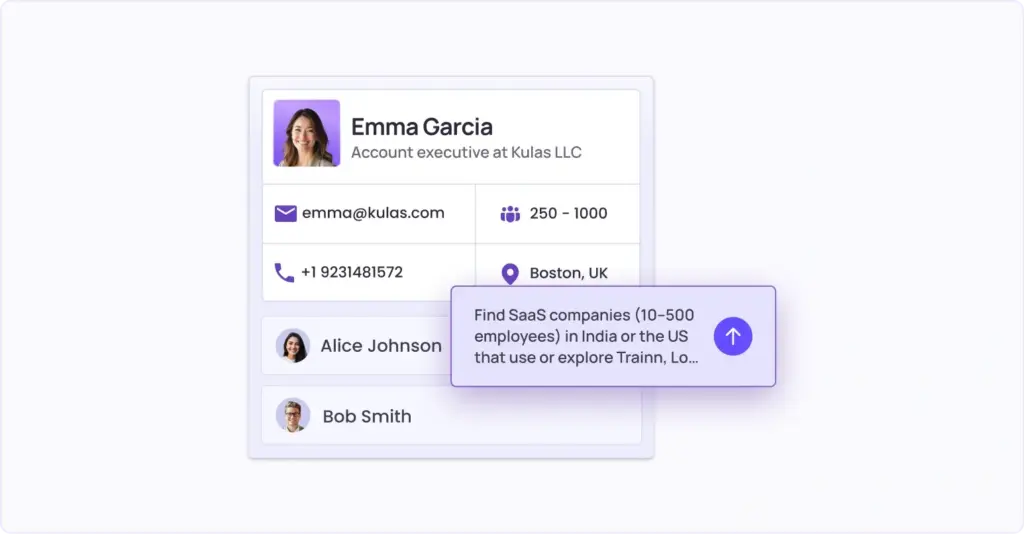
Before you can run a Sphere of Influence play, you need to know which accounts in your list have a connection worth leveraging. Klenty's AI List Builder trains itself on your business, knows who your best customers are, maps your ICP criteria, and builds your account list for you, so you are always starting from accounts that are closest to your existing wins, not a random list.
Once you are inside an account, the Account Panel gives you a complete overview of the account, including communication with each stakeholder and frequency of engagement, and all prior communication across channels in one consolidated view.
Play 02: The Stack-Ranking Play
Trigger: The account is underperforming vs. industry peers, or you have benchmark data showing a gap between where they are and where best-in-class companies are.
Who to target: Executive thread and direct thread. This is a leadership-level wake-up call.
Core message: "Here is where your team stands vs. best-in-class in your space. Here is the gap. Here is what the companies closing that gap are doing differently."
What makes this work: You are not selling. You are showing them their position with external data. The goal is to push the buyer off their status quo by helping them recognize that others in the market are exceeding their benchmark.
Sources for benchmark data:
- Gartner Magic Quadrant rankings
- Frost & Sullivan, Forrester, IDC reports
- Glassdoor, Owler, SEC filings (Form 10-K)
- Industry-specific audit data
What to prepare:
- 2–3 specific data points comparing the account to peers or best-in-class
- One specific example of a similar company that closed the gap
- A clear "why now"; why this gap is becoming more expensive to ignore
How Klenty helps: Outreach Methodology (Multi-Threading)
The Stack-Ranking play only lands if it reaches the right people, and in the right order. Running it bottom-up before you have executive attention is a wasted conversation. Running it top-down without user validation is a pitch with no proof.
Klenty's Multi-Threading ensures adherence to top-down, bottom-up, or custom multi-threading workflows, so your SDRs engage with multiple stakeholders within a company simultaneously, with tailored messaging for individual roles.
Also read: Top 20 Account-Based Selling Tools
Play 03: The Market Trends Play
Trigger: A macro shift relevant to the account's industry- new regulation, technology transition, market consolidation, or emerging competitive pressure.
Who to target: Executive thread. This is a C-suite conversation about where the market is going, not a product pitch.
Core message: "The market is moving in this direction over the next 3 years. Here is where companies that are ahead of this shift are already investing. Here is the risk of waiting."
What makes this work: Most buyers are heads-down running their business. They are not tracking macro trends the way an analyst or an informed vendor would. You become valuable the moment you show them something they did not know and could not easily find themselves.
What to prepare:
- 1–2 third-party sources (Gartner, Forrester, industry reports) projecting the trend
- A clear "so what" for the specific exec you are targeting
- A self-assessment question that makes them think: "Where would you say your team is on this curve - best-in-class, best practices, or standard operating procedures?"
How Klenty helps: Account Playbooks
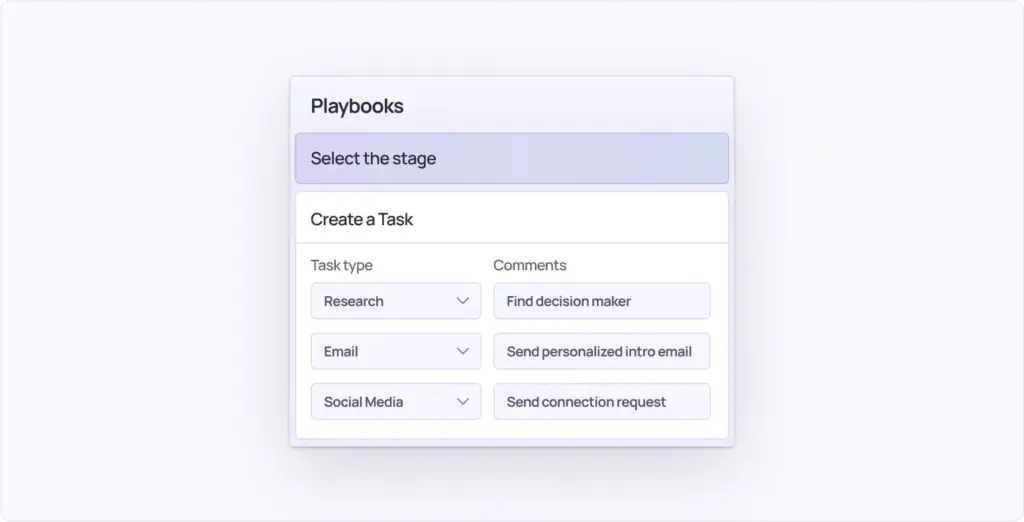
Klenty's Account Playbooks enroll accounts into customized follow-ups based on org-wide engagement level, so when an exec opens your market trends email or engages with a piece of content, the next step is not a manual task your SDR has to remember. The right follow-up triggers automatically, based on where the account actually is in its engagement.
Play 04: The Emerald City Play
Trigger: The account understands the problem but cannot yet see what ‘better’ looks like concretely. They are skeptical of change because the outcome feels abstract.
Who to target: Bottom-up thread - practitioners and team leads who will live in the solution daily.
Core message: "Here is what your team's day looks like after this. Here is a customer like you who made this change. Here is what they said six months in."
What makes this work: People change when they can see, feel, and almost taste the better outcome. Abstract ROI does not move practitioners; concrete stories do.
Your prospective customers are more willing to shift priorities when they have a clear, vivid picture of what the destination looks like, not a slide deck of features, but a real look at what their work life becomes on the other side of the decision.
Ways to execute this play:
- A "day in the life" video or walkthrough showing the before and after for their specific role
- A live demo customized to their actual workflow, not a generic product tour
- A reference call with a practitioner at a similar company - same role, same problem, six months post-implementation
- A collaborative session where they interact with the product on their own use case
What to prepare:
- One strong reference customer with a specific, relatable story
- A demo or video anchored to their workflow, and not your feature list
- An opening question: "If we could show you exactly what this looks like for a team like yours, would that be a useful 30 minutes?"
How Klenty helps: AI Next Step Execution (Action AI)
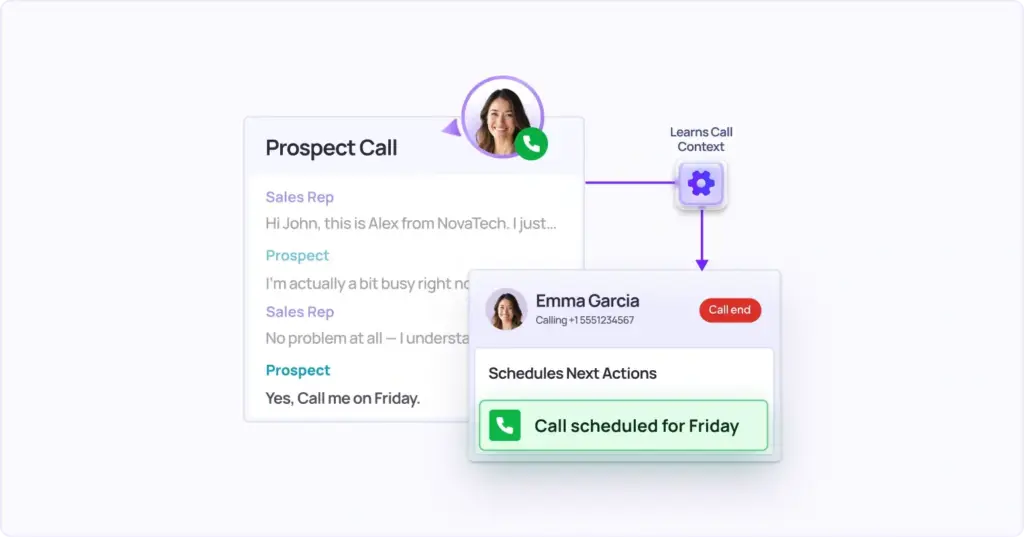
Klenty's Action AI listens to your conversations, surfaces the next step discussed, and intelligently schedules it with context. If a prospect says "send me the case study on the retail team," Action AI executes that follow-up automatically - the right asset, tied to what was actually said on the call, without the SDR digging through transcripts or manually scheduling a task. The play stays alive because no conversation falls through the cracks.
Play 05: The Career Play
Trigger: You have identified a key stakeholder who is a potential champion but is not yet engaged, or who has gone quiet. You want to build a relationship that outlasts any single deal cycle.
Who to target: Bottom-up thread. A practitioner, manager, or team lead who has influence but not budget authority.
Core message: This play has no direct pitch. The message is: "I want to help you, not just your company."
What makes this work: This is the longest-running play in the book, and the one with the highest lifetime value.
Ways to execute this play:
- Broker an introduction to someone in your network who is relevant to their career
- Send an industry report or benchmark that makes them look smart in their next team meeting
- Invite them to an exclusive event they would not otherwise access
- Share a job opportunity - not at your company, something that would genuinely be good for their career
- Give them data they can use to renegotiate their compensation or make a case to leadership
What to prepare:
- One genuine, no-strings gesture in the first touch
- A clear understanding of what that person's career goals are (from prior conversations or their LinkedIn)
- Patience - this play builds over multiple quarters, not multiple days
How Klenty helps: Account Coverage Analysis + Account Stages
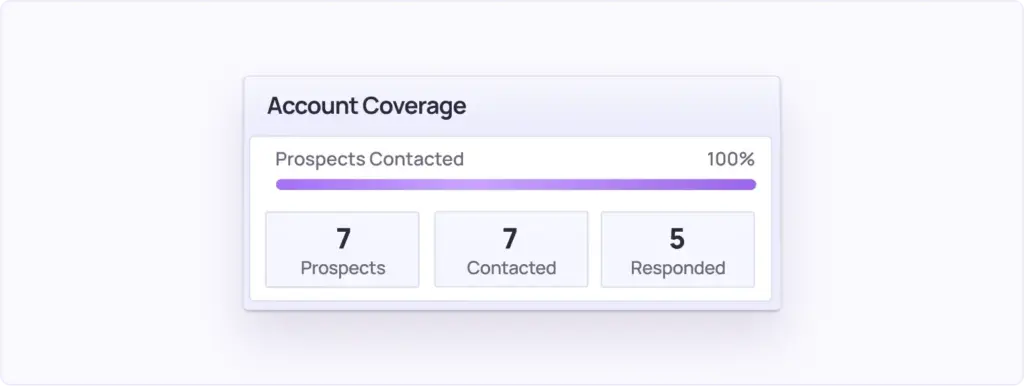
Klenty's Account Coverage Analysis lets you review the percentage of ICP prospects engaged in a given account and identify exactly who has gone dark, so the Career Play gets triggered at the right moment, not six months too late.
And Account Stages track the progression of an account to opportunity over time, giving SDR managers full visibility into which accounts have stalled because a key stakeholder relationship was never properly built, and where the Career Play needs to be activated now.
Next, we will talk about - play tiering. If you have an ABM team working alongside your SDRs, plays get structured across three tiers: One-to-One, One-to-Few, and One-to-Many. Each tier defines how personalised your effort is, how many resources go in, and what success looks like.
| Tier | Who It Is For | What SDRs Do | What ABM Does |
|---|---|---|---|
| One-to-One | Must-win accounts — high ACV, strategic fit, or existing momentum already in the account | Fully custom outreach. Every email and call references something specific to that account. AE involved from day one. | Dedicated microsite, personalised ads per buying committee member, direct mail, and custom content |
| One-to-Few | A cluster of accounts sharing a common trigger — same industry, same tech stack, or the same competitive situation | Sequence templates with account-level customisation. Same core message with different proof points per account. | Shared content hub, persona-targeted ads, and competitive or feature-specific messaging |
| One-to-Many | Full territory or segment — high volume, lower ACV, or early pipeline building | Templated outreach with light personalisation. Focus on speed and coverage across the segment. | Scaled digital advertising, intent-triggered targeting, and territory-level content |
How Klenty Powers This End-to-End
Every challenge in running account-based plays - finding the right accounts, threading the buying committee, personalizing at scale, tracking coverage, triggering the right follow-up- requires a platform that organizes work by account, not by prospect.
Most sales engagement platforms were built for high-volume, prospect-based outbound. They optimize for speed and scale. Account-Based Selling requires depth and coordination. That is a different architecture.
Here is how Klenty enables account-based execution:
Build Your Target Account Universe
ICP Account Mapping and List-Building
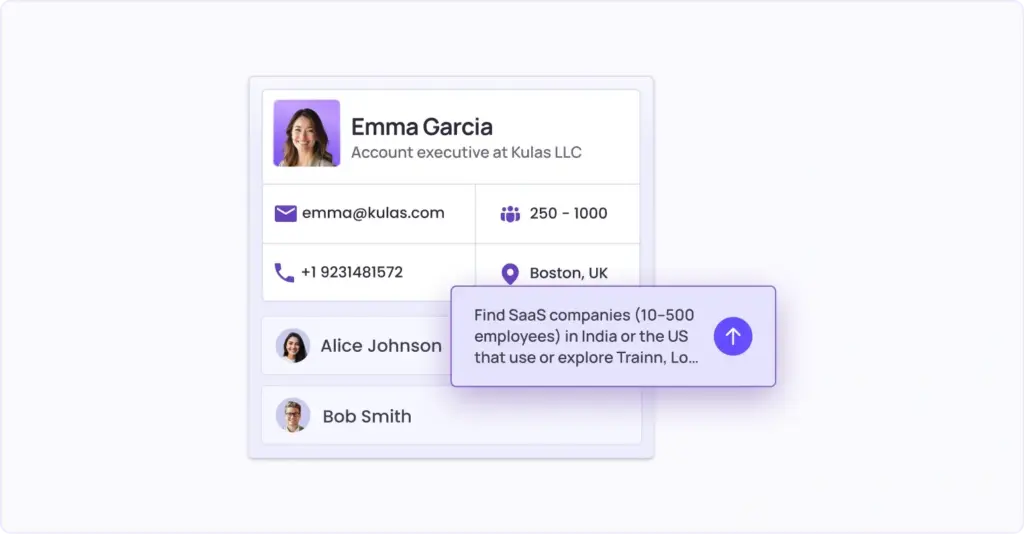
Describe your ICP in natural language and build your target account list in seconds. AI-powered account discovery eliminates manual research and ensures you are targeting the right accounts from day one, so your reps spend time on accounts that actually convert, not on building spreadsheets.
Orchestrate Coordinated Engagement Across Buying Committees
Account Action Window
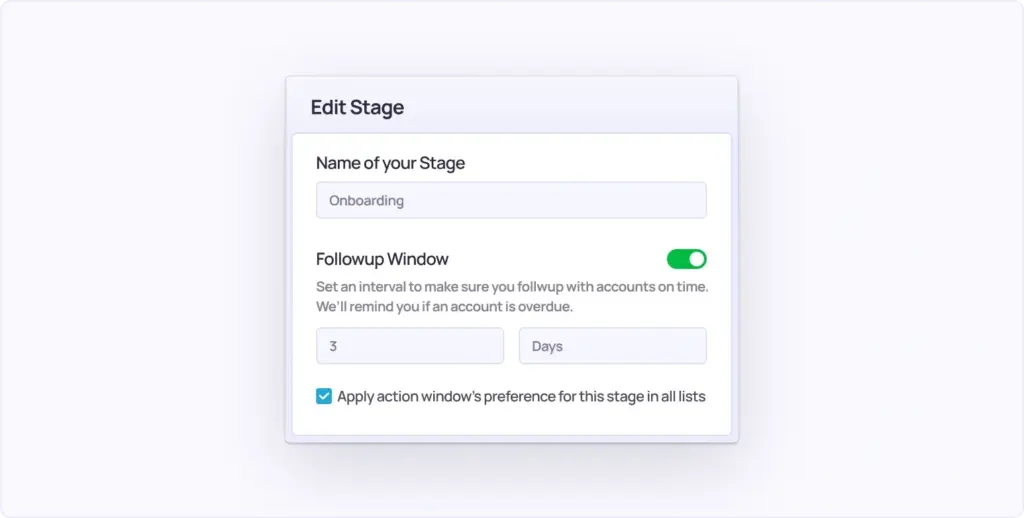
Every target account is at a different stage in its buying journey. Some need urgent action and immediate follow-up to turn into an opportunity - they are in-market. Others need more time, a longer nurture cycle before they are ready to talk to sales.
The problem is that all account actions pile up on your dashboard, leaving no room for prioritization. With traditional sales engagement tools, there's never been a way to control the velocity of rep execution against a set of accounts.
Account Action Windows changes that.
Choose the time period within which actions need to be taken for accounts in each stage. Klenty alerts you when they are overdue. The deeper an account is in its buying journey, the faster reps execute - systematically progressing cold accounts toward an opportunity by following up at set intervals.
Here is what you can do with Account Action Windows:
- Set the frequency, messaging, and channels for every prospect in an account to be engaged.
- Control the velocity of rep execution based on where each account sits in the buying journey.
- Ensure coordinated outreach across the entire buying committee so emails, calls, and LinkedIn touches hit the right people at the right time, not in random bursts.
- Get alerted when action windows are overdue so no account slips through the cracks.
Outreach Methodology (Multi-Threading)
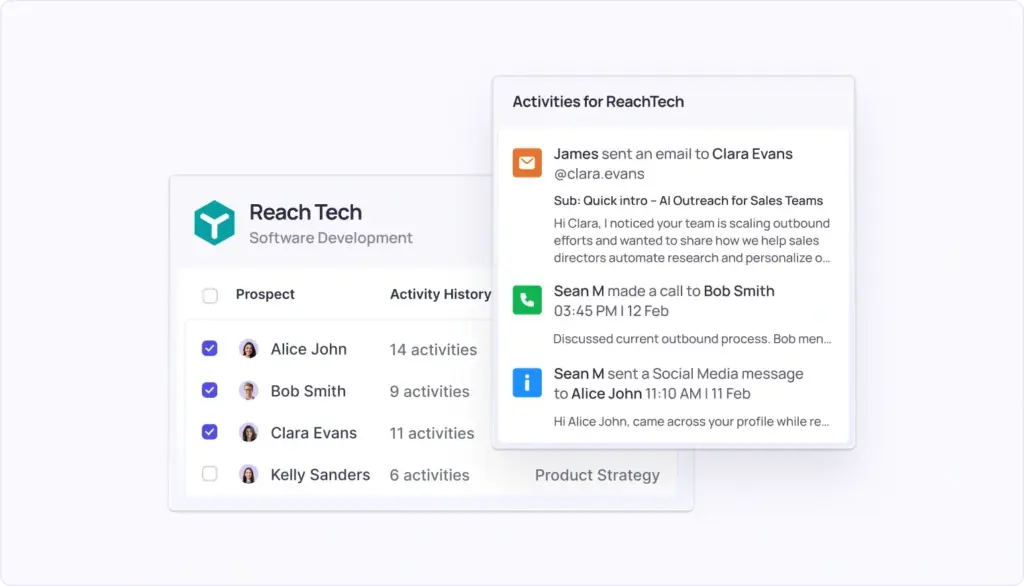
Enforce adherence to top-down, bottom-up, or custom multi-threading workflows. Systematically engage executives, mobilizers, and users within each account based on your preferred approach, ensuring no key stakeholder is left untouched, and every account gets full buying committee coverage.
AI Next Step Execution
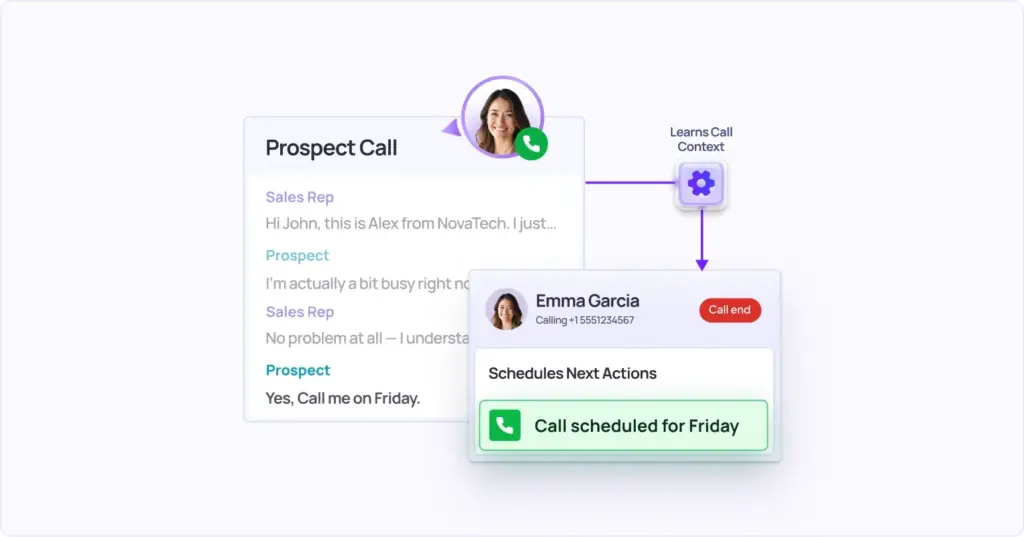
Klenty’s Action AI listens to your sales conversations, understands what was discussed on the call, and intelligently generates the next action. You can focus on dialing, not managing next steps, execute the right tasks at the right time, and save time with auto-generated follow-up messaging.
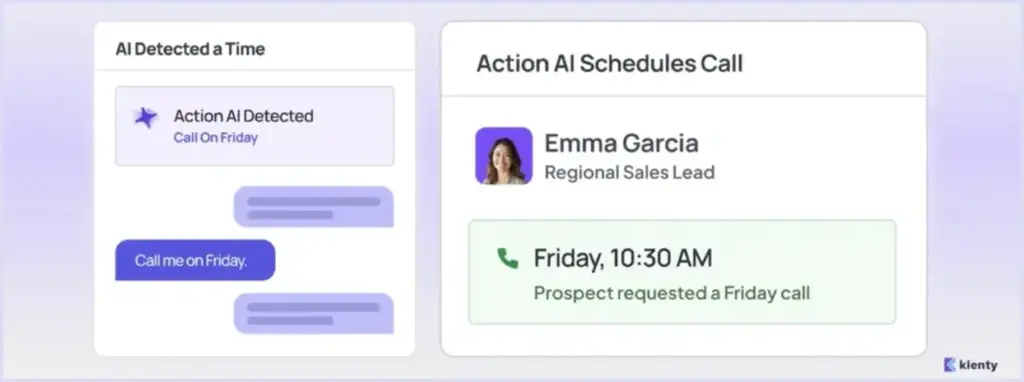
Time-Based Next Actions
Prospect says, “Call me on Friday.” → Action AI schedules a call for Friday with the prospect.
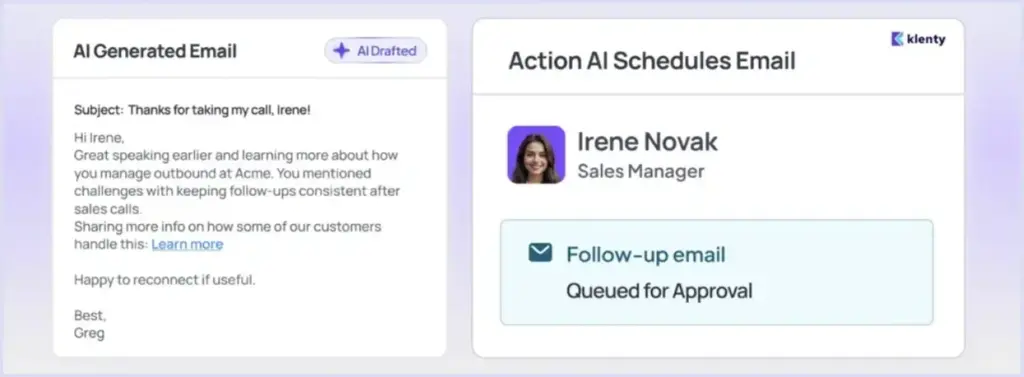
Channel-Based Next Actions
Prospect says, “Send me an email.” → Action AI creates a personalized email and queues it up for approval.
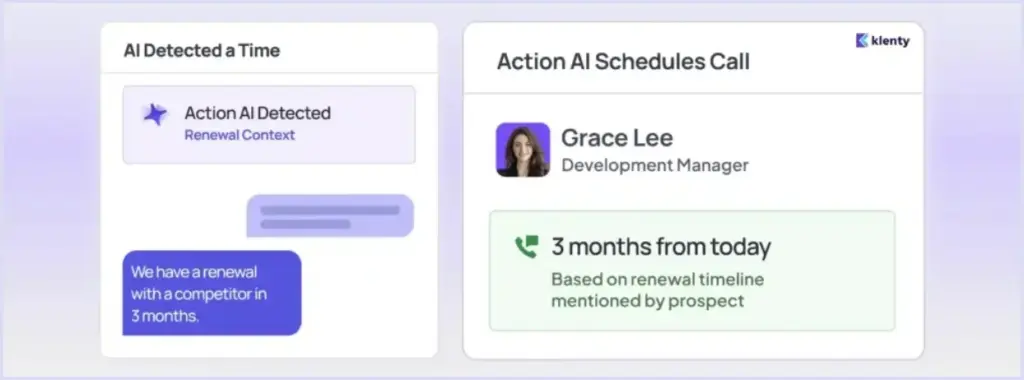
Context-Based Next Actions
Prospect says, “We have a renewal with a competitor in 3 months.” → Action AI schedules a call in 3 months with a call context.
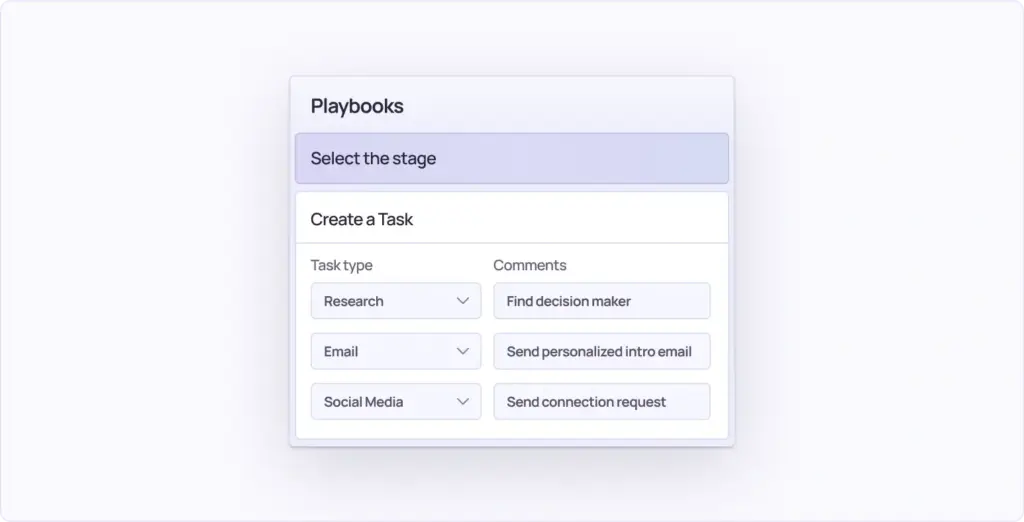
Account Playbooks
Not all accounts are alike. Only 3% of your cold accounts are in-market at any given time; the rest need outreach that adapts to their needs, timing, and fit.
Traditional sales outreach tools are built purely for demand capture, leaving the other 97% of accounts without a structured way to be nurtured toward a buying decision.
Account Playbooks are built for both - helping you capture demand and create it.
Trigger the Right Play at the Right Stage
Set entry and exit criteria for each account stage and define the activities that need to happen as soon as accounts meet the criteria - across emails, calls, and tasks. When accounts show specific signals or reach certain stages, the right plays trigger automatically, so your team responds to buying intent in real time instead of discovering it weeks later in a pipeline review.
Control Velocity and Urgency of Execution
Not all stages carry the same urgency. Set Account Action Windows for each stage to control how fast reps execute. For instance, accounts in a "Decision-Maker Contacted" or "Meeting Booked" stage can be set to require execution instantly or within 24 hours, while earlier-stage accounts follow a longer, more measured cadence.
Orchestrate Playbooks Account-by-Account
Label accounts as "interested," "right contact identified," or "good fit, not now," and execute the right sequence of activities for an entire account before moving on to the next. This ensures outreach is coordinated across the entire buying committee - enrolling every prospect in customized follow-ups based on org-wide engagement level, so no account context is lost mid-play.
Account Panel
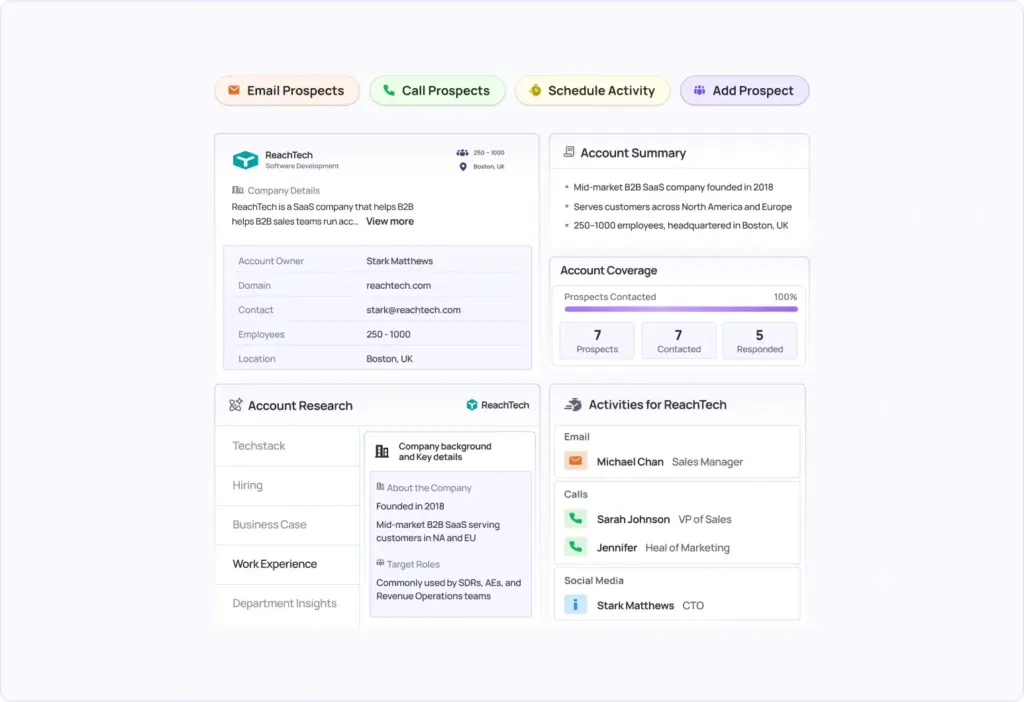
Klenty’s Account Panel helps you to -
Execute Outreach Account-by-Account
Unlike traditional sales engagement tools that are built around individual prospects, the Account Panel lets you group prospects by account and execute emails, calls, and tasks at the account level. Reps can move through research, sending emails, making calls, and finding fresh prospects - all without jumping between tools or losing context mid-execution.
Review the Entire Account's Engagement History
Rather than patching together individual prospect interactions in a spreadsheet, get a consolidated picture of every interaction across all stakeholders in an account, out of the box. Reps walk into every call informed, and managers see the full picture without chasing updates.
Multi-Thread Across the Buying Committee
Know exactly which prospects exist in an account, track coverage across hierarchies, roles, and titles, and add fresh prospects to ensure all relevant stakeholders are being engaged. No contact goes untracked, and no decision-maker falls through the cracks.
Run a Well-Researched, Consultative Sales Process
Basic account details, past conversation summaries, and AI-powered account research insights surface at the moment of dial, so every outreach stays relevant, timely, and specific to the account your rep is working on.
Track Account Progression and Optimize Coverage
Account Stages
Traditional sales outreach tools leave you with an Account Development Gap - you do not know which accounts are moving toward an opportunity and which are stuck, you can't define tailored strategies for each stage, and there's no systematic way to nurture demand across accounts that aren't ready yet.
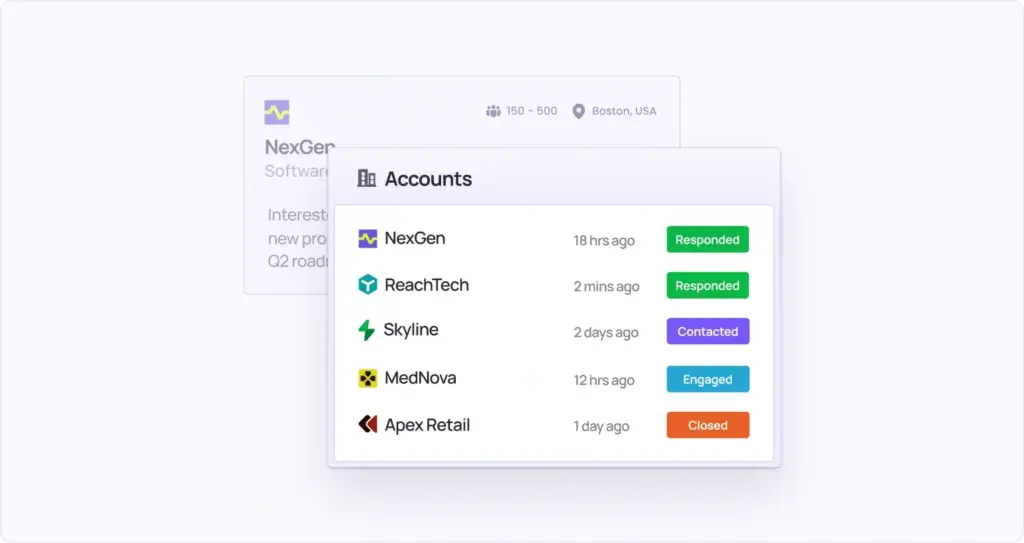
Klenty's Account Stages fixes this with CRM-like stages built specifically for sales outreach.
Define a Custom Pipeline for Account-Based Outreach
Create a custom pipeline for each account list and set up stages that reflect the actual steps accounts go through before turning into an opportunity. Every account has a defined place in the journey; nothing falls into a grey area.
View and Drill Into Accounts at Every Stage
With one click, dig into all accounts sitting at any stage of your pipeline. Drill deeper into account-level details like prospects contacted, notes, next steps, and activity history, all consolidated in a single table view so nothing needs to be chased down manually.
Set Custom Strategies for Each Stage
Define entry and exit criteria for each account stage and prescribe the series of actions that need to happen as soon as an account moves in. Each stage gets its own tailored outreach strategy, so reps always know exactly what to do next, for every account, at every step.
Prescribe the Urgency of Execution at Each Stage
Prevent account rotting. Set deadlines for actions to occur at each stage of the pipeline so accounts at advanced stages get immediate attention, and no high-intent account sits idle waiting for a rep to take action.
Account Coverage Analysis
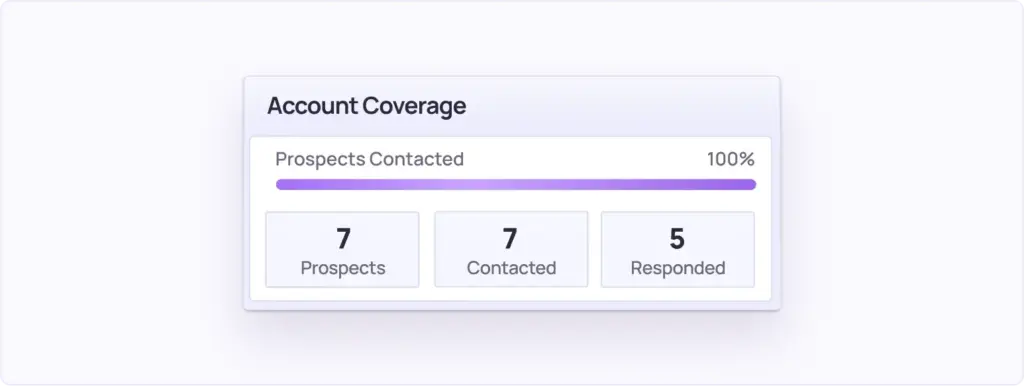
Review the percentage of ICP prospects engaged in any given account and identify gaps for deeper multi-threading. This ensures you are not leaving key stakeholders untouched, the single biggest reason ABS deals stall or die in the pipeline.
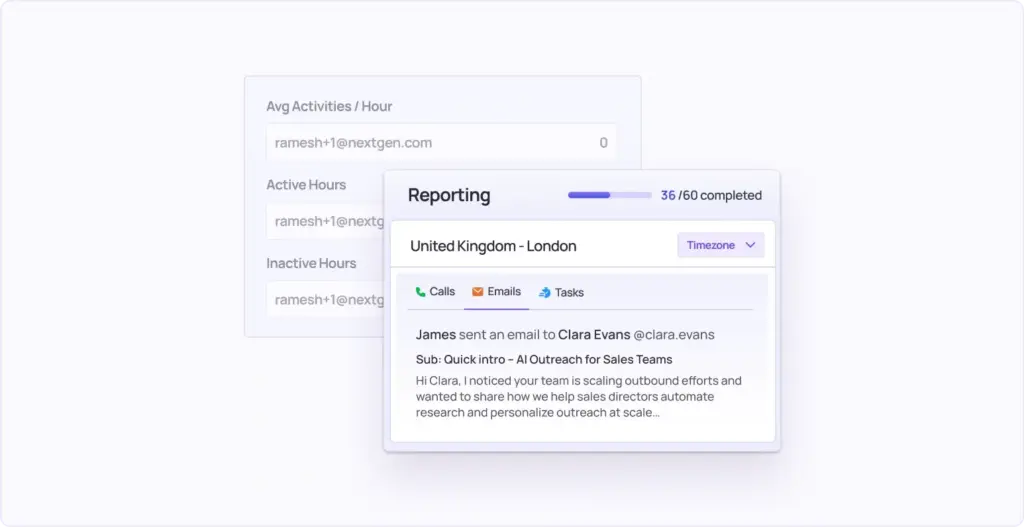
Account-Level Reporting
Track SDR activity across daily, weekly, and monthly timelines and contrast it against target account progression. You measure what actually matters, account movement and pipeline created, not just email volume or call counts that look busy but produce nothing.
Best For- B2B sales teams running Account-Based Selling motions who need to systematically engage buying committees, maintain context across conversations, and track account progression from target to closed deal. Ideal for organizations selling $20K+ ACV products with complex buying groups and sales cycles that require multi-threaded engagement.
- Each play should be activated by a specific signal — funding, a competitive move, a hiring spike, or a stakeholder going dark. Signal-first is what separates a play from a sequence.
- All three threads need to run together. Top-down gets you air cover, bottom-up gets you champions, and direct closes the loop. Running only one or two is why deals stall in committee.
- Your play type should match the account situation, not your preference. New logos need executive sponsorship first. PLG accounts need bottom-up validation. Competitive displacements need a time-bound ROI case. The situation dictates where you start.
- The Career Play is the most underused. No pitch and no short-term conversion goal — and that is exactly why it has the highest long-term win rate. One genuine gesture to a future champion beats ten sequences to a cold executive.
- Coverage is the metric that predicts deal success. Activity tells you how busy your team is. Account coverage tells you whether the right people in the buying committee know you exist. If coverage is below 30% on an engaged account, the deal will likely stall.
- Without an enforced methodology, plays become suggestions. Ten SDRs running their own version means ten different messages in the market and no way to diagnose what is actually working.
Conclusion
You can do Account-Based Selling with Klenty. It is account-first, signal-triggered, and coordinated across every thread of the buying committee. With Klenty, your SDRs know which accounts to prioritise and why. They walk into every call with the full history of every conversation in that account. They follow a defined multi-threading methodology, not because a manager reminded them, but because the platform enforces it. And when a prospect says "call me next Friday" or "speak to Sarah in procurement," that next step happens automatically. It saves you from dropped balls and missed momentum.
Accounts move through stages, through the buying committee, and into the pipeline that your AEs can close. Book a demo and see how Klenty powers account-based selling execution for teams moving upmarket.
FAQs: Account-Based Selling Plays
1. What is an account-based selling play?
2. How is account-based selling different from outbound sales?
3. Why is multi-threading important in account-based selling?
4. When should SDRs run account-based selling plays?
5. What is the goal of account-based selling?
About the Author