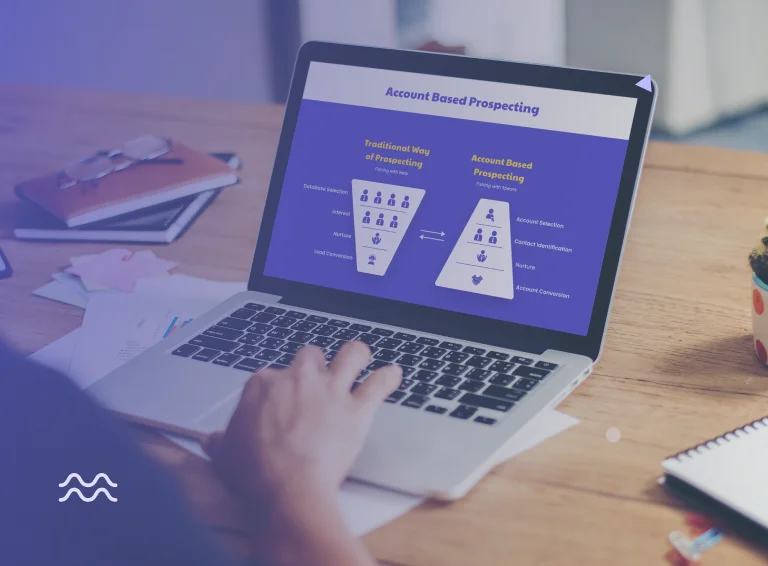
You have a solid list of target accounts, you have run your sequences, and yet the pipeline looks thin.
High-volume outbound works when your total addressable market is enormous. Load thousands of prospects, run sequences, move fast, churn and burn. It does not matter if your connect rate is low because there is always another prospect to call. But when you move upmarket, that logic collapses.
You are selling into a limited TAM - roughly 10,000 accounts across a specific vertical, segment, or industry. Every burned conversation costs you. Every account you approach with generic outreach is an account you may never get another shot at. And you are not selling to one person per account. You are navigating buying committees with multiple stakeholders - CTOs, CIOs, COOs, department heads, procurement, and the end users who live the problem every day.
You need a consultative sales process that treats each account as a market of one. This blog is for SDRs and sales leaders running outbound into complex accounts. By the end, you will have a better understanding of how account development actually works.
The Account Development Gap For SDRs Explained
📘 In This Blog
This blog covers everything you need to understand about account development and how to run it at scale:
- The Account Development Gap: Why traditional high-volume outbound fails when you move upmarket—and why most teams hit a wall
- The 5-Phase Account Development Framework: A proven workflow for systematically developing accounts from first touch to qualified opportunity
- Account Coverage Metrics: What actually matters when measuring account development success
- How Klenty Closes the Gap: The features and infrastructure you need to execute account development at scale
This is the gap between the pipeline your team should be creating from target accounts and the pipeline you actually end up with.
| Challenge | The Number | What It Means |
|---|---|---|
| TAM Constraints | ~10,000 accounts | That is your total addressable market. Every burned conversation costs you. You cannot afford low connect rates or generic messaging. |
| Relationship Selling Challenges | 11+ stakeholders | Every purchase decision involves 11 or more people. You are not reaching one person — you are navigating a buying committee with conflicting priorities and different pain points across levels. |
| Coaching Limitations | 43% of managers | 43% of sales managers are unaware of their reps' coaching areas. Legacy tools show “calls made” but not “account progress,” making strategic coaching difficult. |
The gap exists because your team is not developing enough conversations with each account's buying committee. Three numbers explain why: These three challenges share a common root cause: the tools and tactics your team is using were built for a different kind of outbound.
Here is what that gap looks like in practice:
TAM Constraints: You Cannot Afford to Churn and Burn
| Traditional Outreach | What Your Team Actually Needs | Why Legacy Tools Fail |
|---|---|---|
| Prospect-based approach | Account-based approach | Built for prospects, not accounts |
| Demand capture only | Demand nurture, then capture | Same strategy for every prospect |
| Can afford to churn and burn prospects | Recycle accounts to ensure recurring opportunities | Outreach stops when the sequence stops |
| Uses call volume to compensate for low connect rates | High connect rate with a limited number of accounts | Built to optimize call volume, not connect rate |
Relationship Selling Challenges: You Are Selling to Committees, Not Contacts
| Traditional Outreach | What Your Team Actually Needs | Why Legacy Tools Fail |
|---|---|---|
| 1–2 prospects contacted per account | Engage 11+ prospects per account | Do not track buying committee engagement |
| Prospects scattered across sequences | Connected execution across all prospects in an account | Sequences are built for prospects, not accounts |
| Single-threaded accounts put opportunity creation at risk | Systematic multi-threading across the account | Multi-threading is ad-hoc and requires manual one-off tasks |
| Can get away with a generic pitch to C-suite | Discovery below the line before pitching to CTOs, CIOs, and COOs | No way to define and enforce a multi-threading methodology |
These gaps lead to inconsistent account nurture, insufficient account coverage, and ineffective coaching. Accounts go cold not because they are uninterested, but because you stopped showing up.
Deals stall in committee, not because you lost, but because no one inside the account was championing you. And managers cannot fix what they cannot see.
What Account Development Actually Looks Like: A 4-Phase Workflow
Account development means treating the account as the unit of work, not the individual prospect. You are not trying to book a meeting with one person. You are systematically developing the account - building conversations, gathering context, expanding coverage across the buying committee, until it becomes a qualified opportunity.
Here is how that works in four phases.
Phase 1: Research, Past Conversation Review, and Outreach
The first job is to get into the account with a foundation of research and context.
Your SDR identifies 5–7 contacts in the target account mapped across three threads:
| Thread | Who to Target | Number of Contacts |
|---|---|---|
| Top-Down | Executive-level contacts (VPs, C-suite) – budget owners focused on outcomes | 1–2 |
| Direct | Mid-level managers or directors with budget authority | 2–3 |
| Bottom-Up | End users and practitioners who deal with the problem daily | 2–3 |
Research your accounts before outreach. Generic outreach gets ignored. Senior decision-makers do not respond to cold pitches about features. They respond to relevance- insights tied to their business priorities, technology environment, and strategic initiatives.
Here is what research SDRs should be gathering:
| Research Area | What to Look For | Why It Matters |
|---|---|---|
| Tech Stack | What tools are they currently using? Any recent adoptions or changes? | Identifies integration opportunities or competitive displacement angles |
| Hiring Trends | Are they expanding the team? Any new roles posted? | Signals growth, budget availability, and urgency |
| Business Case | Recent funding, acquisitions, market expansion, or compliance requirements | Provides context on why now is the right time to engage |
| Work Experience | Key stakeholders’ backgrounds and tenure | Helps personalize outreach and identify decision-makers and influencers |
| Department Insights | How is the team structured? What workflows are in place? | Helps you speak to real day-to-day operations, not assumptions |
What context in action looks like:
An SDR is calling into an account that just went through a major infrastructure migration. Instead of: (Wrong) "Hi, we help sales teams be more productive..."
They open with: (Right) "I noticed your team recently completed a migration to [platform]. One pattern we see at companies at this stage is that the sales team is now under pressure to accelerate the pipeline before the next infrastructure cycle. Is that a conversation happening internally?"
That is a contextual conversation, and it is what gets decision-makers to actually talk to you.
Also read: Top 20 Account-Based Selling Tools
Phase 2: Discovery
The goal of discovery is not pitching. Talk like a consultant, not a vendor. You are uncovering five critical elements.
- Pain Points - What is their biggest challenge?
- Need - Does the problem exist in their organization?
- Timing - When do they need to solve it?
- Fit - Are they a good fit for your solution?
- Decision-Maker - Who actually owns this decision?
Use discovery conversations to start dialogue and identify who else should be involved.
"We work with companies dealing with [specific challenge]. I am curious how your team handles [related process]."
"I have been researching how companies in your space approach [problem area]. Would you be open to a quick conversation?"
The goal is to understand if the problem exists, when they need to solve it, and whether they are genuinely a fit for what you offer.
Phase 3: Multi-Threading
This creates credibility and urgency at the top
(Get proof points)
(ROI + timeline)
(Already using you)
(Budget owner)
(Strategic alignment)
(User validation)
Once your SDR has initial conversations and discovery, the next phase is multi-threading - engaging multiple stakeholders across the account in a coordinated way.
Here is the critical distinction most teams miss:
Multi-threading is not random outreach to 15 people at once.
Multi-threading means building connected conversations where what you learn from one stakeholder directly informs how you engage the next. You engage high and wide - reaching across multiple levels and functions within the account in a structured sequence.
Example of connected multi-threading:
| Step | Thread | Who | What You Say | What You Learn |
|---|---|---|---|---|
| 1 | Bottom-Up | Team Lead | "What is your biggest challenge with your current vendor management process?" | "We spend 30% of our time on manual reconciliation across three different systems." |
| 2 | Direct | Procurement Manager | "I was speaking with [Team Lead] about the reconciliation overhead across your systems. From an operations perspective, how much time is your team spending troubleshooting vs. building scalable processes?" | "We have three tools that do not integrate with each other. Procurement becomes a bottleneck every quarter." |
| 3 | Top-Down | CIO / VP | "I have been speaking with a few members of your team about operational efficiency. A consistent theme is that your team is losing significant productive time due to fragmented infrastructure, which is creating a procurement bottleneck every quarter." | Meeting booked |
Notice what happened. By the time the SDR reaches the executive, they are not pitching cold. They are synthesizing what the team has already told them. That is what creates credibility and urgency at the top.
The three threads and when to use them:
| Situation | Lead With | Support With | Close With |
|---|---|---|---|
| New logo / major change management | Top-Down (executive alignment and air cover) | Bottom-Up (proof points from practitioners) | Direct (ROI and implementation timeline) |
| Land-and-expand within existing accounts | Bottom-Up (engaged users) | Top-Down ("Your team is already using us") | Direct (budget owner alignment) |
| Competitive displacement | Direct (time-bound ROI and risk of inaction) | Top-Down (strategic alignment) | Bottom-Up (user validation) |
Phase 4: Active Demand Nurture and Progression
In account development, accounts move through stages, and each stage requires different actions and continuous follow-up from your SDR. Track momentum and progress accounts systematically.
| Stage | What It Means | Actions Required | Goal |
|---|---|---|---|
| Not Contacted | The account is in your TAM, but no outreach has been made | Execute initial outreach to 5–7 prospects across all three threads | Start conversations and gather insights |
| Contacted | Outreach has been executed, but no response yet | Follow up with prospects; add new contacts based on research | Identify the mobilizer or decision-maker |
| Engaged | At least one prospect has responded or shown interest | Multi-thread across the buying committee; share relevant content tailored to each thread | Build awareness and consensus across stakeholders |
| Responded | Multiple stakeholders are engaged and momentum is building | Schedule discovery calls; connect the threads; involve an AE if needed | Qualify the opportunity and move it into the pipeline |
Action windows create forcing functions. Set time limits for each stage so accounts do not sit idle:
- Not Contacted - 4 days to complete initial outreach across threads
- Contacted - 3 days to execute follow-up actions
- Engaged - 2 days to multi-thread and expand coverage
- Responded - 1 day to schedule next steps
Without these forcing functions, accounts drift. SDRs move on to the next account, and a potentially qualified opportunity quietly goes cold.
Phase 5: Account Reporting and Visibility
The final phase is tracking account health and identifying where visibility is lacking that prevents accounts from progressing into opportunities.
Here are the critical areas you need to measure:
Discovery
- Need - Are they struggling to coordinate engagement across multiple decision-makers? Do they have a limited TAM they need to develop systematically?
- Timing - Major organizational changes, infrastructure migrations, recent funding rounds, new hiring, or upcoming renewal cycles. These are your windows to engage.
- Fit - Do they have the team structure and sales motion required to execute coordinated outreach across buying committees?
Coverage
- Number of stakeholders engaged per account: Are you talking to enough people?
- Are key decision-makers still untouched?
Multi-Threading
- Pattern and hierarchy: Did you contact all three levels (top-down, direct, bottom-up)?
- Is there a logical sequence to your stakeholder engagement, or is it random?
Conversations
- Number of quality conversations per account: Are conversations moving discovery forward, or just logging activity?
Meetings
- Number of meetings scheduled per account
- No-show rate: Are prospects actually showing up, or losing interest between scheduling and call time?
This is where account development ends and closing begins. An opportunity is qualified when the AE believes they can close the deal. At this point, the account moves from SDR ownership into the sales pipeline, and the focus shifts from developing the account to advancing the deal.
Track these areas consistently, and you will see exactly where accounts are getting stuck and what needs to happen to move them forward.
Account Coverage: The Metric That Predicts Whether a Deal Lives or Dies in Committee
In account development, you need to measure account-level outcomes:
| Vanity Metric (What Most Teams Track) | Account-Level Metric (What Actually Matters) |
|---|---|
| Total calls made | Connect rate per account |
| Total emails sent | Accounts progressing through stages |
| Total meetings booked | Meetings booked per target account |
| Activities per rep | Account coverage percentage (What % of the buying committee has been engaged?) |
| Overall reply rate | Multi-threading depth (How many stakeholders per account are in active conversations?) |
| Sequence completion rate | Stage velocity (How quickly accounts move from one stage to the next) |
How Klenty Closes the Account Development Gap
Most sales engagement tools are built for high-volume, prospect-based outbound, optimizing for call volume, not connect rate, and running sequences on individuals, not coordinated plays across buying committees. That is why most account development programs fail at execution.
Klenty organizes work by account so your SDRs can systematically develop every account in your TAM from first touch to qualified opportunity, with full visibility into buying committee coverage, stage progression, and what needs to happen next at every point in the motion.
Here is how Klenty enables account-based execution:
Build Your Target Account Universe
ICP Account Mapping and List-Building
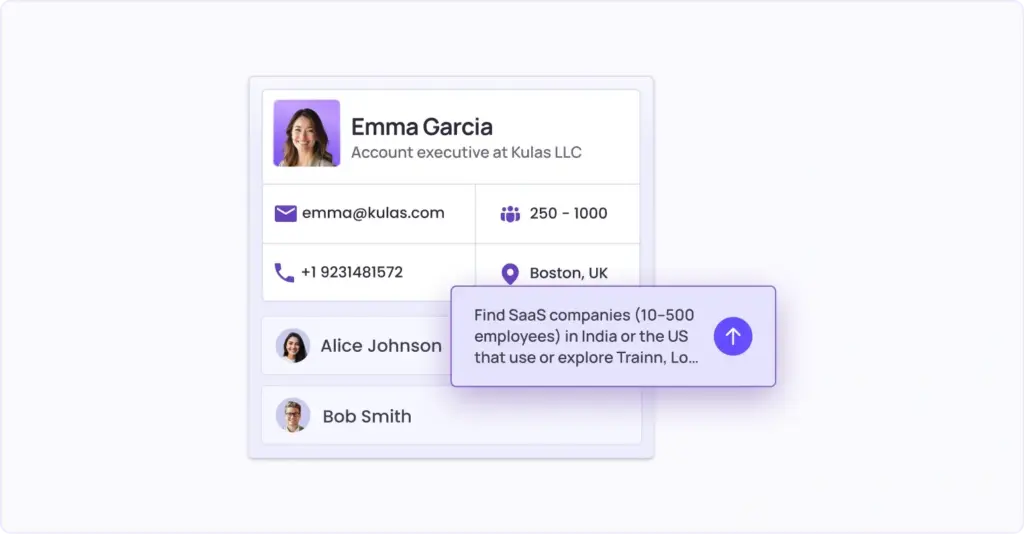
Describe your ICP in natural language and build your target account list in seconds. AI-powered account discovery eliminates manual research and ensures you are targeting the right accounts from day one, so your reps spend time on accounts that actually convert, not on building spreadsheets.
Connect and Engage at Scale
AI Dialer
Klenty's Connect AI is a proprietary dialing infrastructure purpose-built to solve the structural reasons why calls go unanswered. Connect AI addresses every reason: numbers flagged as spam from overuse, calls going out at the wrong time, numbers shared across the team, short call durations signaling spam behavior to carriers, and no segmentation by phone intent.
Before dialing even begins, Connect AI optimizes five critical layers:
- Number Inventory: AI assigns unique numbers for each rep with dedicated pools organized by geography and territory, reducing overuse and spam flag risk.
- Call Timing Selection: AI chooses the perfect time to place each dial based on past call connects, email open times, and prospect timezone, ensuring calls hit during prospect active hours.
- Phone Intent: AI surfaces prospects likely to answer the phone by tracking missed incoming calls, multi-channel engagement signals, and recent outbound interaction. Reps start with contacts most likely to answer, not dialing blindly.
- Number Auto-Rotation: During dialing, Connect AI intelligently rotates numbers based on call-from number health and historical pick-up behavior, protecting number reputation while increasing pickup probability on follow-up attempts.
- Local Dialing: AI matches the right local area code to your prospect's region. When prospects see a familiar local number instead of an unfamiliar caller ID, pickup probability increases significantly.
After each dialing session, Connect AI continues optimizing. Number Health Reporting tracks pick-up rate, hang-up rate, voicemail rate, and average call duration. Underperforming numbers are automatically pulled from rotation and replaced with fresh ones. Reps can drop one-click personalized voicemails to extend call duration, improve callback rates, and maintain dialing speed.
Multichannel Outreach
Multi-channel outreach is critical for reaching buying committees, but personalization at scale is impossible without the right tools. Klenty enables you to execute coordinated outreach across email, calls, SMS, and other platforms while maintaining hyper-personalization at the account level.
Merge Fields and Liquid Templates let you add custom phrases and dynamic content based on prospect type and behavior. Kai, Klenty's AI Cadence Writer, scans the prospect's website to pick out personalization points and insert hyper-personalized openers, problem statements, and CTAs.
With auto-rotation of inboxes, email warmup, and AI-researched personalization, your emails land in primary inboxes and win more replies. Klenty's Multi-Channel Inbox collates all prospect communication in one place, allowing you to manage interactions without switching tabs.
This means every stakeholder in the buying committee receives relevant, personalized outreach across their preferred channels, without adding manual work to your SDRs. You control timing and messaging at the account level, ensuring coordinated touches across all threads, not disconnected individual outreach.
Execute and Coach in Real-Time
AI Coaching Suite
Klenty's Call Coaching Suite directly addresses the two problems that hold most outbound teams back: managers who cannot see what is happening on live calls, and reps who have no clear picture of where their conversations are breaking down.
AI Call Scoring
Every call is automatically scored across key sections: opener, discovery, objection handling, and closing. Managers get a full picture of rep performance without having to listen to every recording. Reps get clear, specific feedback on what went well and where to improve. Custom scorecards can be built for different products or verticals, making scoring relevant regardless of what the team is selling.
Live Call Studio
Managers and reps can see who is on a call in real time and click to listen in from a centralized view. Junior reps can listen to veteran reps' live calls to learn how top performers handle objections and move prospects forward, without waiting for a weekly debrief. Managers can leave notes immediately after a call while the context is still fresh.
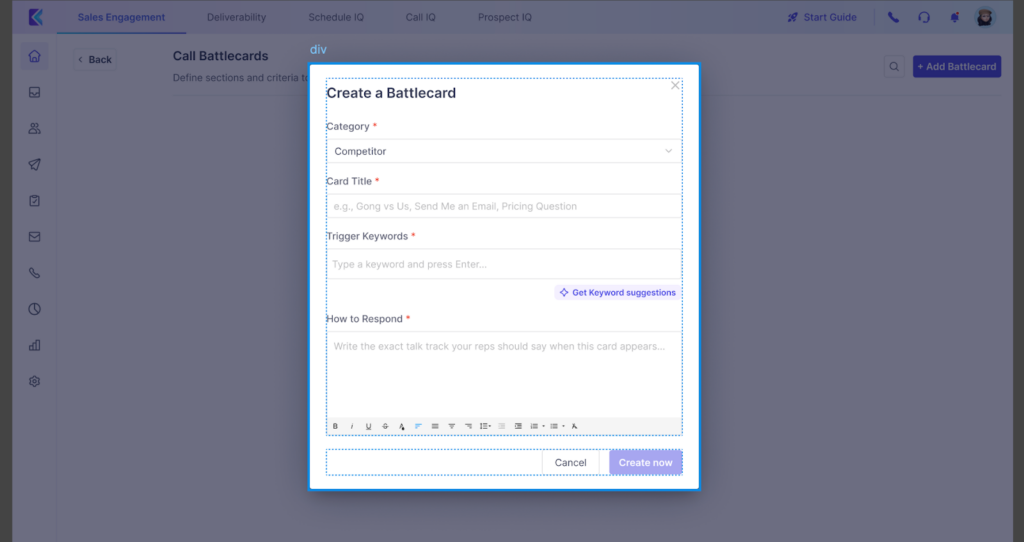
Battlecards
Battlecards give reps real-time, on-call guidance the moment a critical keyword or topic is detected in the conversation. When a prospect brings up pricing, a specific competitor, or a common objection, a tailored card instantly pops up with the right talk track, proof points, and questions to ask, so reps never have to scramble for answers or put prospects on hold.
This helps new reps ramp faster, keeps messaging consistent across the team, and ensures your best objection-handling tactics are used on every call, not just by your top performers.
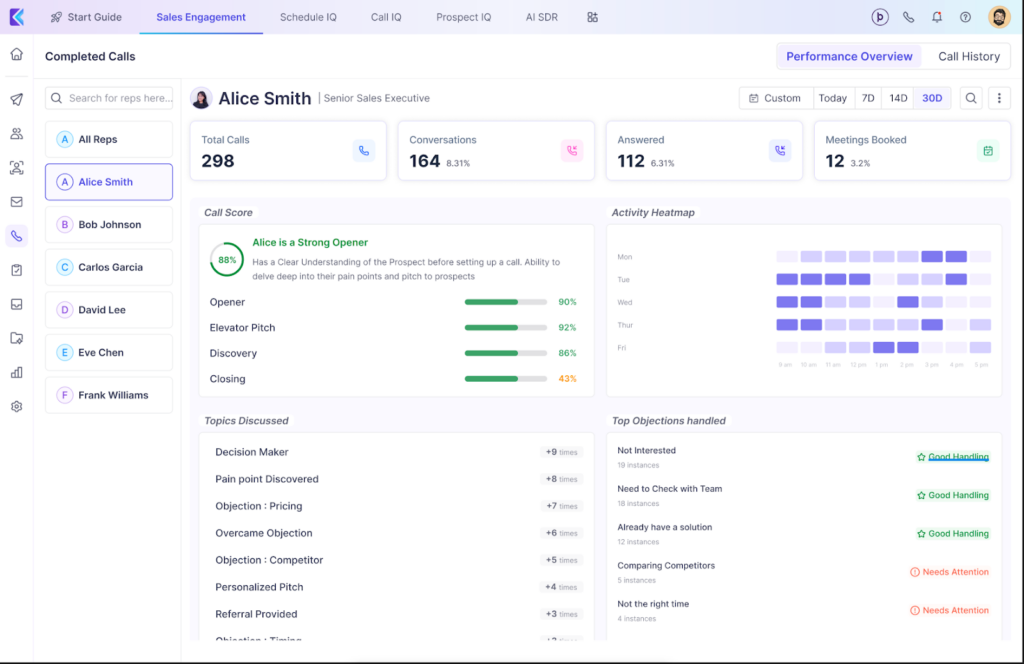
Call Performance Overview
The Call Performance Overview turns every conversation into a coaching asset by breaking down how well a rep handled key parts of the call - from opener to discovery questions to objections and closing.
After each call (or over a time period), managers and reps can see which moments were executed well, where conversations typically stall, and which topics or keywords come up most often, visualized as easy-to-scan charts. This makes it simple to identify top-performing talk tracks, spot skill gaps at an individual or team level, and prioritize coaching around the objections and themes that actually dominate real calls.
Orchestrate Coordinated Engagement Across Buying Committees
Account Action Window
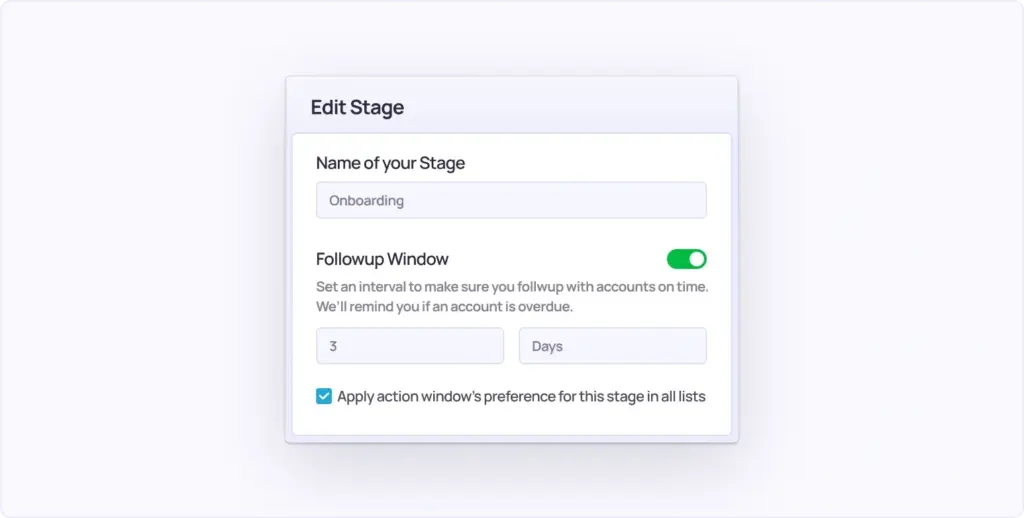
Every target account is at a different stage in its buying journey. Some need urgent action and immediate follow-up to turn into an opportunity - they are in-market. Others need more time, a longer nurture cycle before they are ready to talk to sales.
The problem is that all account actions pile up on your dashboard, leaving no room for prioritization. With traditional sales engagement tools, there's never been a way to control the velocity of rep execution against a set of accounts.
Account Action Windows changes that.
Choose the time period within which actions need to be taken for accounts in each stage. Klenty alerts you when they are overdue. The deeper an account is in its buying journey, the faster reps execute - systematically progressing cold accounts toward an opportunity by following up at set intervals.
Here is what you can do with Account Action Windows:
- Set the frequency, messaging, and channels for every prospect in an account to be engaged.
- Control the velocity of rep execution based on where each account sits in the buying journey.
- Ensure coordinated outreach across the entire buying committee so emails, calls, and LinkedIn touches hit the right people at the right time, not in random bursts.
- Get alerted when action windows are overdue so no account slips through the cracks.
Outreach Methodology (Multi-Threading)
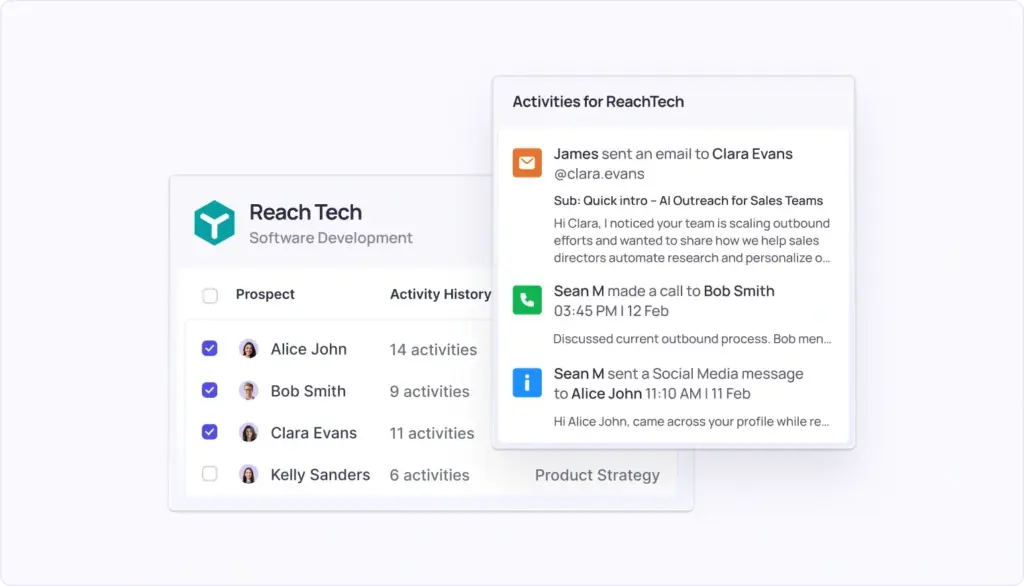
Enforce adherence to top-down, bottom-up, or custom multi-threading workflows. Systematically engage executives, mobilizers, and users within each account based on your preferred approach, ensuring no key stakeholder is left untouched, and every account gets full buying committee coverage.
AI Next Step Execution
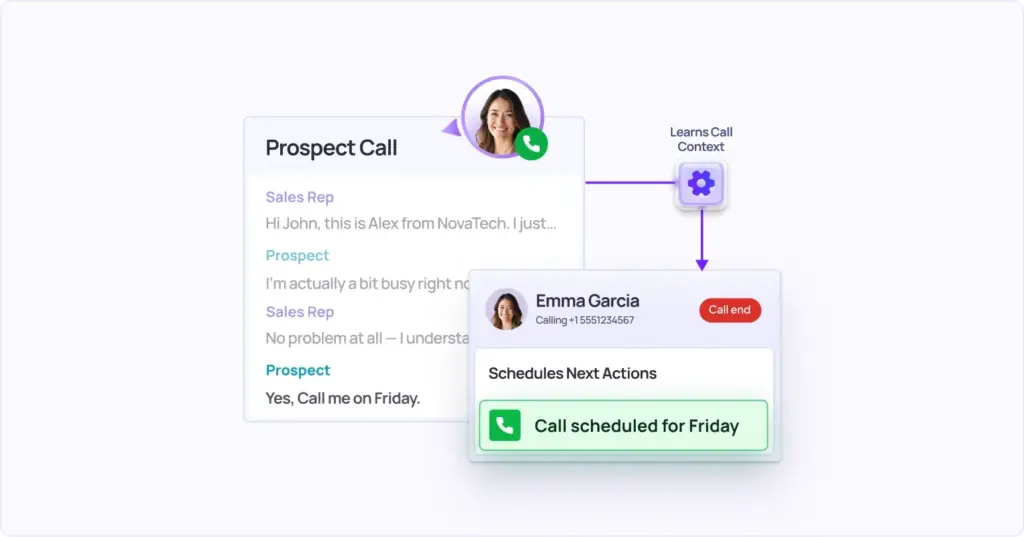
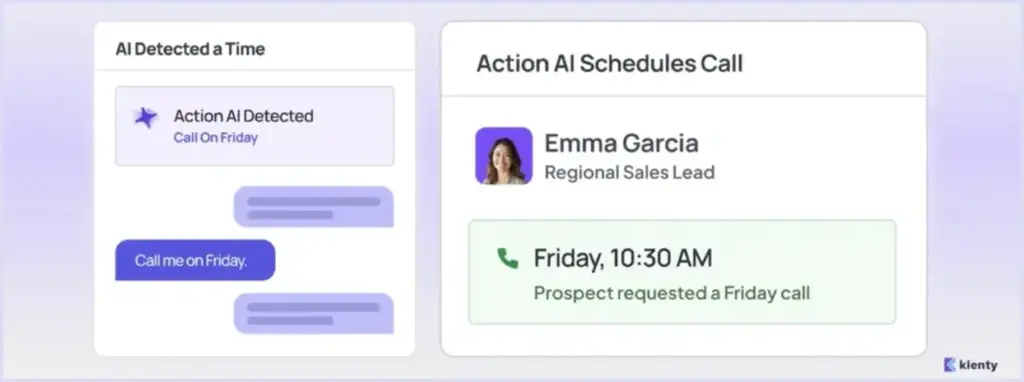
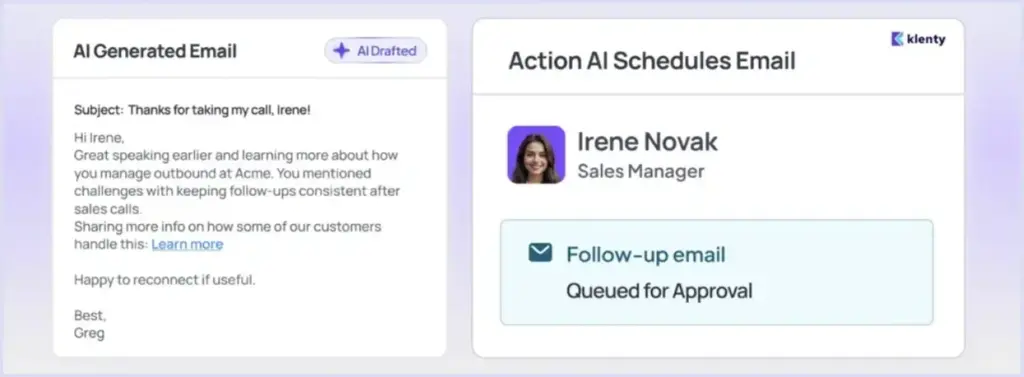
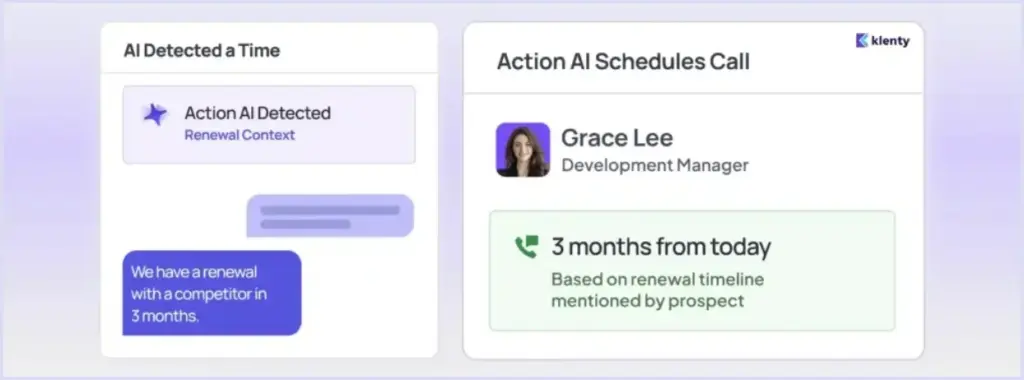
Klenty’s Action AI listens to your sales conversations, understands what was discussed on the call, and intelligently generates the next action. You can focus on dialing, not managing next steps, execute the right tasks at the right time, and save time with auto-generated follow-up messaging.
Time-Based Next Actions
Prospect says, “Call me on Friday.” → Action AI schedules a call for Friday with the prospect.
Channel-Based Next Actions
Prospect says, “Send me an email.” → Action AI creates a personalized email and queues it up for approval.
Context-Based Next Actions
Prospect says, “We have a renewal with a competitor in 3 months.” → Action AI schedules a call in 3 months with a call context.
Account Playbooks
Not all accounts are alike. Only 3% of your cold accounts are in-market at any given time; the rest need outreach that adapts to their needs, timing, and fit.
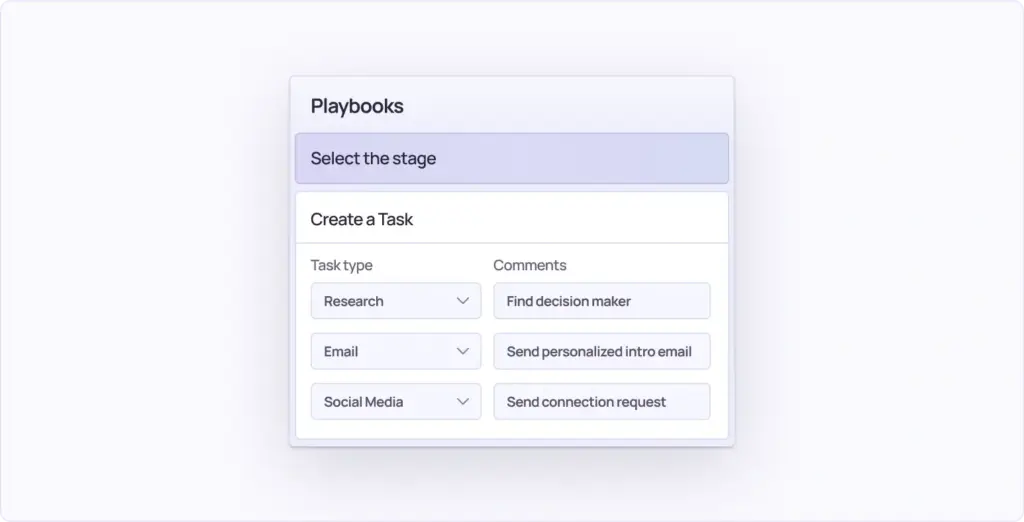
Traditional sales outreach tools are built purely for demand capture, leaving the other 97% of accounts without a structured way to be nurtured toward a buying decision.
Account Playbooks are built for both - helping you capture demand and create it.
Trigger the Right Play at the Right Stage
Set entry and exit criteria for each account stage and define the activities that need to happen as soon as accounts meet the criteria - across emails, calls, and tasks. When accounts show specific signals or reach certain stages, the right plays trigger automatically, so your team responds to buying intent in real time instead of discovering it weeks later in a pipeline review.
Control Velocity and Urgency of Execution
Not all stages carry the same urgency. Set Account Action Windows for each stage to control how fast reps execute. For instance, accounts in a "Decision-Maker Contacted" or "Meeting Booked" stage can be set to require execution instantly or within 24 hours, while earlier-stage accounts follow a longer, more measured cadence.
Orchestrate Playbooks Account-by-Account
Label accounts as "interested," "right contact identified," or "good fit, not now," and execute the right sequence of activities for an entire account before moving on to the next. This ensures outreach is coordinated across the entire buying committee - enrolling every prospect in customized follow-ups based on org-wide engagement level, so no account context is lost mid-play.
Account Panel
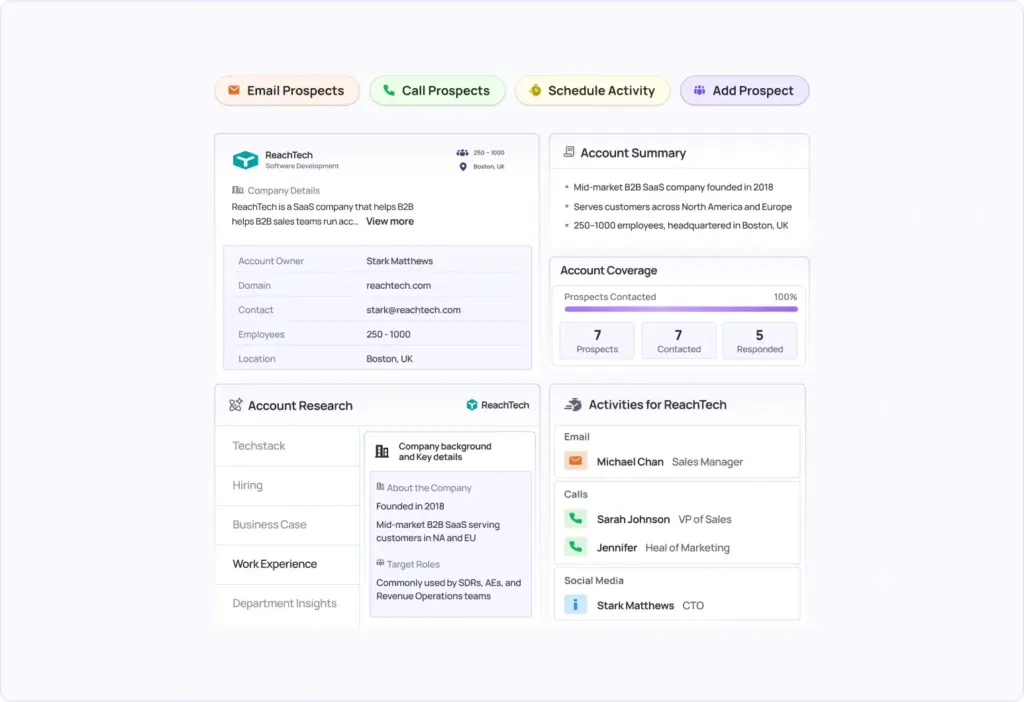
Klenty’s Account Panel helps you to -
Execute Outreach Account-by-Account
Unlike traditional sales engagement tools that are built around individual prospects, the Account Panel lets you group prospects by account and execute emails, calls, and tasks at the account level. Reps can move through research, sending emails, making calls, and finding fresh prospects - all without jumping between tools or losing context mid-execution.
Review the Entire Account's Engagement History
Rather than patching together individual prospect interactions in a spreadsheet, get a consolidated picture of every interaction across all stakeholders in an account, out of the box. Reps walk into every call informed, and managers see the full picture without chasing updates.
Multi-Thread Across the Buying Committee
Know exactly which prospects exist in an account, track coverage across hierarchies, roles, and titles, and add fresh prospects to ensure all relevant stakeholders are being engaged. No contact goes untracked, and no decision-maker falls through the cracks.
Run a Well-Researched, Consultative Sales Process
Basic account details, past conversation summaries, and AI-powered account research insights surface at the moment of dial, so every outreach stays relevant, timely, and specific to the account your rep is working on.
Track Account Progression and Optimize Coverage
Account Stages
Traditional sales outreach tools leave you with an Account Development Gap - you do not know which accounts are moving toward an opportunity and which are stuck, you can't define tailored strategies for each stage, and there's no systematic way to nurture demand across accounts that aren't ready yet.
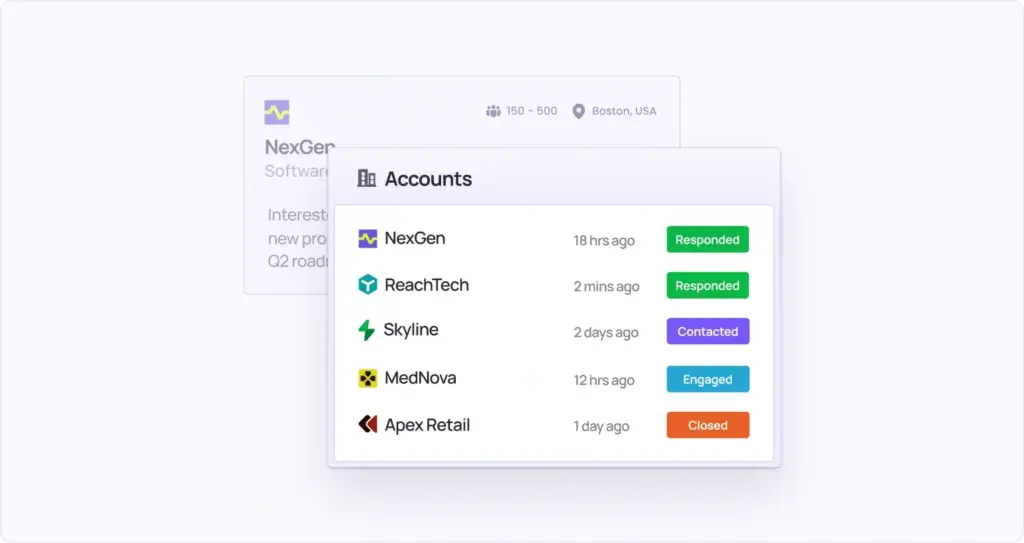
Klenty's Account Stages fixes this with CRM-like stages built specifically for sales outreach.
Define a Custom Pipeline for Account-Based Outreach
Create a custom pipeline for each account list and set up stages that reflect the actual steps accounts go through before turning into an opportunity. Every account has a defined place in the journey; nothing falls into a grey area.
View and Drill Into Accounts at Every Stage
With one click, dig into all accounts sitting at any stage of your pipeline. Drill deeper into account-level details like prospects contacted, notes, next steps, and activity history, all consolidated in a single table view so nothing needs to be chased down manually.
Set Custom Strategies for Each Stage
Define entry and exit criteria for each account stage and prescribe the series of actions that need to happen as soon as an account moves in. Each stage gets its own tailored outreach strategy, so reps always know exactly what to do next, for every account, at every step.
Prescribe the Urgency of Execution at Each Stage
Prevent account rotting. Set deadlines for actions to occur at each stage of the pipeline so accounts at advanced stages get immediate attention, and no high-intent account sits idle waiting for a rep to take action.
Account Coverage Analysis
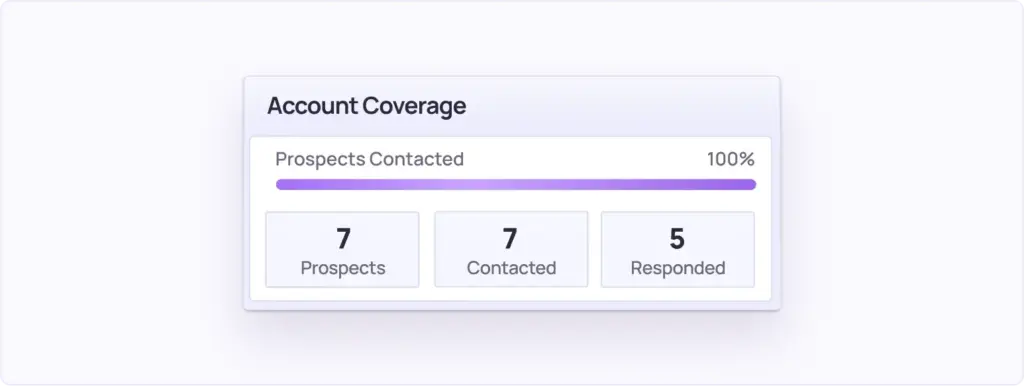
Review the percentage of ICP prospects engaged in any given account and identify gaps for deeper multi-threading. This ensures you are not leaving key stakeholders untouched, the single biggest reason ABS deals stall or die in the pipeline.
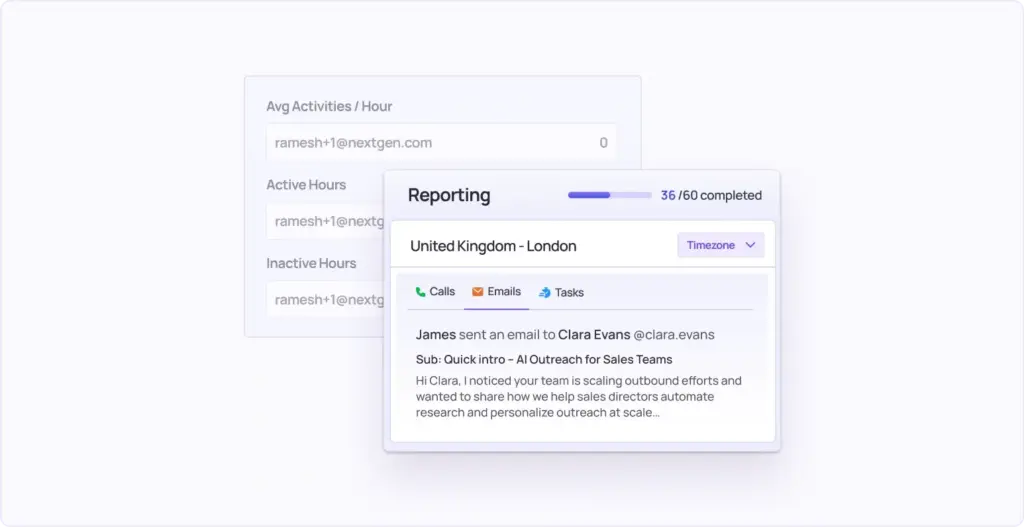
Account-Level Reporting
Track SDR activity across daily, weekly, and monthly timelines and contrast it against target account progression. You measure what actually matters, account movement and pipeline created, not just email volume or call counts that look busy but produce nothing.
Conclusion
Klenty gives your SDRs a structured way to develop every account in your TAM - from mapping your ICP and building your target list, to coordinating outreach across buying committees, to tracking stage progression and coverage gaps, to letting AI handle next steps so nothing falls through the cracks.
Every feature is built around one outcome: converting more accounts into a qualified pipeline, predictably and at scale.
For SDRs, that means spending less time on admin and more time on conversations that actually move accounts forward. For sales leaders, that means full visibility into account health, coverage gaps, and where the pipeline is really coming from.
If your team is ready to move from spray-and-pray outbound to a structured account development motion that actually scales, Klenty gives you the infrastructure to execute it.
Book a demo and see how Klenty helps you develop more accounts into a qualified pipeline.
Frequently Asked Questions
How many accounts should we target?
How long does account development take?
How many stakeholders should we contact per account?
What's a good connect rate in account development?
When does an account become a qualified opportunity?
One prospect said no. Is the account dead?
What do we measure in account development?
Can we do this with our current tools?
About the Author