Sales reps spend barely 2–3 hours of their workday on actual pipeline activity. The rest disappears into research, data entry, follow-ups, and admin tasks that never move a deal forward. An AI sales engagement platform changes that equation completely. It automates repetitive outreach, personalizes messaging at scale, handles call scheduling, and executes follow-ups based on real conversation context. In this guide, we break down what an AI sales engagement platform does, how it works, the features that matter most, and how to pick the right one for your team.
What Is an AI Sales Engagement Platform?
A sales engagement platform is software that helps sales teams plan, execute, and track prospect interactions across channels like email, phone, LinkedIn, and SMS. It brings sequencing, calling, tracking, and analytics into a single workspace.
An AI sales engagement platform goes much further. It uses artificial intelligence to handle the work that traditionally eats up a rep's entire day - building prospect lists, researching accounts, writing personalized emails, deciding the best channel and timing for outreach, making calls efficiently, and scheduling follow-ups based on what prospects actually say in conversations.
Here's the distinction that matters:
| Capability | Traditional Sales Engagement | AI Sales Engagement |
|---|---|---|
| List Building | Manual — reps search databases and build lists | AI-powered — describe your ICP in plain English, get scored accounts |
| Account Research | Manual — reps spend 15–30 min per prospect | Automated — AI surfaces funding, hiring, tech stack, growth signals |
| Sequences | Static, linear templates applied to all prospects | Dynamic, account-specific cadences generated by AI |
| Personalization | Manual — reps write each variation | Automated — AI inserts relevant insights into every message |
| Calling | Single-line dialing, manual next steps | Parallel/power dialing, AI-suggested contacts, auto-tasks |
| Follow-ups | Scheduled on fixed intervals | Triggered by prospect behavior and actual call conversations |
| CRM Updates | Reps log activities manually | Auto-synced from all outreach activity |
In short, a traditional platform gives reps tools. An AI sales engagement platform gives reps an AI co-pilot that handles execution while they focus on conversations that close deals.
How an AI Sales Engagement Platform Works
An AI sales engagement platform operates across the full outreach lifecycle. Here's the workflow, step by step:
1. Prospect Identification and List Building
AI analyzes your ideal customer profile (ICP) and searches databases to surface accounts that match. Instead of manually building lists, reps describe their target in plain language - like "Find B2B SaaS companies hiring SDRs, expanding to APAC, using Salesforce" - and the AI list builder returns scored, validated matches with verified contact data.
2. Account Research
The platform researches each account across 150+ public data sources - company websites, LinkedIn profiles, news articles, funding announcements, hiring trends, and tech stack data. It distills this into actionable prospect-level insights that reps can use immediately. What used to take 15–30 minutes per prospect now happens instantly.
3. Personalized Message Generation
Using the research data and proven sales frameworks, the AI writer crafts personalized emails, subject lines, and CTAs for each prospect. This isn't merge-tag personalization - it's messaging that references specific business priorities, recent events, and contextual triggers like funding rounds or leadership changes.
4. Multichannel Sequence Execution
The platform executes outreach across email, phone (parallel dialer and power dialer), LinkedIn, and SMS in coordinated sequences. AI determines the best channel and timing based on how each prospect has engaged so far.
5. Intelligent Calling with AI Dialers
Built-in parallel dialing and click-to-call capabilities let reps make significantly more calls without switching tools. AI reduces downtime from voicemails, phone trees, and missed connections - and suggests the right contacts to call based on engagement signals.
6. AI-Powered Next Step Execution
This is where modern AI platforms truly differentiate. After every call, the AI listens to the conversation, understands what was discussed, and automatically generates the next action. If a prospect says "Call me Friday at 3 PM," the system schedules it. If they say "Send me pricing," the AI drafts and queues the follow-up. If they mention a colleague to contact, the AI finds that person and creates the task.
7. CRM Sync and Reporting
Every touchpoint - emails sent, calls made, replies received - syncs automatically to your CRM. Reps never manually log activities, and managers get real-time visibility into pipeline activity without chasing updates.
💡 Pro TipThe biggest productivity gains come from AI handling research, list building, and next-step execution — the three tasks that consume the most rep time but feel too important to skip. When the platform handles those, reps can focus entirely on live conversations.
Key Features of an AI Sales Engagement Platform
Not every platform that claims AI actually delivers it. Here are the features that separate a genuine AI sales engagement platform from basic automation with an AI label:
1. AI List Builder
The foundation of effective outreach is reaching the right accounts. An AI list builder lets reps create high-quality prospect lists using simple English prompts rather than complex boolean searches.
What to look for: - Natural language ICP input (e.g., "Find B2B SaaS companies hiring SDRs, expanding to APAC, using Salesforce") - Access to large contact databases (700M+ contacts) - AI-scored accounts based on ICP fit with reasoning for each score - Automatic enrichment with verified emails and phone numbers - Direct integration into outreach sequences
Why it matters: SDRs get tired, vetted accounts ready for outreach — saving hours of manual research and ensuring they're targeting prospects most likely to convert.
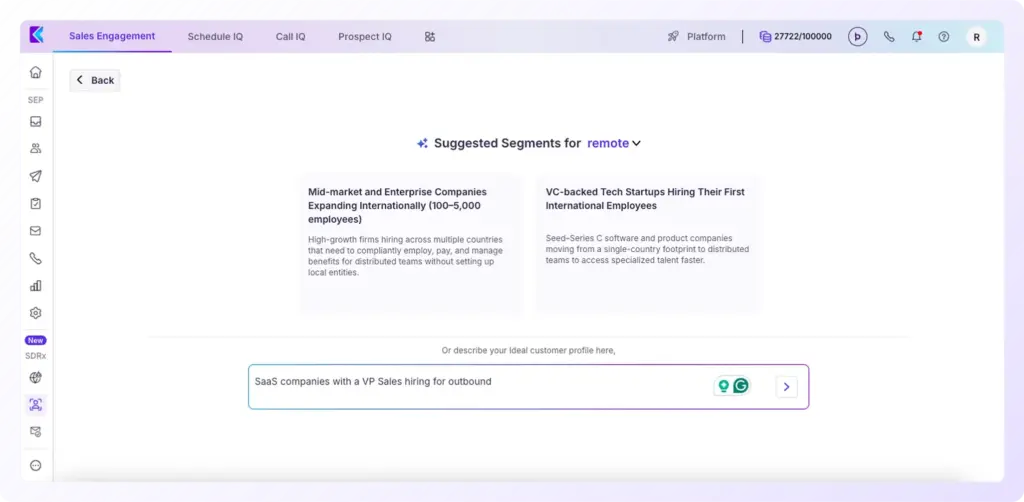
Klenty's AI List Builder delivers exactly this, tapping into a 700M+ contact database and scoring every account against your specific ICP.
2. AI Account Research
Before any outreach, reps need context. AI account research instantly surfaces insights about accounts and prospects — recent funding, tech stack, hiring trends, social activity, and company growth signals.
What to look for: - Research across 150+ public data sources - Automatic insight extraction (not just raw data dumps) - Prospect-level details from LinkedIn and company pages - Growth signals and timing triggers (funding, expansion, leadership changes) - Direct insertion of insights into outreach templates
Why it matters: AI research ensures SDRs know the right accounts to prioritize, the right contacts to engage, and the most relevant messaging angles — eliminating hours of manual research while enabling highly personalized outreach.
Klenty's AI Account Research does this automatically for every prospect in your sequences.
3. Agentic Cadences
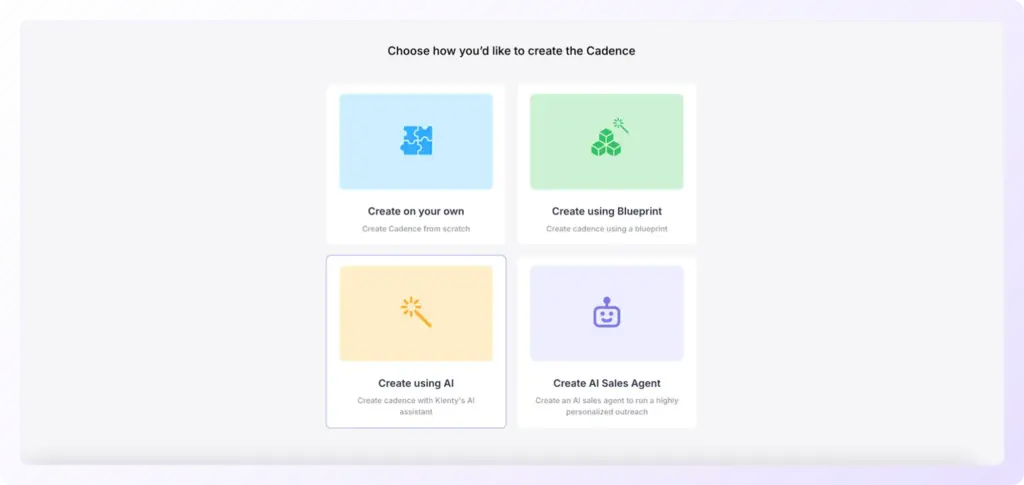
This is where AI goes far beyond templates. Agentic cadences design account-specific engagement strategies across email, calling, and research actions. AI generates personalized sequences, inserts account insights into templates, and adapts automatically to prospect behavior.
What to look for: - AI-generated, account-specific outreach strategies - Automatic personalization of subject lines, openers, body copy, and CTAs - Adaptive sequencing based on prospect engagement - Multi-channel orchestration (email + calls + LinkedIn) - Review-and-approve workflow (not fully autonomous, but rep-assisted)
Why it matters: SDRs can review and approve AI-generated steps rather than drafting each email manually. Every interaction becomes timely, relevant, and high-touch — without the manual effort.
Klenty's Agentic Cadences research each account, build tailored strategies, and write personalized emails for every prospect automatically.
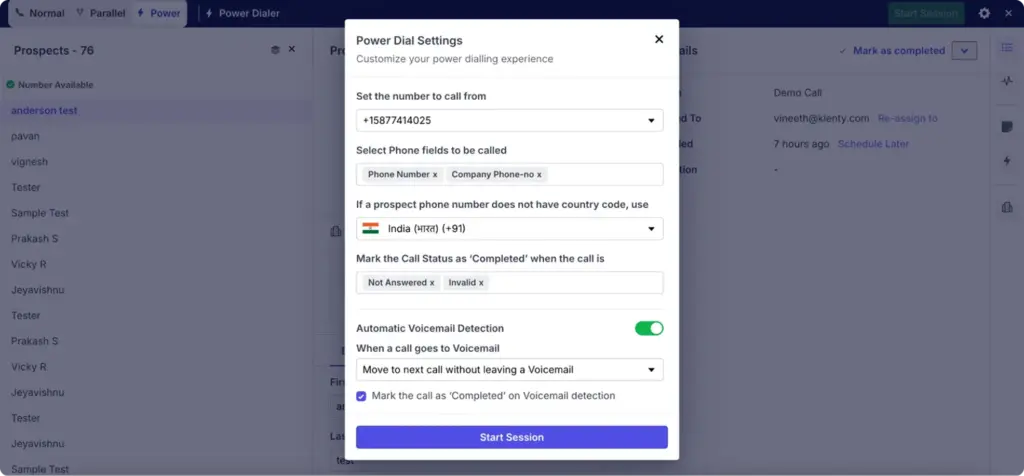
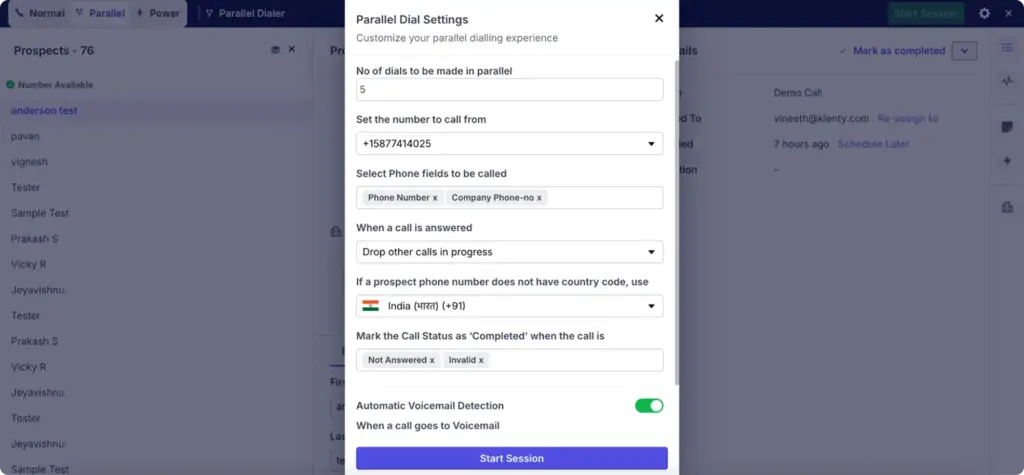
4. AI Parallel & Power Dialer
Scale outbound calling efficiently with automated dialing, click-to-call, and multi-line support. AI-powered dialers reduce downtime from voicemails, phone trees, or missed connections — letting SDRs focus on real conversations.
What to look for: - Parallel dialing (multiple lines simultaneously) - Power dialing with automatic progression - Click-to-call from any screen - AI-suggested contacts based on engagement signals - Voicemail drop and call disposition tracking - Integration with sequences and CRM
Why it matters: Combined with AI suggestions for the right contacts, reps reach more prospects without wasting time on manual dialing or missed connections. A rep using parallel dialing can make 3–5x more calls per hour than single-line dialing.
5. Email Deliverability Infrastructure
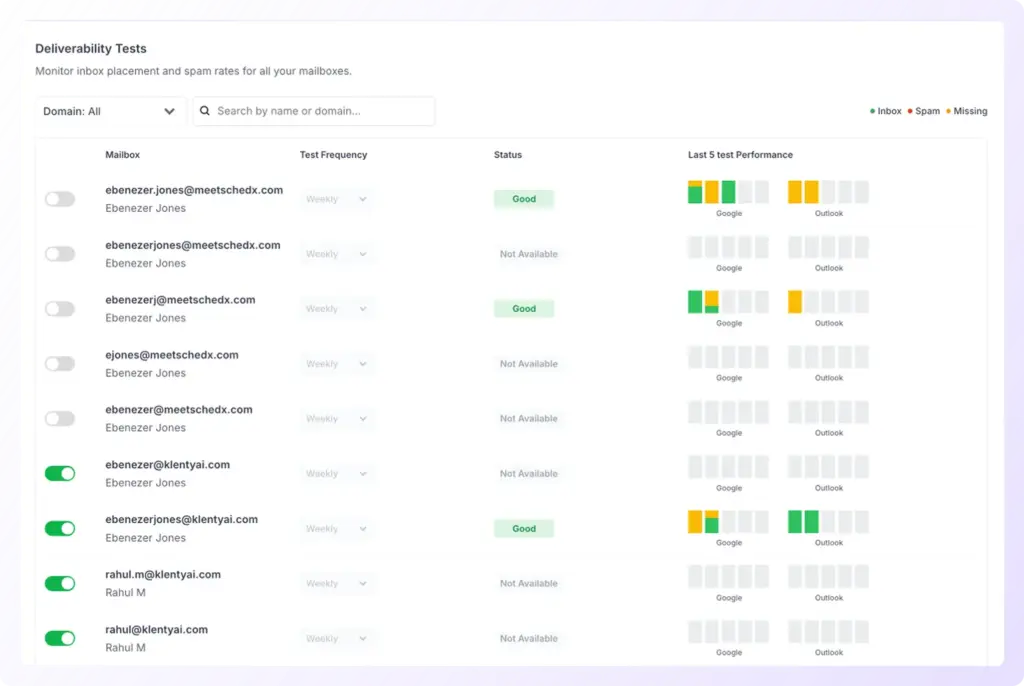
Personalized messages mean nothing if they land in spam. A strong AI sales engagement platform includes full-stack deliverability infrastructure to ensure your outreach reaches inboxes.
What to look for: - Done-for-you domain and mailbox setup (SPF, DKIM, DMARC authentication) - Auto warm-up to build sender reputation - Inbox rotation and volume throttling to mimic human sending behavior - Custom domain tracking links (no shared tracking domains) - Spam-safeguard checks before sending - Centralized reports at mailbox and domain levels for optimization
Why it matters: Without proper deliverability setup, even the best AI-written emails end up in spam folders. Deliverability infrastructure is the foundation that makes all other features work.
Klenty's deliverability setup handles all of this automatically, ensuring your emails consistently reach primary inboxes.
6. AI-Based Next Step Execution (Action AI)
This feature separates true AI platforms from basic automation. After every sales call, the AI listens to the conversation, understands what was discussed, and intelligently generates the next action — without rep involvement.
What to look for:
Schedule Next Actions Automatically: Skip digging through transcripts or manually creating tasks. The AI identifies the next action from your call and automatically creates it. If a prospect says "Call me Friday at 3 PM," the AI schedules that follow-up automatically.
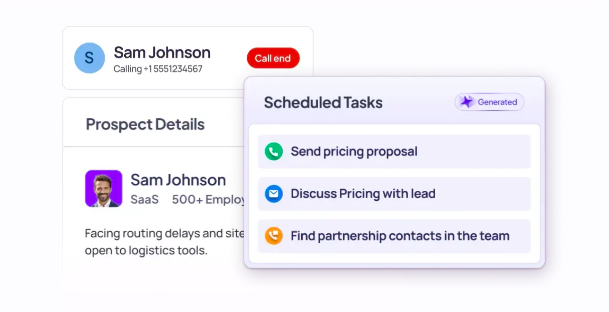
AI-Generated Follow-Up Messaging: No more spending 30 minutes writing follow-up emails. The AI uses conversation context to draft personalized follow-ups instantly. If a prospect says "Reach out next week," the AI selects a smart default window based on rep-defined rules and queues the message.
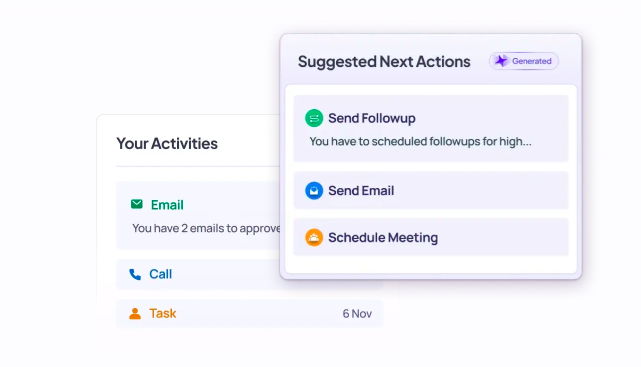
Intelligent Contact Discovery: If a prospect says "You should speak to Sarah, our Head of Procurement," the AI searches for Sarah, adds her to the account, and generates the appropriate outreach task — all without manual intervention.
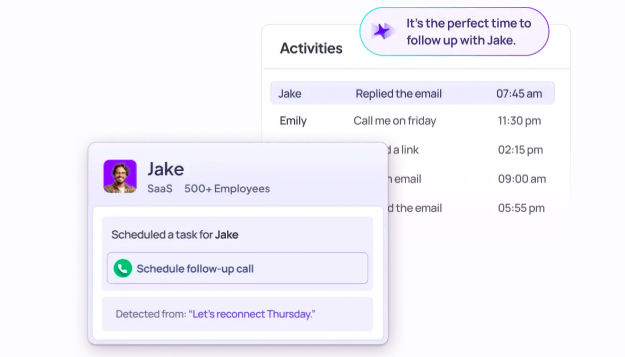
Why it matters: Reps can focus on dialing, not managing next steps. Every conversation moves forward with the right action at the right time, and no follow-up falls through the cracks.
Klenty's Action AI delivers all three capabilities, turning every call into automatic next steps.
7. AI-Powered Personalization
Leverage real-time insights at the account and prospect level to craft highly relevant messages. AI automatically highlights timely events - funding rounds, hiring trends, social updates, product launches — letting SDRs personalize at scale while maintaining context and tone.
What to look for: - Real-time event detection and alerting - Automatic insertion of insights into email templates - Tone and context matching - Personalization at scale (not just first-name merge tags) - A/B testing of personalized variations
Why it matters: Personalized emails have 26% higher open rates and 139% higher click-through rates than generic messages. AI lets you achieve this level of personalization across thousands of prospects without manual effort.
8. Native CRM Integrations
Seamlessly connect with Salesforce, HubSpot, Pipedrive, and Zoho. A true AI sales engagement platform syncs all prospect data and activities automatically, enables trigger-based workflows, supports in-CRM outreach, and logs all activity for accurate pipeline tracking.
What to look for: - Bi-directional sync (CRM ↔ engagement platform) - Real-time activity logging (emails, calls, replies) - Trigger-based sequence enrollment - In-CRM outreach capabilities - Contact and account data enrichment - No manual entry required
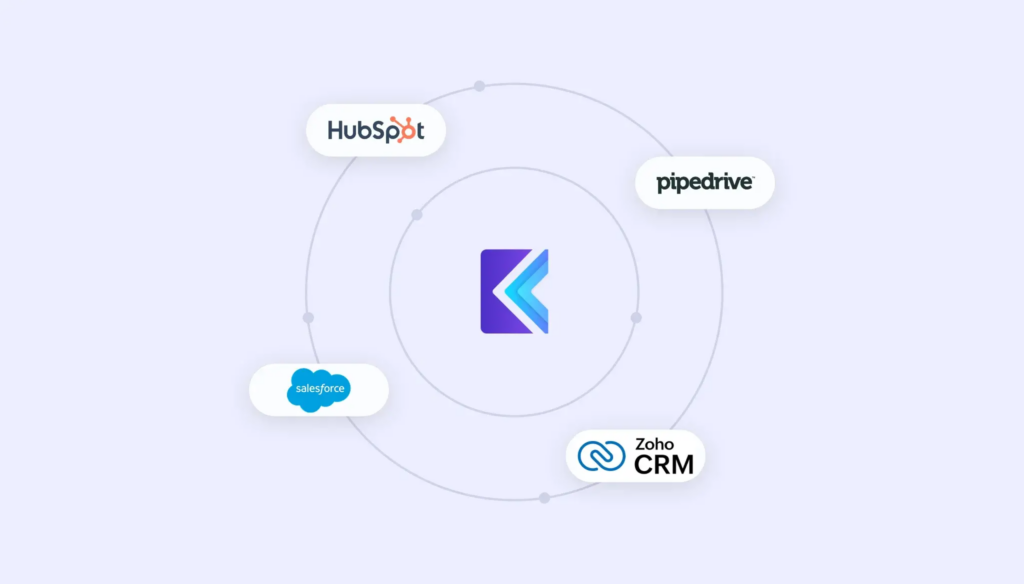
Why it matters: If reps have to update both the CRM and the engagement platform, adoption drops and data quality suffers. Native integration eliminates this friction and ensures your CRM remains the source of truth.
Benefits of an AI Sales Engagement Platform
The data on AI-powered sales engagement is consistent across multiple industry reports. Here's what teams actually see:
More Selling Time
According to industry research, 81% of sales professionals say AI helps them spend less time on manual tasks. Teams using AI-powered engagement tools save 4–7 hours per week per rep — time that goes directly to pipeline-building activities like calls and meetings.
Higher Conversion Rates
AI-driven lead prioritization and personalization lead to measurable improvements. Sales teams using AI report up to 30% higher lead conversion rates and 15% shorter sales cycles.
Better Personalization Without More Effort
Personalized outreach outperforms generic messaging by a wide margin — 26% higher open rates and 139% higher click-through rates. An AI sales engagement platform delivers that level of personalization without requiring reps to spend 30 minutes researching each prospect.
Consistent Follow-Up Execution
Deals often stall not because of disinterest but because reps get buried in tasks and forget to follow up. AI-driven automation - especially Action AI that creates next steps from call conversations - ensures every prospect receives timely, relevant follow-ups. Zero overdue tasks, zero missed opportunities.
More Calls, Better Connections
AI parallel and power dialers let reps make 3–5x more calls per hour than manual dialing. Combined with AI-suggested contacts and reduced voicemail/phone tree time, reps have more actual conversations with qualified prospects.
Revenue Impact
Teams using AI sales tools are 1.3x more likely to experience revenue growth. Companies adopting AI-driven sales tools report 6–10% average revenue increases, with 74% achieving ROI within the first year.
Scalable Outreach
An AI sales engagement platform lets a team of 5 reps cover the same territory that previously required 10 — without sacrificing personalization quality. The AI handles list building, research, writing, calling efficiency, and follow-up execution, so each rep can engage more accounts with better quality.
Best Practices for Using an AI Sales Engagement Platform
Buying the platform is the easy part. Getting real results requires thoughtful implementation:
1. Start with a Pilot Team
Don't roll out to your entire sales org on day one. Begin with a small team - 3 to 5 reps - who can test workflows, identify friction, and document what works. Use their experience to build playbooks before expanding.
2. Define Clear Metrics Before Launch
Decide what success looks like upfront. Track metrics like meetings booked per rep, reply rate, time saved on research, calls made per day, and pipeline generated. Without clear benchmarks, you won't know whether the platform is actually moving the needle.
3. Trust AI for Research and First Drafts — Review Before Sending
AI-generated messages are good, but they're not perfect out of the box. Have reps review AI-drafted emails during the first few weeks to calibrate tone and accuracy. Once the AI learns your brand voice and messaging patterns, you can increase automation confidence.
Pro Tip: Set up cadence playbooks for different ICPs and buying stages. This gives AI the right framework to generate relevant sequences rather than generic outreach.
4. Use Multichannel Sequences — Not Just Email
Email-only cadences leave engagement on the table. Build sequences that combine email, phone, LinkedIn, and SMS to reach prospects on their preferred channel. Data shows multichannel outreach consistently outperforms single-channel approaches. LinkedIn messages alone see 10.3% reply rates versus 5% for email.
5. Maximize Your Dialer Capabilities
If your platform includes parallel or power dialing, use it. Train reps on multi-line calling workflows, set up voicemail drops, and leverage AI-suggested contacts. The productivity gains from efficient calling compound quickly.
6. Keep Your CRM Data Clean
AI is only as good as the data it works with. Ensure your CRM records are accurate and up to date. Deduplicate contacts, standardize fields, and set up rules to keep data quality high. Clean data leads to better AI personalization and fewer misfires.
7. Review and Optimize Regularly
Check your sequence analytics weekly. Identify which messages, channels, and timing produce the best results. Retire underperforming sequences, double down on what works, and let AI insights guide your iteration.
How to Choose the Right AI Sales Engagement Platform
With dozens of tools on the market — each claiming AI capabilities — here's a framework for cutting through the noise:
Match the Platform to Your Sales Motion
An enterprise team running complex, multi-threaded deals needs different capabilities than an SMB team doing high-volume outbound. Define your outreach style (high-touch vs. high-volume), your typical deal cycle, and your team's daily workflow before evaluating platforms.
Verify the AI Is Real
Many platforms add "AI" to their marketing but deliver basic rule-based automation underneath. Test whether the platform can genuinely: - Build prospect lists from natural language ICP descriptions - Research accounts and surface actionable insights automatically - Generate unique personalized content (not just merge tags) - Adapt sequences based on prospect behavior - Create next steps from actual call conversations
Ask for a demo with your own data, not a polished pitch deck.
Prioritize CRM Integration
The platform must sync natively with your CRM — Salesforce, HubSpot, Pipedrive, or Zoho. Bi-directional sync is non-negotiable. If reps have to manually update both systems, adoption will drop and data will suffer.
Evaluate Dialer Capabilities
If calling is part of your motion, check that the platform includes robust dialing features: - Parallel dialing for maximum call volume - Power dialing for efficient progression - Click-to-call from any screen - AI-suggested contacts based on engagement - Call recording and disposition tracking
Check Multichannel Capabilities
Verify the platform supports email outreach, calling, LinkedIn automation, and SMS from within a single interface. Switching between tools kills productivity.
Consider Deliverability Infrastructure
If your emails don't reach the inbox, nothing else matters. Make sure the platform includes domain authentication, email warm-up, inbox rotation, and deliverability monitoring. Platforms like Klenty's cold email software build this directly into the stack.
Assess Onboarding and Support
The best platform is the one your team actually uses. Evaluate the vendor's onboarding process, training resources, and ongoing support. A phased rollout with dedicated support will drive adoption far more than a self-serve setup.
Compare Real Pricing, Not Feature Lists
Features mean nothing if they're locked behind enterprise pricing tiers. Ask for transparent pricing, understand what's included at each tier, and calculate cost per rep. The most expensive platform isn't always the best fit, and the cheapest may cost you more in lost productivity.
Why Klenty Is Built for AI-Driven Sales Engagement
Among the AI sales engagement platforms on the market, Klenty stands out by pairing human reps with AI agents at every step of the outreach process. Rather than just automating sends, Klenty's AI handles the work that bogs reps down — list building, account research, email writing, efficient calling, follow-up scheduling, and CRM updates.
Here's what makes Klenty's approach different:
AI List Builder — Create high-quality prospect lists using simple English prompts. Klenty taps into a 700M+ contact database, scores accounts based on your ICP with reasoning for each score, and enriches lists with verified emails and phone numbers.
AI Account Research — Instantly surface insights about accounts and prospects: recent funding, tech stack, hiring trends, social activity, and company growth signals. SDRs know exactly which accounts to prioritize and what messaging will resonate.
Agentic Cadences — AI designs account-specific engagement strategies across email, calling, and research actions. It generates personalized sequences, inserts account insights into templates, and adapts automatically to prospect behavior. Reps review and approve rather than draft manually.
AI Parallel & Power Dialer — Scale outbound calling efficiently with automated dialing, click-to-call, and multi-line support. Reduce downtime from voicemails and phone trees. Combined with AI-suggested contacts, reps reach more prospects without wasting time.
Action AI — After every call, Klenty's AI listens to the conversation, identifies next steps discussed, and automatically creates tasks and follow-ups with full context. When a prospect says "send me pricing," Action AI drafts and queues it. When they mention a colleague, Action AI finds them and creates the outreach task.
Email Deliverability — Full-stack deliverability with done-for-you domain setup, auto warm-up, inbox rotation, volume throttling, custom tracking links, and centralized reporting.
Native CRM Integration — Two-way sync with Salesforce, HubSpot, Pipedrive, and Zoho. Every email, call, and reply syncs without reps touching the CRM.
Klenty is an end-to-end AI sales engagement platform that combines AI-driven list building, multi-channel sequencing, adaptive playbooks, intelligent dialing, conversation-based next steps, and deliverability intelligence. It saves SDRs time, fixes poor lists, automates execution, and helps teams go after more accounts without sacrificing personalization or reply quality.
Trusted by 5,000+ sales teams, Klenty is designed to help reps book 3x more meetings by eliminating the non-selling work that fills their day.
- An AI sales engagement platform automates list building, account research, personalized outreach, efficient calling, and intelligent follow-up execution so reps can focus on selling.
- True AI platforms go beyond automation — they build lists from natural language, research accounts automatically, generate personalized content, power efficient dialing, and create next steps from actual call conversations.
- Key features to look for: AI List Builder, AI Account Research, Agentic Cadences, AI Parallel & Power Dialer, Email Deliverability, Action AI (next step execution), AI Personalization, and Native CRM Integration.
- AI-powered tools save reps 4–7 hours per week and drive up to 30% higher conversion rates.
- Start with a pilot team, define success metrics upfront, use multichannel sequences, maximize dialer capabilities, and keep CRM data clean.
- Prioritize real AI capabilities over marketing claims — test list building, account research, personalization, dialing, and next-step execution using your own data.
- The AI SDR market is projected to reach $15 billion by 2030, growing nearly 30% annually. Early adopters gain a significant competitive advantage.
The shift from manual outreach to AI-powered engagement isn't a future trend - it's happening now. The question isn't whether your team needs an AI sales engagement platform. It's how fast you can implement one before your competitors do.
Ready to see how Klenty's AI can transform your outreach? Book a demo and see Agentic Cadences and Action AI in action.
Frequently Asked Questions (FAQs)
What is an AI sales engagement platform?
How is an AI sales engagement platform different from a traditional sales engagement platform?
What are the key features to look for in an AI sales engagement platform?
AI List Builder — Create prospect lists using natural language ICP descriptions
AI Account Research — Auto-surface funding, hiring, tech stack, and growth signals
Agentic Cadences — AI-generated, account-specific outreach strategies
AI Parallel & Power Dialer — Multi-line calling with AI-suggested contacts
Email Deliverability — SPF/DKIM/DMARC setup, warm-up, and inbox rotation
Action AI — Automatic next-step creation from call conversations
AI Personalization — Real-time event detection and insight insertion
Native CRM Integration — Bi-directional sync with Salesforce, HubSpot, Pipedrive, or Zoho