Choosing the right sales engagement platform can completely transform the way your team works and the outcomes you see. If you’re looking at Apollo.io vs Klenty, you’re probably wondering which platform makes it easier for your reps to build pipeline, automate more of their day-to-day, and drive rep productivity.
Apollo.io is well known for making email outreach easier and helping you build standardized cadences. But as you dig deeper into how Apollo works in real sales teams, you’ll see it can lead to several common challenges:
- After every conversation, reps have to manually create tasks, schedule follow-ups, write recap emails, and update CRM fields. This breaks their momentum, increases context switching, and results in missed next steps.
- Chasing the wrong accounts, filter-based solutions, and an AI assistant that does not map your ICP from the get-go.
- Standardized cadences that lead to the same sequence run for every account.
- Task overload for your reps- Apollo puts the burden of execution on users, leading to lots of overdue tasks.
- Limited support for scaling winning channels- No built-in deliverability infrastructure and limited dialing capabilities
In this guide, you'll see how Apollo.io and Klenty compare in the areas that matter most: automation, sales workflows, multi-channel outreach, CRM integration, and deliverability.
By the end, you’ll have a clearer idea of which sales engagement platform is the best fit for your team’s needs and growth goals.
What Is Apollo.io?
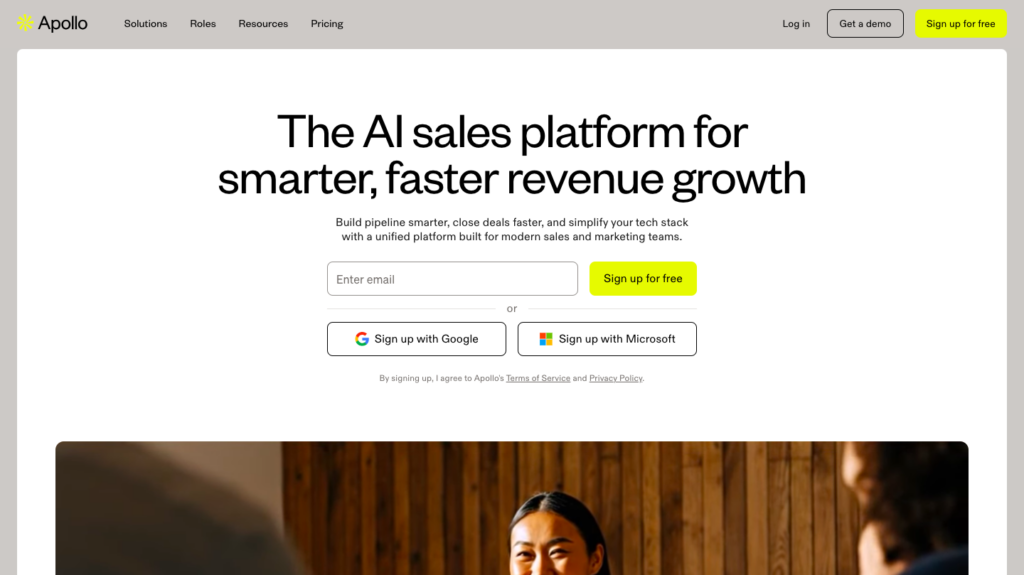
Apollo.io is a cloud-based sales automation platform focused on lead generation, contact database management, and email outreach. Founded in 2015, it serves as a lead intelligence and sales engagement platform trusted by nearly 9,000 customers, including major global enterprises. Apollo.io provides tools to identify prospects, automate outreach sequences, and manage contacts effectively to help sales teams build a pipeline and close deals.
What Is Apollo.io Best For?
- Founding BDRs or small teams targeting high-volume total addressable market (TAM)
- Sending email outreach at scale
- Building bulk campaigns with straightforward automation
- Teams focused on pipeline generation using a large data source
Features of Apollo.ai
- Sequences: Automate multi-step sales outreach, including emails, calls, and LinkedIn actions. Build dynamic workflows using if/then logic to adapt to prospect engagement.
- Dialer: Make, receive, and record calls inside Apollo.io. Use parallel dialing, call logging, and real-time call analytics for better outreach efficiency.
- Task Manager: Manage sales activities within an integrated workspace. Keep track of calls, emails, LinkedIn connections, and other daily sales tasks directly in your Apollo account.
- Apollo AI (AI Writing Assistant): Generate and personalize sales emails using Apollo’s built-in AI writer. Leverage buyer activity signals to customize outreach at scale.
- Bidirectional CRM Integrations: Sync all contact data and engagement activity with Salesforce and HubSpot. Maintain real-time data flow between Apollo and your CRM for seamless management.
- Plays (Template Library): Launch automation using pre-built Play templates. Access a continuously updated library to deploy best-practice workflows in seconds.
Pros and Cons of Apollo
Pros of Apollo.io
- Large B2B Database: Apollo.io provides access to a database of over 275 million contacts and 73 million companies, enabling highly targeted prospecting with advanced filters.
- Pricing: Apollo.io offers a free-forever plan and affordable paid tiers, giving startups and growing teams access to robust sales tools without a high upfront cost.
- Flexible Email Sending: You can send high volumes of emails per day by connecting multiple mailboxes, with raised thresholds on paid plans. (Note: There are still best-practice and deliverability-related caps to observe, but Apollo is more flexible than many competitors).
Cons of Apollo.io
- Reps need to execute tasks manually
Once a sales conversation ends, Apollo surfaces suggested next actions inside the call transcript, but reps still have to break their dialing rhythm, recall the call context, manually schedule the next step, and then resume the session. As more calls stack up, overdue follow-ups accumulate, critical next steps get delayed, and warm conversations turn cold. - Built for demand capture, not demand creation
Apollo.io excels primarily in finding and capturing “in-market” leads, leveraging its extensive contact database and campaign automation features. Its design is optimized for targeting active buyers, using filters, prospect research, email deliverability, and tracking, but lacks top-of-funnel demand creation features or broader multi-channel orchestration for generating new demand. - Standardized cadence for each account
Apollo.io’s Sequence tool enables building automated workflows, but users are limited to pre-existing automation templates. This means that every account can end up following the same cadence; customization is reduced because you cannot create fully custom triggers or advanced branching, which diminishes the ability to adapt to each prospect’s context. - No way to scale email without compromising deliverability: Apollo.io provides recommendations and guardrails for daily sending limits (suggesting no more than 50 emails per day per mailbox) because sending too quickly or in high volumes can cause inbox placement to drop due to spam filters and rate limiting.
Deliverability is reliant on manually configuring and monitoring SPF, DKIM, DMARC, and inbox warmup; going beyond recommendations introduces risk to sender reputation and reduces the ability to safely scale outreach volume.
Apollo’s workflow and technical gaps build up non-pipeline activity for your team, while Klenty’s platform and the 2025 AI Outbound Playbook move you from task overload to pipeline focus, letting AI agents handle the tedious steps so you can prioritize what grows revenue.
Pricing
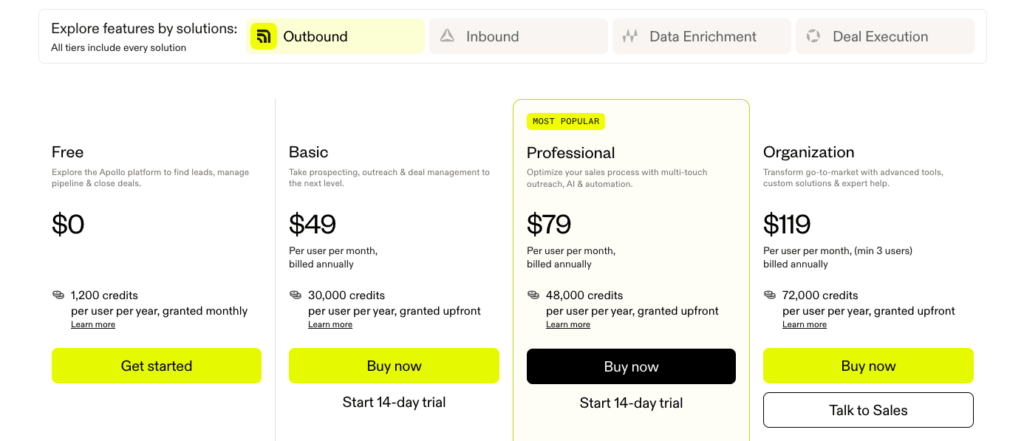
- Free: The Free plan lets you use Apollo with limited monthly credits and core outreach tools. This includes basic email campaigns (Gmail only), database access, and essentials for setting up sales conversations. It’s ideal for individuals or teams who want to get started with Apollo at no cost.
- Basic: The Basic plan unlocks more credits, expanded features, higher export limits, and support for additional email providers beyond just Gmail. Users can automate outreach, make calls, and manage pipelines with more volume and flexibility than the Free plan.
- Professional: The Professional plan provides advanced automation and sequencing, higher quota limits, and comprehensive pipeline management. It’s designed for scaling teams who need deeper analytics, increased outreach, and additional integrations to accelerate customer acquisition.
- Organization: The Organization plan is for large teams and enterprises with high volume and advanced requirements. It offers top-tier usage limits, administrative controls, priority support, and custom integrations, with features aimed at streamlining governance and complex workflows.
Apollo.io's G2 Reviews
A sales engagement platform is a significant investment for your organization, and a wrong decision can prove to be costly.
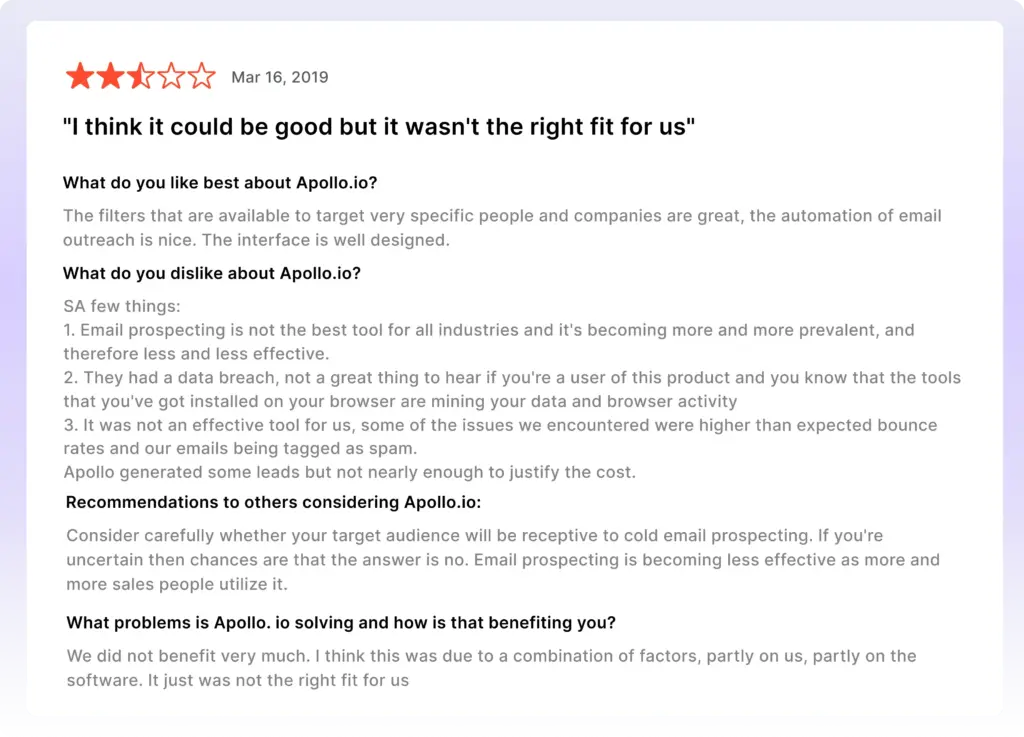
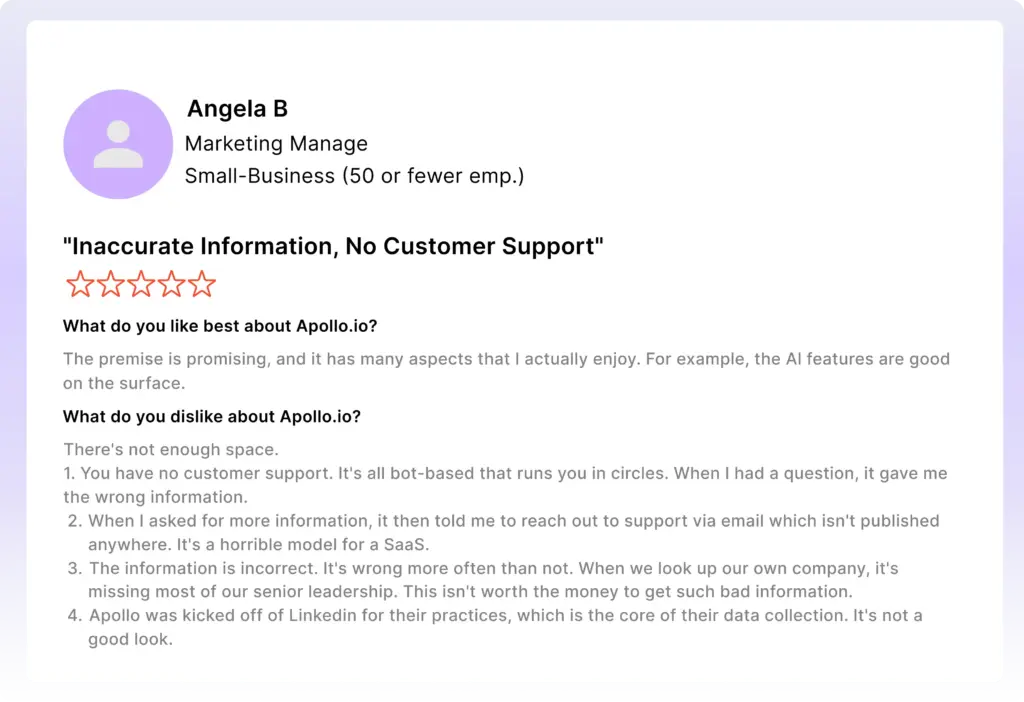
A sales engagement platform is a significant investment for your organization, and a wrong decision can prove to be costly.
So, checking reviews on G2 from users who have used the solution you’re evaluating will give you valuable insights about its pros and cons, helping you make a well-informed decision.
Why Klenty Is a Better Alternative
Klenty doesn’t pile you up with admin work. Reps act as approvers rather than task-doers, which means less time on overdue follow-ups and more time moving opportunities forward.
Other Sales Engagement Platforms log next steps in notes or transcripts, but Klenty’s Action AI listens, understands what was discussed in your sales conversations, and intelligently generates and executes the right next action based on call context, so reps can stay focused on selling rather than task management.
Where other platforms force reps to stop dialing, recall the context, remember who to follow up with, and manually schedule tasks or write emails, Klenty’s approach ensures follow-ups are automatically created, queued, or scheduled at the right time with full context, preserving momentum and reducing dropped actions.
With built-in deliverability infrastructure and advanced parallel dialing capabilities, you scale outreach across winning channels and maximize the time your team spends on pipeline-building activity.
Let's delve into why Klenty might be a more appealing choice for your growing sales team.
Features of Klenty
1. AI-based next step execution
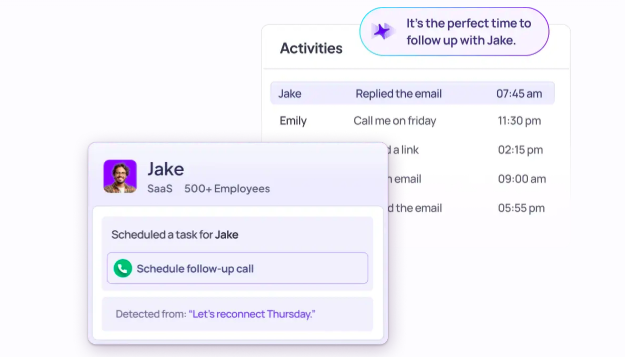
Klenty’s Action AI listens to your sales conversations, understands what was discussed on the call, and intelligently generates the next action. You can focus on dialing, not managing next steps, execute the right tasks at the right time, and save time with auto-generated follow-up messaging.
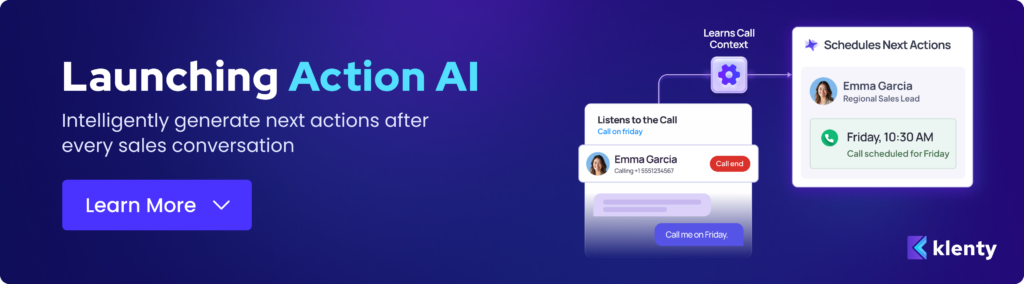
Schedule Next Actions As Soon As the Cold Call Ends
Skip digging through transcripts or manually creating tasks. Action AI identifies the next action from your call and automatically creates it.
Example: If a prospect says – "Call me Friday at 3 pm," then Action AI schedules that follow-up automatically.
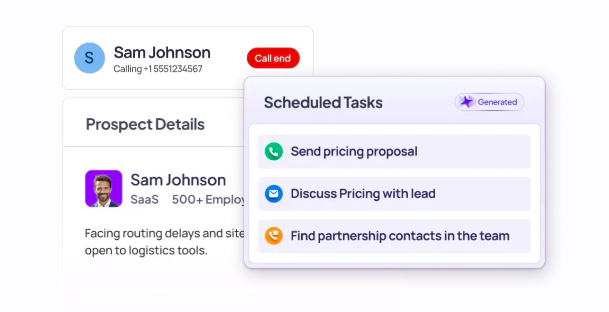
Find Your Next Actions Generated For You
No more spending 30 minutes writing follow-up emails or finding new contacts. Action AI uses conversation context to draft personalized follow-ups instantly.
Example: If a prospect says – "Reach out next week," then Action AI selects a smart default window based on rep-defined rules.
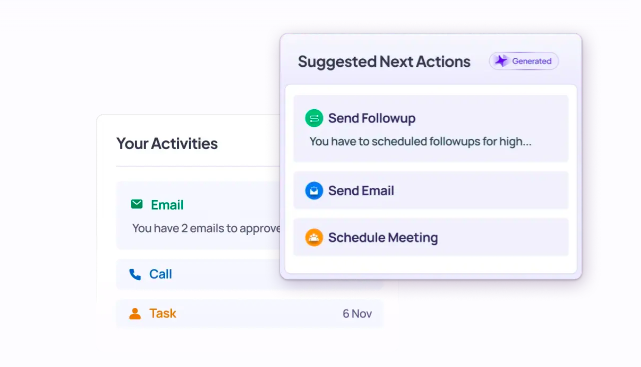
Execute the Right Action at the Right Time, effortlessly.
Say goodbye to forgetting follow-ups. Action AI surfaces the right next action for the right prospects at the right time, so every conversation moves forward.
Example: If a prospect says – "You should speak to Sarah, our Head of Procurement," then Action AI searches for Sarah, adds her to the account, and generates the appropriate task.
2. Agentic Cadences
Agentic Cadences help sales teams create a unique strategy of engagement for each account- and then execute that strategy with AI.
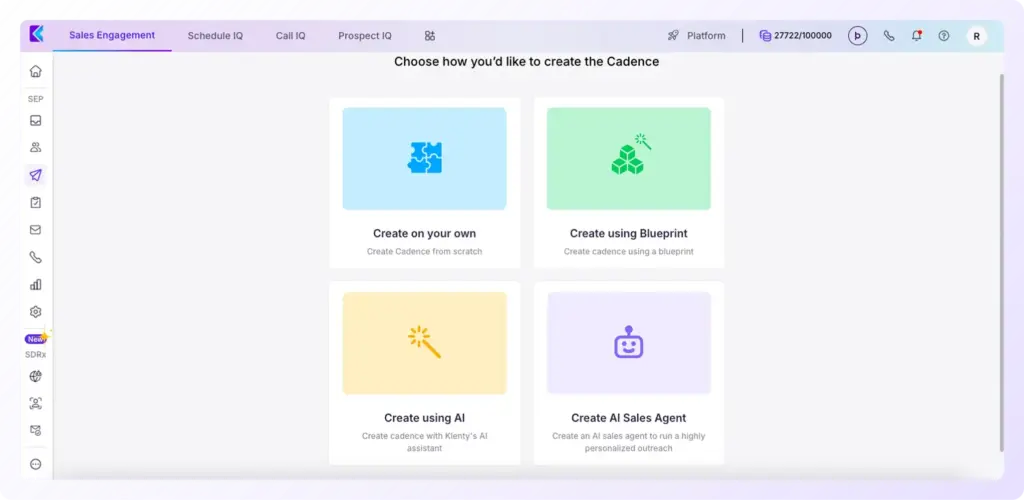
Agentic Cadences let you use AI in 3 specific ways
- Create entire personalized cadences with AI
- Ask AI to create specific email steps in the cadence- be it personalized emails or research actions.
- insert account and prospect research into your existing templates with ‘AI Variables’
Agentic Cadences allow reps to go from manually drafting every sequence and every email to just ‘reviewing and approving’ AI output.
You get complete control over AI generation- set guardrails at the global-level (across your team), sequence-level, or at the email-level.
3. Demand Nurture and Demand Capture with AI Playbooks
Static sequences assume all prospects behave the same way. Klenty’s AI Playbooks change that by allowing cadences to respond dynamically to prospect behavior.
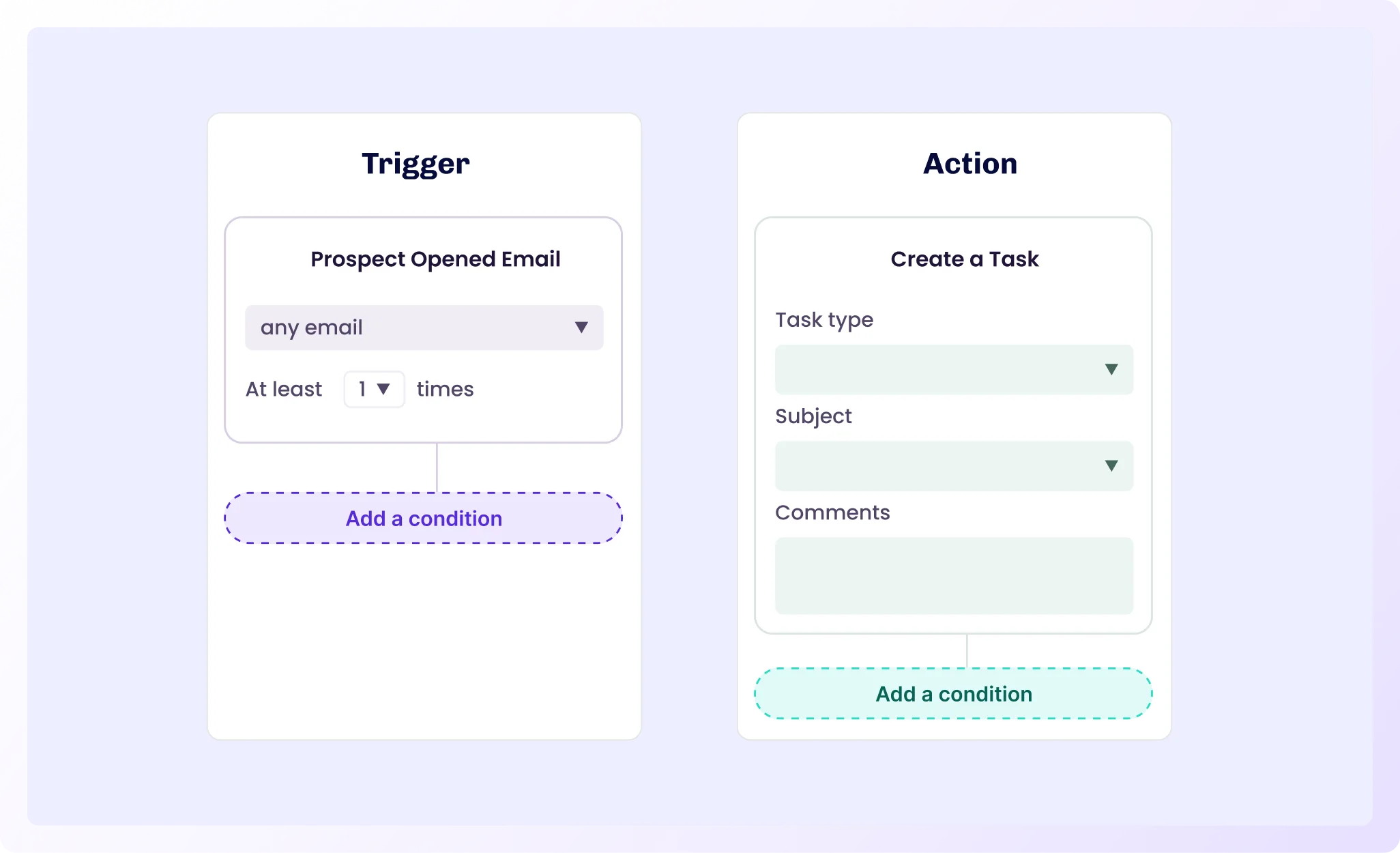
Klenty’s AI Playbooks automatically shift prospects to the right sequence based on their behavior.
Examples:
- A prospect who opens/replies → moves to a high-touch follow-up
- A cold lead → enters a long-term nurture sequence
- A demo request or CRM lead → gets slotted into the right outbound flow instantly
What sets Klenty apart is that the AI doesn’t just execute rules; it also suggests the next best step for each prospect. Based on engagement patterns, reply sentiment, and overall sequence performance, the platform can recommend whether to escalate, delay, personalize further, or move the lead into a different campaign. Your reps stay in control, but the system does the thinking for them.
This level of intelligent routing keeps your outbound engine agile and ensures every lead is followed up with the right message, at the right time, without falling through the cracks.
4. AI Agents That Execute Tasks for Your Reps
With Klenty, you get a team of AI Agents that execute all non-pipeline tasks across your outbound process, while your reps review, approve, and focus on pipeline-generating activities.
AI Agents build your account lists, find prospects and fetch emails and phone numbers, research accounts and prospects, write personalized emails, insert personalization into stale templates, and even take notes and summarize calls, so your team spends more time in conversations and less time on manual work.
5. Talk Track Tables
Talk Track Tables offers a clear, structured breakdown of call data, giving you an eagle-eye view of your reps’ performance.
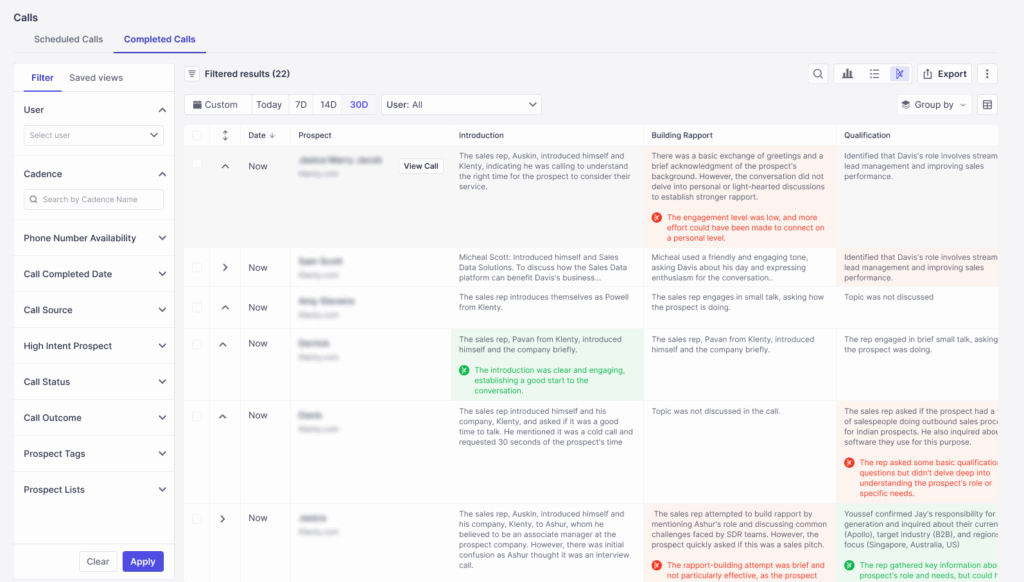
By transcribing and scoring calls based on clarity, engagement, persuasiveness, and data collection, Talk Track Tables turns unstructured data into actionable insights, allowing managers to instantly pinpoint strengths and improvement areas against an ideal standard.
Think of Talk Track Tables as an AI-powered SDR Analyst:
- Listening to hundreds of calls over time.
- Jotting down call details, breaking down calls into steps.
- Comparing what was done to what should have been done.
- Telling you where your reps need retraining or improvement.
With Talk Track Tables, sales ma nagers can:
- Identify patterns that make great or bad cold calls.
- Identify skill gaps across reps based on consistent areas of weakness.
- See which openers, calls to action, and value prop delivery techniques yield the best results for converting calls to meetings.
- Ensure adherence to sales methodology and frameworks built into the AI (use our default frameworks or custom-build your own).
6. Email Deliverability Suite
Klenty provides a full-stack email deliverability suite to ensure your emails don’t end up in spam.
It handles everything from the initial setup to optimization:
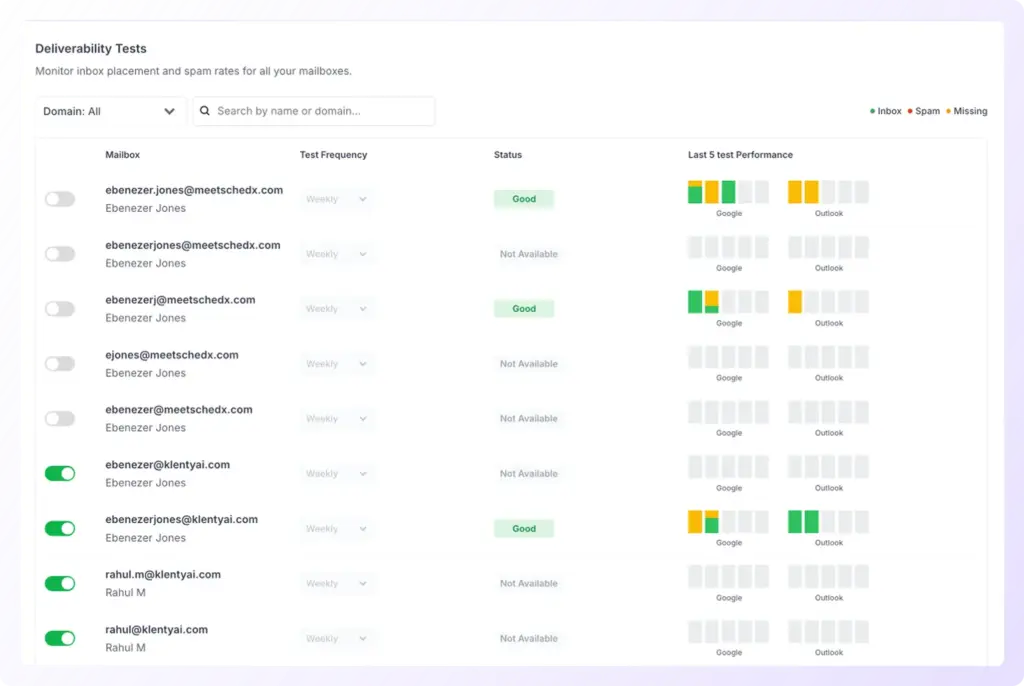
Email deliverability is improved using features like:
- Done-for-you domain and mailbox setup, including DKIF, DMARC, and SPF
- Auto-email warmup and Auto-inbox rotation
- Centralized domain-level and mailbox-level reporting
- Periodic optimization and on-demand deliverability tests
- Email throttling to mimic human-like send patterns
- Custom tracking domains and spam safeguard checks
Klenty provides deliverability insights showing the percentage of emails that land in the Primary Tab across different email service providers, along with suggestions for improving deliverability.
This goes beyond basic deliverability tools by giving actionable intelligence on inbox placement rates - something most competitors don't offer.
Additionally, Klenty's custom domain tracking helps build custom links and domains to avoid spam filters
7. AI Voicemail Detection
AI Voicemail Detection in Klenty is designed to handle high-volume dialing with maximum efficiency. This feature allows the dialer to auto-detect voicemails and instantly move on to the next call, saving valuable time and ensuring your team focuses on conversations that drive results.
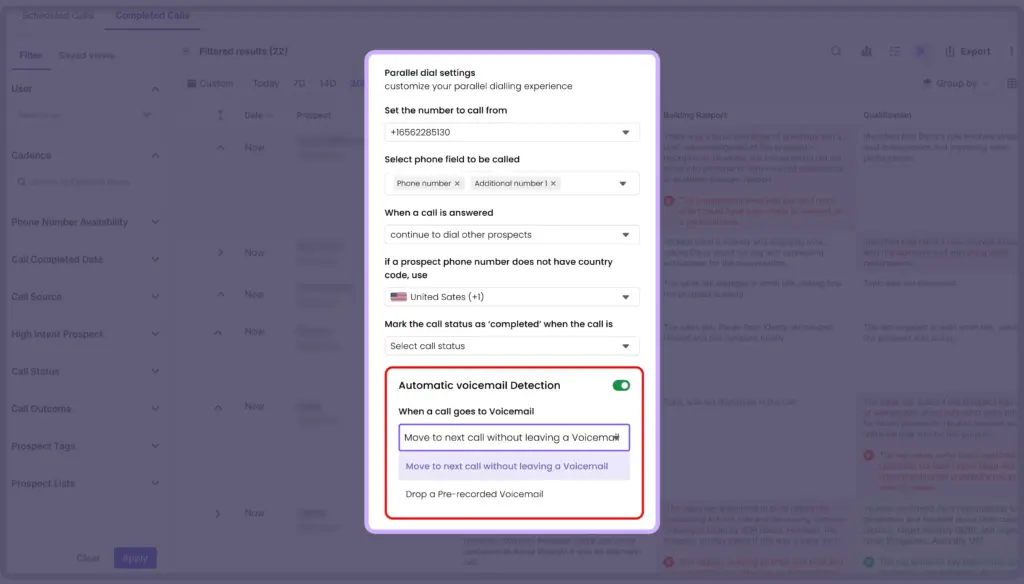
With Klenty’s AI Voicemail Detection, you benefit from:
- Instant Detection of Voicemail Greetings: The system identifies when a call reaches voicemail by recognizing standard greetings, allowing you to transition to the next call without delay.
- Pattern Recognition of Silence and Beeps: AI detects extended periods of silence or characteristic beeps typical of voicemail, ensuring your reps don’t spend time waiting for a response that won’t come.
- Advanced Speech Pattern Analysis: Klenty’s AI can distinguish the specific speech patterns associated with voicemail messages, further improving filtering accuracy so that sales teams only engage with live prospects.
- Automatic Filtering for Human Connects: Calls routed to voicemail are bypassed automatically, so every minute is spent on meaningful conversations with real people.
This feature can bypass up to 80% of calls that go to voicemail, maintaining your team’s momentum and supporting Power Dialer, Parallel Dialer, and Click-to-Call Dialer operations.
By leveraging AI voicemail detection, sales teams eliminate wasted time, optimize calling workflows, and dramatically improve connect rates.
8. CRM Integrations
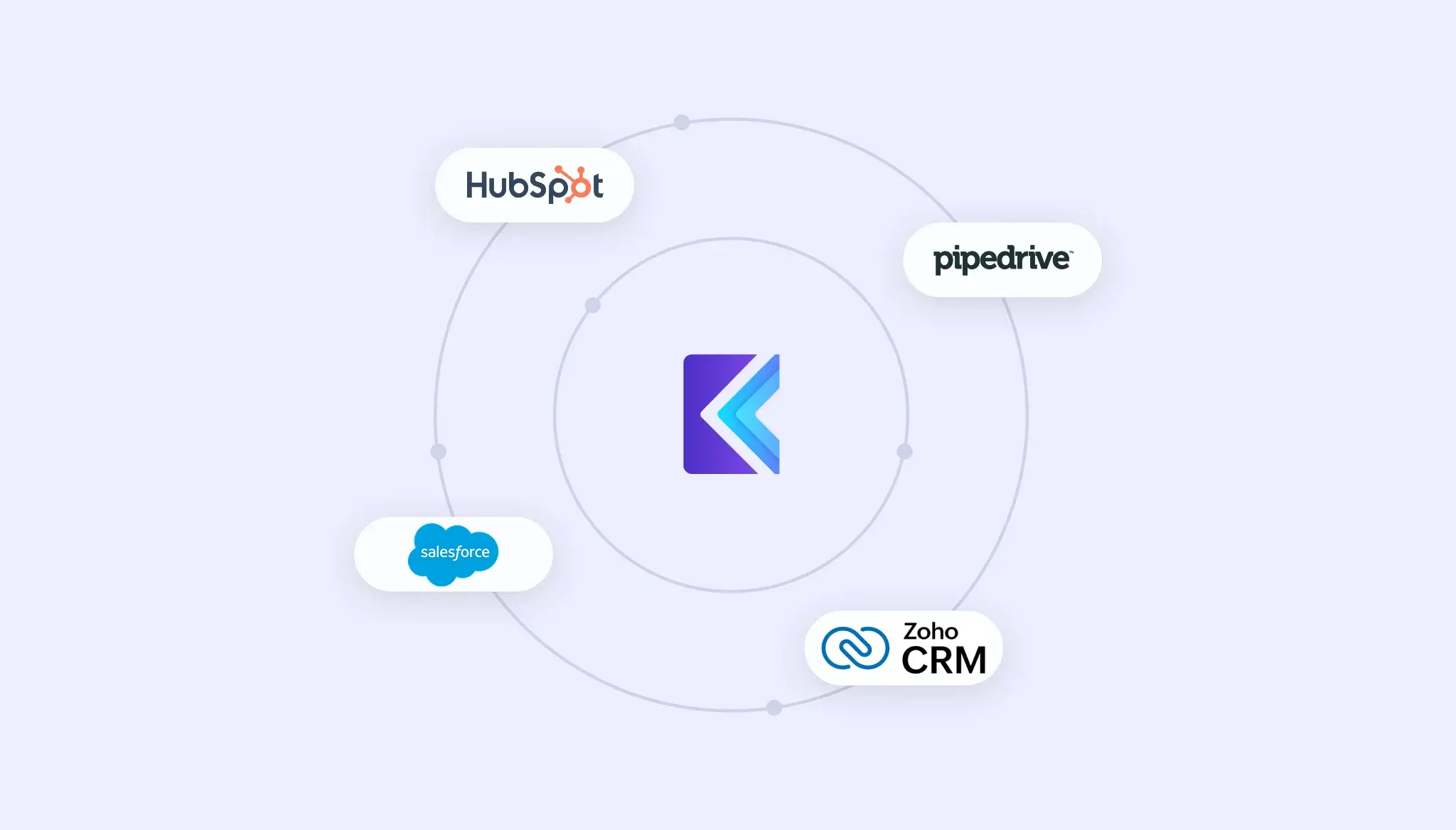
Klenty connects with Salesforce, Zoho CRM, Pipedrive, and HubSpot, not through clunky zaps or middleware, but through purpose-built plugins and connectors designed for direct workflow efficiency.
- Prospects can be imported from CRM into Klenty for streamlined campaign and outreach management.
- The integration allows users to personalize campaigns based on CRM data for every contact.
- Users can build and execute custom sales workflows directly from their CRM system.
- Activities and engagements in Klenty are automatically synced and updated in the CRM, maintaining complete and accurate sales records.
- Dedicated plugins allow reps to initiate, manage, and automate outreach directly within the CRM interface, eliminating unnecessary context switching.
- Sales activities, such as calls, tasks, and emails, are synced for comprehensive activity tracking.
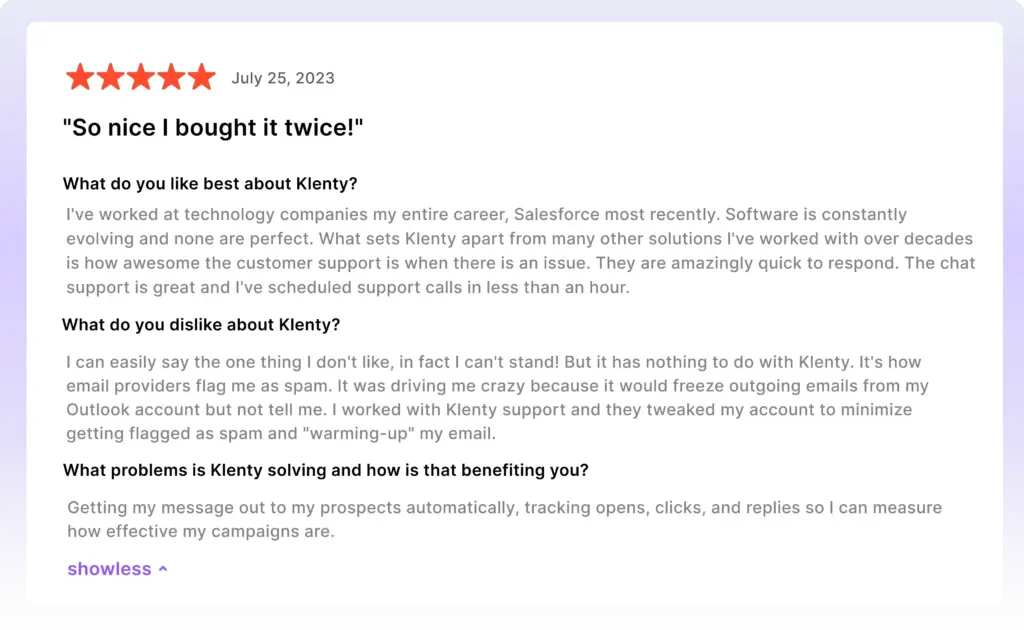
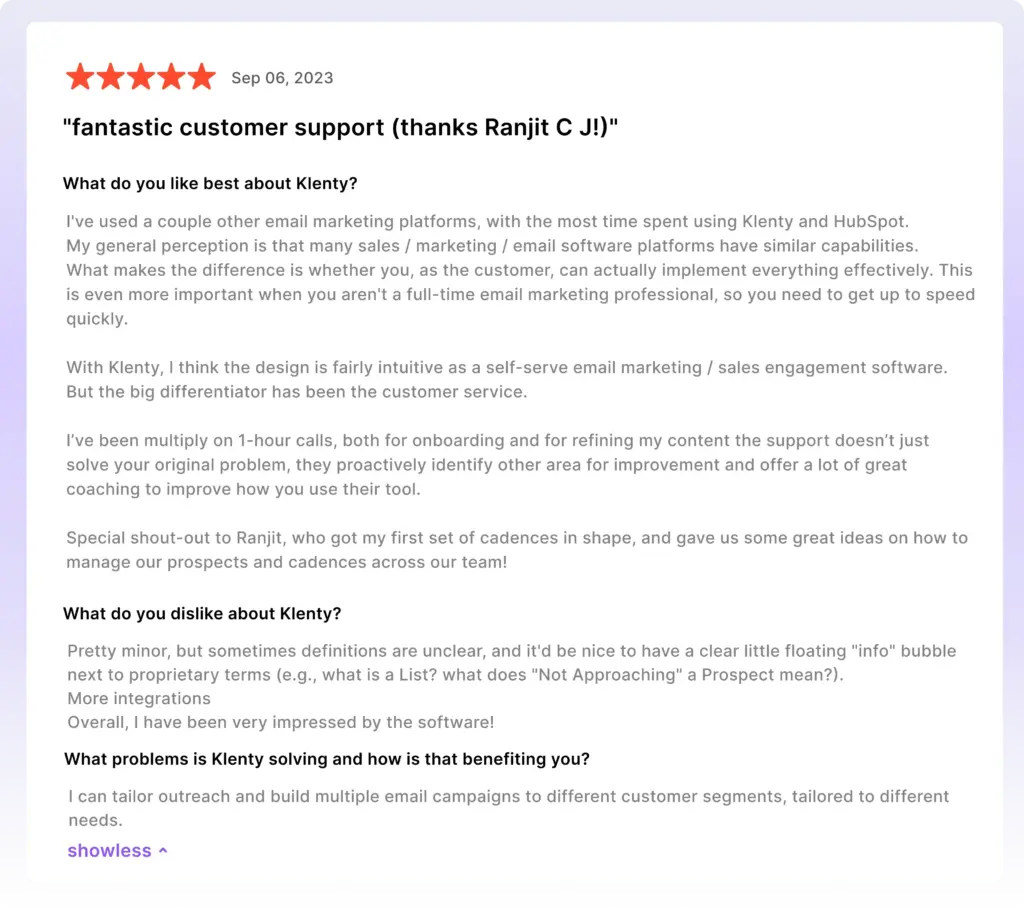
Klenty’s G2 Reviews
Conclusion
Choosing the right sales engagement platform is a critical decision for modern sales teams.
If your business is ready to move beyond manual processes and clunky workarounds, solutions like Klenty provide intuitive, powerful features designed for efficiency, personalization, and scalability.
Klenty’s biggest differentiator is its Action AI feature, which automatically creates the next step after your sales conversation ends, schedules follow-up, drafts personalized messages, and keeps reps focused on pipeline-building instead of admin work
Take the next step toward optimizing your sales outreach.
Ready to up your sales game? Book a demo with Klenty today and unlock more meetings, higher productivity, and smarter workflows.
Frequently Asked Questions
1. Which platform is easier for sales reps to use, Apollo.io or Klenty?
2. Can I automate outreach across more channels with Klenty or Apollo.io?
3. How does CRM integration compare between Apollo.io and Klenty?
4. Which tool helps you track real sales goals and outcomes?
5. Who should pick Apollo.io, and when is Klenty the better fit?
About the Author